
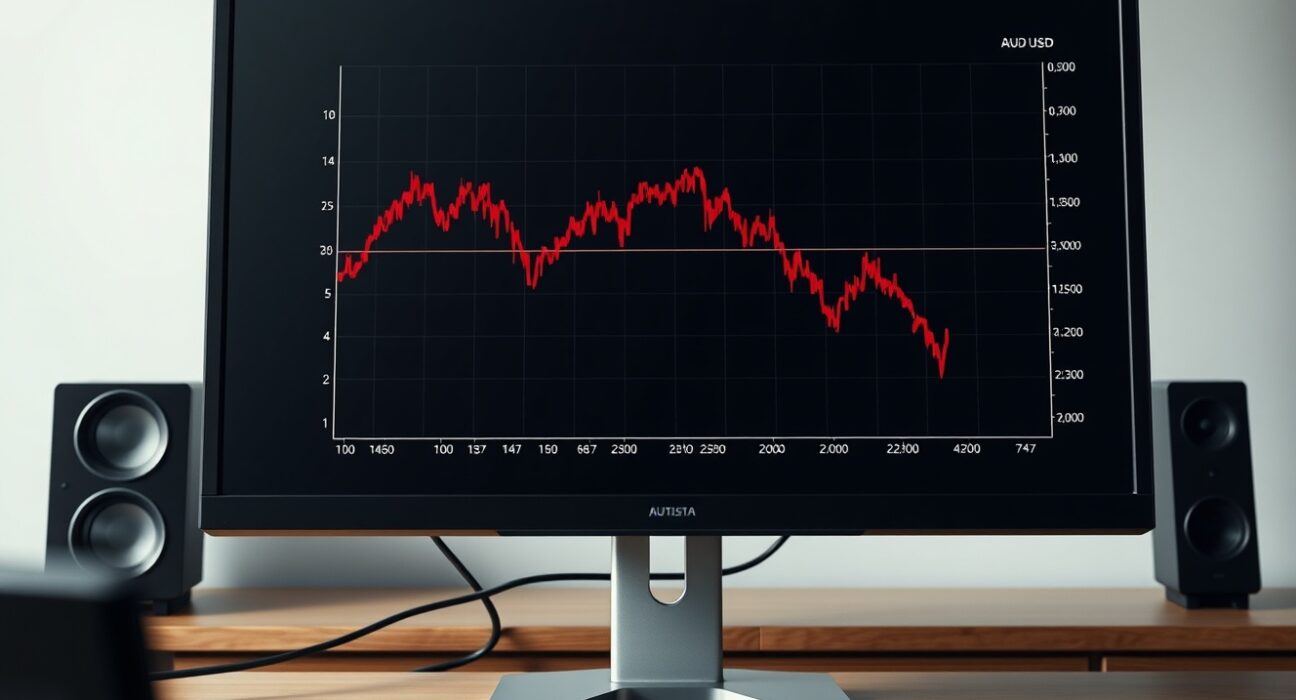
The Australian dollar suffered a significant setback against the US dollar this week, with the AUD/USD currency pair decisively breaking below the psychologically crucial 0.7000 support level. This move, observed in global forex markets, has triggered a wave of bearish technical signals that analysts are now scrutinizing for future direction. Consequently, market participants are reassessing their positions amid shifting macroeconomic fundamentals.
AUD/USD Price Forecast: Analyzing the Technical Breakdown
The breach of the 0.7000 handle represents more than a simple round-number milestone. Historically, this level has acted as a major pivot point for the currency pair, often separating bullish and bearish regimes. The breakdown was confirmed by a surge in trading volume, adding credibility to the move. Furthermore, the pair closed several consecutive four-hour and daily candles below this threshold, signaling sustained selling pressure rather than a fleeting spike.
Several key technical indicators now flash warning signs. The 50-day and 200-day simple moving averages have completed a bearish crossover, a pattern traders often call a “death cross.” Meanwhile, the Relative Strength Index (RSI) on the daily chart has plunged into oversold territory below 30. However, momentum indicators like the MACD show no immediate sign of a bullish divergence, suggesting the downtrend may have further room to run.
Key Technical Levels to Watch
With 0.7000 now acting as resistance, chartists identify the next potential support zones. The immediate focus shifts to the 0.6920 area, a low from the previous quarter. A break below that could open the path toward 0.6850, a level not seen in over two years. On the upside, any recovery attempt will likely face stiff resistance not only at 0.7000 but also at the converging 50-day moving average, currently near 0.7050.
Fundamental Drivers Behind the Australian Dollar’s Decline
The technical breakdown did not occur in a vacuum. It coincides with a recalibration of market expectations around several core economic factors. Primarily, diverging central bank policies between the Reserve Bank of Australia (RBA) and the US Federal Reserve have exerted immense pressure. While the Fed maintains a firm “higher for longer” interest rate stance to combat inflation, the RBA’s recent communications have been perceived as more dovish, hinting at a potential end to its tightening cycle.
Commodity markets, a traditional backbone of the Australian economy, have also provided mixed signals. Although iron ore prices have remained relatively resilient, other key exports like coal and liquefied natural gas have seen price volatility. Moreover, concerns about a slowing Chinese economy, Australia’s largest trading partner, continue to cast a shadow over growth prospects and, by extension, currency strength. Geopolitical tensions and risk-off sentiment in broader financial markets have additionally bolstered demand for the US dollar as a safe-haven asset, further pressuring the AUD/USD pair.
Market Impact and Trader Sentiment Shifts
The sustained move below 0.7000 has tangible consequences for different market participants. For international businesses and importers in Australia, a weaker currency increases the cost of foreign goods and services, potentially feeding into domestic inflation. Conversely, Australian exporters may benefit from more competitive pricing on the global stage. According to the latest Commitments of Traders (COT) report from the Chicago Mercantile Exchange, leveraged funds have significantly increased their net short positions on the Australian dollar, reflecting a pronounced shift in professional sentiment.
This sentiment is echoed in the options market, where the premium for puts (bearish bets) over calls (bullish bets) has widened noticeably. The one-month risk reversal, a gauge of market positioning, shows its most bearish skew for the AUD in several months. Meanwhile, implied volatility has spiked, indicating traders are pricing in larger price swings and hedging against further downside risk.
Historical Context and Cycle Analysis
Examining past cycles provides crucial context. The AUD/USD pair has traded below 0.7000 during periods of global financial stress, such as the early stages of the COVID-19 pandemic in 2020 and the 2008 Global Financial Crisis. However, it also breached this level during the US dollar bull market of 2014-2015. The current environment shares characteristics with both: a strong USD driven by Fed policy and emerging concerns about global growth. Analysts note that sustained breaks below this level often lead to extended trends, with the pair averaging a further 5-7% decline in the following six months based on the past three major breakdowns.
Expert Analysis and Forward-Looking Scenarios
Financial institutions have begun revising their AUD/USD forecasts. Several major banks have downgraded their year-end targets, with median projections now clustering around the 0.6800-0.6900 range. Their analysis typically hinges on two key variables: the trajectory of US inflation and labor data, and China’s success in stimulating its domestic economy. A reacceleration of US inflation could force the Fed to be even more aggressive, widening the interest rate differential and pushing the pair lower. Conversely, a substantial Chinese stimulus package could provide a lifeline for the commodity-linked Aussie dollar.
Technical analysts emphasize the importance of the weekly and monthly chart closes. A weekly close firmly below 0.6980 would confirm the breakdown on a higher timeframe, increasing its significance. The path forward likely involves one of three scenarios: a swift continuation of the downtrend, a period of consolidation and basing below 0.7000, or a false breakdown and rapid recovery back above the level. Market microstructure data, including order flow analysis, currently shows a predominance of selling pressure at every minor rally, favoring the first two scenarios.
Conclusion
The AUD/USD forecast remains bearish following the decisive break below the critical 0.7000 support level. This move is supported by a confluence of bearish technical signals and shifting fundamental drivers, primarily centered on monetary policy divergence. While the pair is technically oversold in the near term, which may prompt a corrective bounce, the broader trend structure has turned negative. Traders and investors should monitor key support levels near 0.6920 and 0.6850, while watching for any fundamental catalysts that could alter the current trajectory of the Australian dollar against its US counterpart.
FAQs
Q1: Why is the 0.7000 level so important for AUD/USD?
The 0.7000 level is a major psychological and technical benchmark. It has served as a key support and resistance zone for over a decade, often dictating the medium-term trend. A sustained break below it signals a significant shift in market structure and sentiment.
Q2: What are the main fundamental reasons for the Australian dollar’s weakness?
The primary drivers are the policy divergence between the hawkish US Federal Reserve and the potentially dovish Reserve Bank of Australia, concerns about demand from China, and a general risk-off environment that boosts the US dollar’s safe-haven appeal.
Q3: What is a “death cross” and why does it matter?
A “death cross” occurs when a security’s short-term moving average (like the 50-day) crosses below its long-term moving average (like the 200-day). It is widely interpreted by chartists as a confirmation of a bearish trend change, though it is a lagging indicator.
Q4: How does a weaker AUD affect the Australian economy?
A weaker currency makes imports more expensive, contributing to inflation, but makes Australian exports cheaper and more competitive internationally, which can benefit sectors like mining, agriculture, and education.
Q5: What key data points should traders watch next?
Traders should monitor US CPI and employment data, RBA meeting minutes and statements, Chinese PMI and industrial production figures, and commodity price movements, particularly for iron ore and coal.
Disclaimer: The information provided is not trading advice, Bitcoinworld.co.in holds no liability for any investments made based on the information provided on this page. We strongly recommend independent research and/or consultation with a qualified professional before making any investment decisions.