
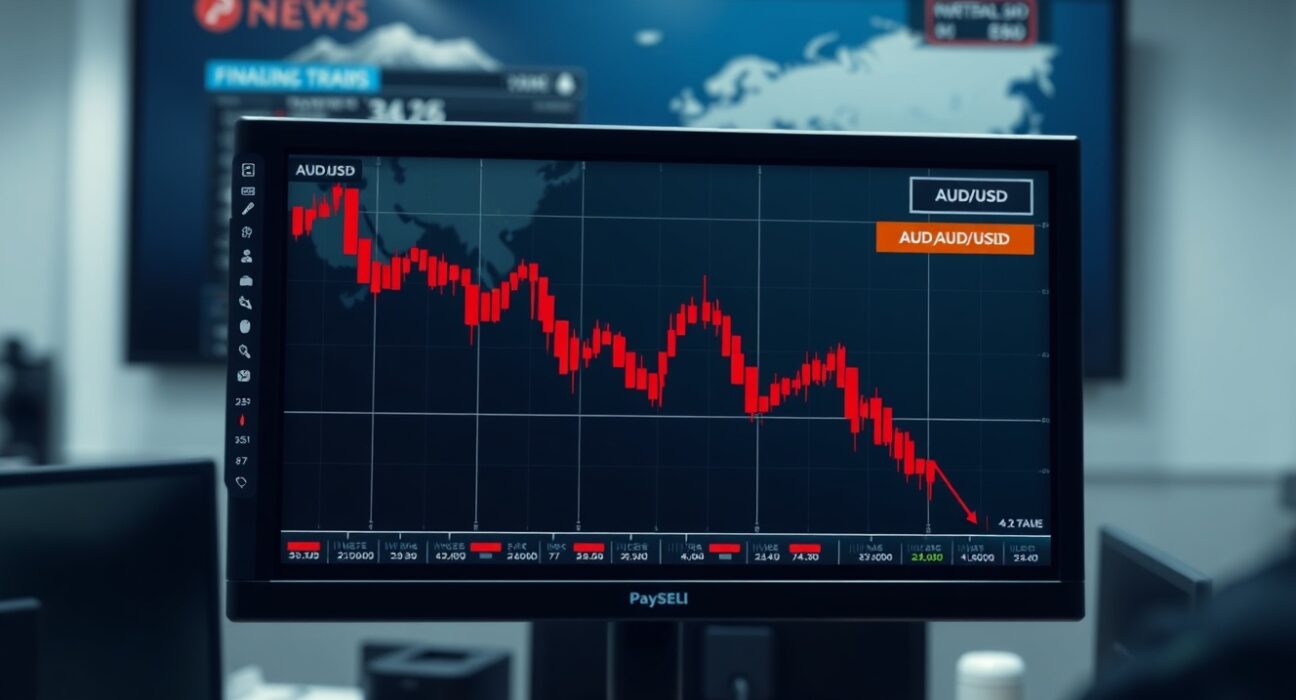
The AUD/USD currency pair experienced a sharp sell-off in Asian trading sessions, plunging to multi-week lows as former President Donald Trump’s administration took decisive military action against Iranian assets in the Strait of Hormuz. This aggressive geopolitical maneuver immediately triggered a classic flight-to-safety response, funneling capital into the US dollar and Brent crude oil futures. Consequently, the Australian dollar, a commodity-linked currency sensitive to global risk sentiment, bore the brunt of the selling pressure. Market analysts now scrutinize the potential for a prolonged risk-off environment that could reshape forex and commodity correlations throughout 2025.
AUD/USD Technical Breakdown and Immediate Market Reaction
Forex charts from major trading platforms showed the AUD/USD pair breaking decisively below the critical 0.6600 support level, a zone it had defended for most of the prior week. The move represented a decline of over 1.2% in a single session, one of the most significant daily drops this quarter. Market depth data indicated sustained selling pressure from institutional funds, not just speculative retail flows. Furthermore, the US Dollar Index (DXY), which tracks the greenback against a basket of six major currencies, rallied by 0.8%, underscoring broad-based dollar strength. This inverse correlation between the DXY and AUD/USD intensified dramatically following the news headlines.
Several key technical levels were violated in rapid succession. Analysts point to the break of the 50-day moving average as a particularly bearish signal. The subsequent price action suggests the market is now targeting the next major support cluster around the 0.6520-0.6540 region. A breakdown below this area could open the path toward the yearly lows. The table below summarizes the key technical moves observed in the initial hours after the news broke.
| Instrument | Key Level Broken | Intraday Move | Primary Driver |
|---|---|---|---|
| AUD/USD Spot | 0.6600 (Support) | -1.25% | Geopolitical Risk-Off |
| US Dollar Index (DXY) | 104.50 (Resistance) | +0.82% | Safe-Haven Demand |
| Brent Crude Oil | $88/barrel | +3.1% | Supply Disruption Fears |
Geopolitical Context: Trump’s Iran Policy and Regional Tensions
The immediate catalyst was a statement from the White House confirming targeted strikes on Iranian Revolutionary Guard Corps (IRGC) naval facilities. These actions were framed as a response to alleged provocations against commercial shipping. This escalation marks a significant shift from the prior administration’s diplomatic stance and reintroduces a high level of uncertainty into global energy supply chains. The Strait of Hormuz, a critical chokepoint through which about 20% of the world’s oil passes, sits at the heart of the conflict zone. Historical precedent shows that tensions in this region have an outsized and rapid impact on both oil volatility and currency markets, as traders price in potential supply shocks.
Market participants are now evaluating the likelihood of a protracted conflict. Key considerations include potential Iranian retaliation, the response of other regional powers, and the impact on global oil shipments. Intelligence assessments cited by major financial institutions suggest the situation remains fluid. However, the default market reaction is to price in heightened risk, which manifests in stronger demand for traditional safe-haven assets like the US dollar and US Treasuries, while pressuring growth and commodity-sensitive currencies like the Australian dollar.
Expert Analysis on Forex and Commodity Linkages
Senior currency strategists at leading investment banks emphasize the dual-channel impact on the AUD. First, the direct safe-haven bid for the USD weighs on all USD pairs. Second, while higher oil prices typically support commodity currencies like the AUD, this relationship can break down during acute geopolitical crises. The fear of a global growth slowdown caused by an oil price shock can overwhelm the positive terms-of-trade effect for Australia. “We are witnessing a decoupling of the usual AUD-oil correlation,” noted one strategist. “The risk-off impulse from geopolitics is currently a stronger force than the support from rising commodity export prices.”
This analysis is supported by cross-asset flows. While Brent crude futures surged, Australian equity markets, particularly the materials and financial sectors, sold off sharply. The implied volatility in AUD/USD options spiked, indicating traders are hedging against further large swings. This environment creates a feedback loop where heightened volatility itself deters risk-taking, perpetuating USD strength and AUD weakness until a clear de-escalation path emerges.
Broader Economic Impacts and Central Bank Implications
The sudden shift in market dynamics presents a fresh challenge for central banks. The Reserve Bank of Australia (RBA) must now factor in a weaker currency, which is inflationary, against the backdrop of potential global demand destruction from higher oil prices, which is disinflationary. Similarly, the Federal Reserve’s calculus on interest rates becomes more complex. A stronger dollar helps tame US inflation by making imports cheaper, but financial conditions tighten globally, which could affect the US economy. Market pricing for future interest rate cuts by both banks has adjusted, though the net effect remains uncertain.
For Australia, the immediate impact on trade balances is ambiguous. Higher prices for key exports like liquefied natural gas (LNG) and coal provide a revenue boost. Conversely, the nation is a net importer of refined petroleum products, so rising oil prices increase the import bill. The net effect on the current account and the Australian dollar’s fundamental valuation will depend on the duration and magnitude of the oil price spike relative to the movement in other commodity prices and overall risk sentiment.
- Risk Sentiment: Global equity markets fell, with the MSCI World Index down 1.5%.
- Commodity Divergence: While oil surged, industrial metals like copper declined on growth fears.
- Yield Spreads: The interest rate differential between US and Australian government bonds narrowed, removing a key support for the AUD.
Conclusion
The sharp decline in the AUD/USD pair serves as a potent reminder of forex markets’ acute sensitivity to geopolitical shocks. Trump’s escalation of the Iran conflict has catalyzed a powerful rally in the US dollar and oil prices, overwhelming the Australian dollar’s typical commodity-linked strengths. The immediate technical breakdown suggests further downside risk for the AUD/USD pair unless a swift de-escalation occurs. Traders and investors must now monitor diplomatic channels closely, as the path of the conflict will dictate whether this is a short-term volatility event or the beginning of a sustained repricing of risk assets and currency valuations for 2025.
FAQs
Q1: Why does the AUD/USD fall when geopolitical risk increases?
The Australian dollar is considered a ‘risk-sensitive’ or ‘growth-linked’ currency. When global risk aversion spikes, investors sell riskier assets and seek the safety of the US dollar and US Treasuries. This ‘flight to safety’ causes the USD to appreciate against most currencies, especially those like the AUD.
Q2: Doesn’t higher oil help Australia’s economy and the AUD?
Typically, yes, as Australia is a major energy exporter. However, during a geopolitical crisis, the negative impact of potential global economic slowdown and pure risk-off sentiment can be stronger than the positive benefit from higher export prices, causing the AUD to fall despite rising oil.
Q3: What other currency pairs are most affected by Middle East tensions?
Pairs involving commodity currencies (AUD, CAD, NOK) and risk-sensitive currencies (NZD, EM currencies) often weaken against the USD, JPY, and CHF. The USD/JPY can also be volatile due to its role as a funding currency for carry trades that get unwound.
Q4: How long might this impact on AUD/USD last?
The duration depends entirely on the evolution of the conflict. A rapid de-escalation could see a partial retracement of the move. A prolonged crisis or expansion of hostilities could lead to sustained AUD/USD weakness and continued volatility.
Q5: What should traders watch next for clues on direction?
Key indicators include official statements from US and Iranian officials, shipping traffic data through the Strait of Hormuz, weekly US dollar positioning data (COT report), and broader equity market performance as a barometer of global risk appetite.
Disclaimer: The information provided is not trading advice, Bitcoinworld.co.in holds no liability for any investments made based on the information provided on this page. We strongly recommend independent research and/or consultation with a qualified professional before making any investment decisions.