

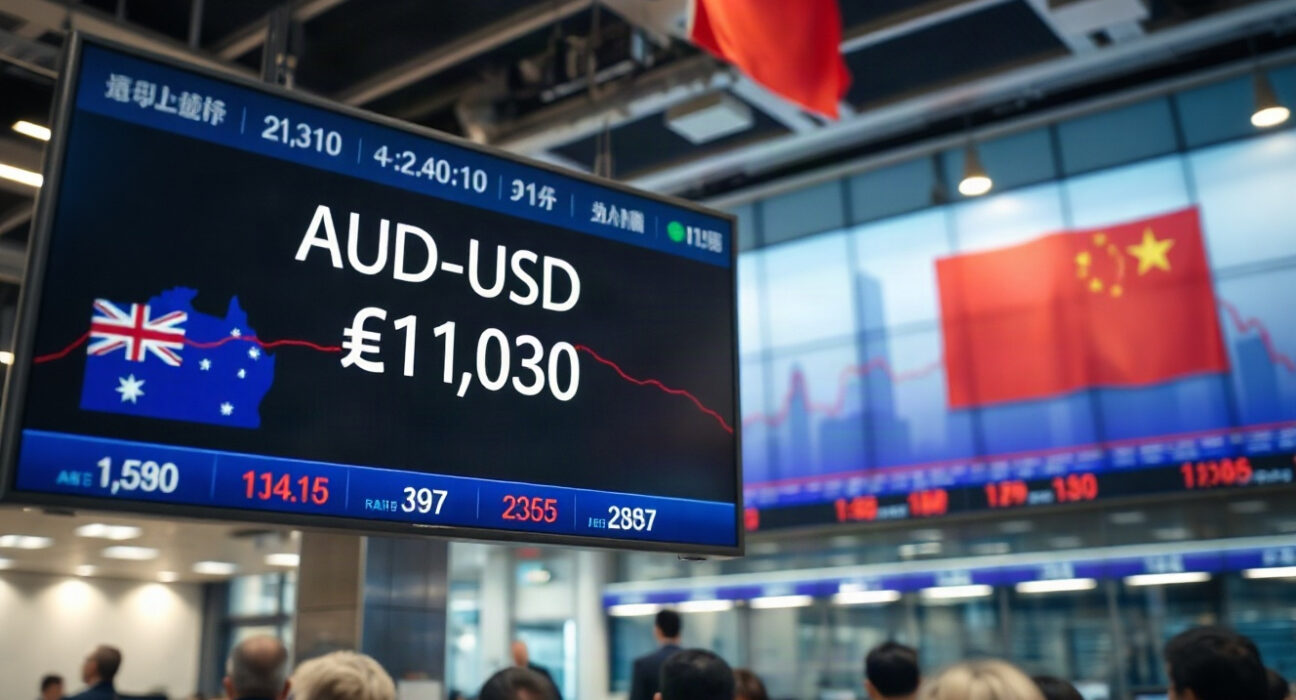
The Australian Dollar edged lower against the US Dollar in early Asian trading on Wednesday, as mixed Chinese Purchasing Managers’ Index (PMI) data for March 2026 failed to provide fresh impetus for the currency. The official manufacturing PMI came in at 50.5, slightly above the 50.0 threshold that separates expansion from contraction, but the non-manufacturing PMI slipped to 50.8 from 51.4 in February, signaling a slowdown in the services sector. This mixed reading tempered optimism about China’s economic recovery, a key driver for the Australian economy and its currency.
Market Reaction and Immediate Impact
The Australian Dollar weakened by approximately 0.2% against the US Dollar, trading around 0.6570 as of 10:30 AEST. The currency initially spiked to 0.6585 after the manufacturing PMI beat expectations, but quickly reversed as investors focused on the softer services data and the ongoing weakness in employment subindices. The mixed data suggests that China’s recovery remains uneven, which could weigh on Australian export demand, particularly for iron ore and coal.
Analysts note that the Australian Dollar’s reaction was muted compared to previous PMI releases, indicating that markets are already pricing in a gradual Chinese recovery. “The market is looking for more concrete signs of sustained momentum in China,” said a Sydney-based currency strategist. “Today’s data doesn’t change the fundamental picture, but it does reinforce the view that the RBA will likely keep rates on hold in the near term.”
Broader Context and Implications
The Australian Dollar has been under pressure in recent weeks, driven by expectations that the Reserve Bank of Australia (RBA) may cut interest rates later this year, while the US Federal Reserve remains hawkish. The mixed Chinese data adds to the uncertainty, as Australia’s trade relationship with China is a critical factor for the domestic economy. China accounts for over a third of Australian goods exports, and any slowdown in Chinese demand directly impacts Australian terms of trade.
Investors are now awaiting further cues from upcoming US economic data, including the non-farm payrolls report due later this week, which could influence the Fed’s policy path and, consequently, the AUD/USD pair. A stronger US economy would likely push the pair lower, while any signs of weakness could provide some support for the Australian Dollar.
Why This Matters to Forex Traders
For forex traders, the Australian Dollar’s reaction to Chinese PMIs is a classic example of how external data can influence currency movements. The AUD is often used as a proxy for Chinese economic health, and traders should monitor both official and Caixin PMI readings for trading signals. The current mixed data suggests that the AUD may remain rangebound in the short term, with support around 0.6500 and resistance near 0.6600.
Conclusion
In summary, the Australian Dollar’s modest decline reflects the market’s disappointment with the mixed Chinese PMI data, which failed to provide a clear directional catalyst. While the manufacturing sector showed resilience, the softer services and employment components highlight ongoing challenges in China’s recovery. Traders should keep an eye on upcoming US data and any further Chinese economic releases for clearer signals on the AUD/USD trajectory.
FAQs
Q1: What are Chinese PMIs and why do they affect the Australian Dollar?
Chinese PMIs are monthly surveys of purchasing managers in manufacturing and services sectors, indicating economic expansion or contraction. Since China is Australia’s largest trading partner, changes in Chinese economic activity directly influence Australian export revenues and, in turn, the AUD’s value.
Q2: How does the RBA’s monetary policy impact the Australian Dollar?
The RBA’s interest rate decisions affect the AUD’s attractiveness to investors. Higher rates tend to strengthen the currency, while lower rates or expectations of cuts can weaken it. The market’s current pricing of potential RBA cuts is a key factor in the AUD’s recent softness.
Q3: What should traders watch next for AUD/USD direction?
Traders should monitor upcoming US economic data, especially employment figures, as they influence the Fed’s policy stance. Additionally, any further Chinese data releases, such as trade figures or GDP, could provide fresh momentum for the AUD/USD pair.
Disclaimer: The information provided is not trading advice, Bitcoinworld.co.in holds no liability for any investments made based on the information provided on this page. We strongly recommend independent research and/or consultation with a qualified professional before making any investment decisions.
