

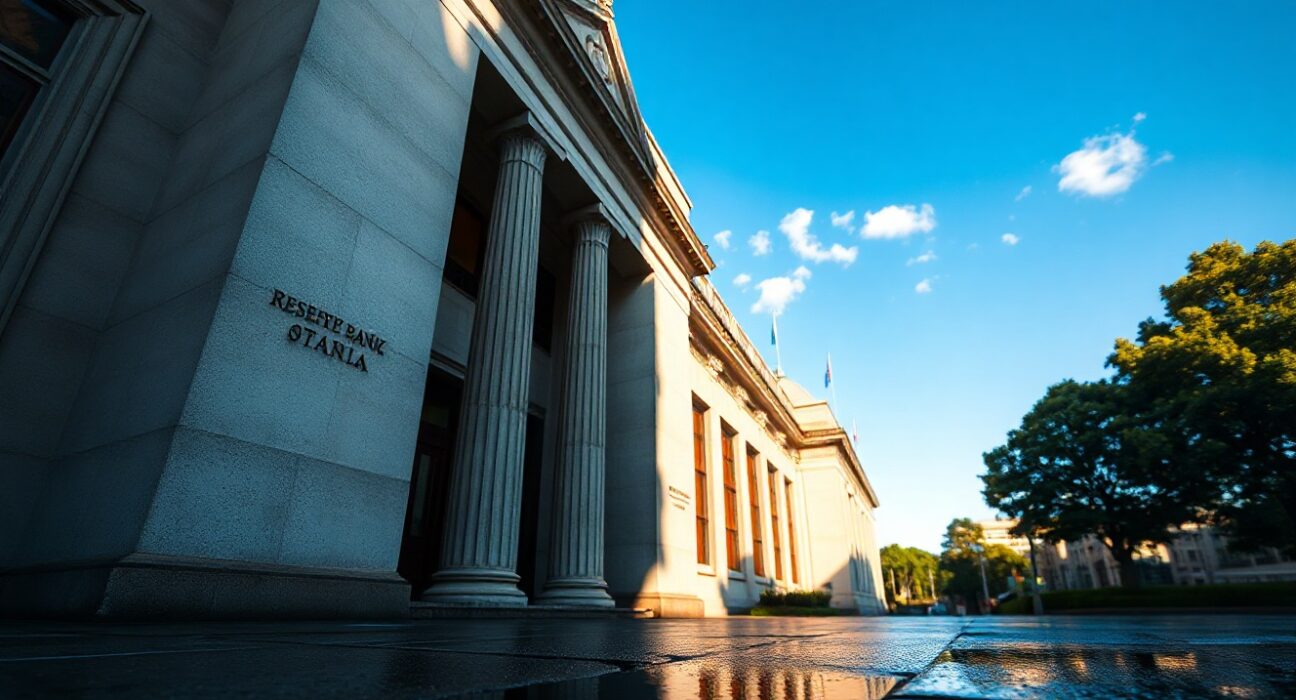
The Australian dollar edged lower in early Asian trading on Tuesday after the Reserve Bank of Australia (RBA) kept its official cash rate unchanged at 4.35%, as widely expected. However, the central bank’s accompanying statement struck a more cautious tone than some market participants had anticipated, signaling that the fight against inflation is not yet over and that further policy tightening remains a possibility.
RBA Holds Firm, But Rhetoric Remains Restrictive
The RBA’s decision to pause its tightening cycle was largely priced in by markets, with the focus squarely on the language of the statement. The central bank acknowledged that inflation has moderated from its peak but emphasized that it remains too high and that the outlook is uncertain. Crucially, the board reiterated that it remains resolute in its determination to return inflation to the 2–3% target range within a reasonable timeframe.
This hawkish bias, while not a surprise, provided limited support for the Australian dollar. Traders interpreted the statement as a signal that the RBA is not yet ready to pivot to an easing stance, even as other major central banks, such as the Federal Reserve and the European Central Bank, are moving closer to rate cuts. The divergence in policy expectations continues to weigh on the Aussie.
Market Reaction and Immediate Impact
Following the decision, the AUD/USD pair slipped from around 0.6570 to 0.6545, reflecting a modest but clear move lower. The decline was driven by a combination of profit-taking after a recent rally and a reassessment of the rate outlook. The yield on Australia’s three-year government bond, which is sensitive to interest rate expectations, edged lower, suggesting that some traders had hoped for a slightly more dovish tone.
The Australian dollar’s weakness was also amplified by a broadly stronger US dollar, as geopolitical uncertainties and risk-off sentiment supported safe-haven flows. The market is now pricing in a roughly 50% chance of a rate cut by the RBA by November, though the central bank’s statement suggests that such expectations may be premature.
What This Means for Traders and the Economy
For forex traders, the RBA’s decision reinforces a cautious approach to the Australian dollar. The currency remains highly sensitive to global risk appetite, commodity prices, and the relative pace of monetary policy between Australia and its major trading partners, particularly China and the United States.
From an economic perspective, the RBA’s hawkish pause reflects a delicate balancing act. While inflation has eased from its 2022 peak of 7.8% to around 3.4%, it remains sticky in the services sector. The labor market also remains tight, with the unemployment rate at 3.9%. These factors give the RBA little room to signal a dovish shift, even as household consumption weakens and the housing market shows signs of cooling.
Conclusion
The RBA’s decision to hold rates steady while maintaining a hawkish bias was a measured response to an uncertain economic environment. The Australian dollar’s modest decline reflects the market’s disappointment that the central bank did not offer a clearer path toward policy easing. Going forward, the currency’s direction will depend on incoming data on inflation, employment, and global risk sentiment. For now, the Aussie remains caught between a hawkish RBA and a cautious market.
FAQs
Q1: Why did the Australian dollar fall after the RBA held rates?
The Australian dollar fell because the RBA’s statement was more hawkish than some traders had hoped. While the rate hold was expected, the central bank emphasized that inflation remains too high and did not signal an imminent shift to rate cuts. This disappointed traders who were looking for a more dovish tone, leading to profit-taking and a move lower in the AUD/USD pair.
Q2: What does a ‘hawkish pause’ mean?
A hawkish pause occurs when a central bank keeps interest rates unchanged but uses language in its statement that suggests it remains vigilant about inflation and is not ready to cut rates. It signals that the central bank is still leaning toward tighter policy if needed, rather than preparing to ease. This can be negative for the currency because it keeps interest rates higher for longer, but also dampens expectations of future growth.
Q3: How does the RBA’s decision affect Australian mortgage holders?
For Australian mortgage holders, the RBA’s decision to hold rates means no immediate increase in variable mortgage repayments. However, the hawkish tone suggests that rate cuts are not imminent, so borrowers should not expect relief in the near term. Those on fixed rates that are due to expire may still face higher repayments when they roll over to current variable rates. The central bank’s focus on inflation means it will only cut rates once it is confident price pressures are sustainably under control.
Disclaimer: The information provided is not trading advice, Bitcoinworld.co.in holds no liability for any investments made based on the information provided on this page. We strongly recommend independent research and/or consultation with a qualified professional before making any investment decisions.
