

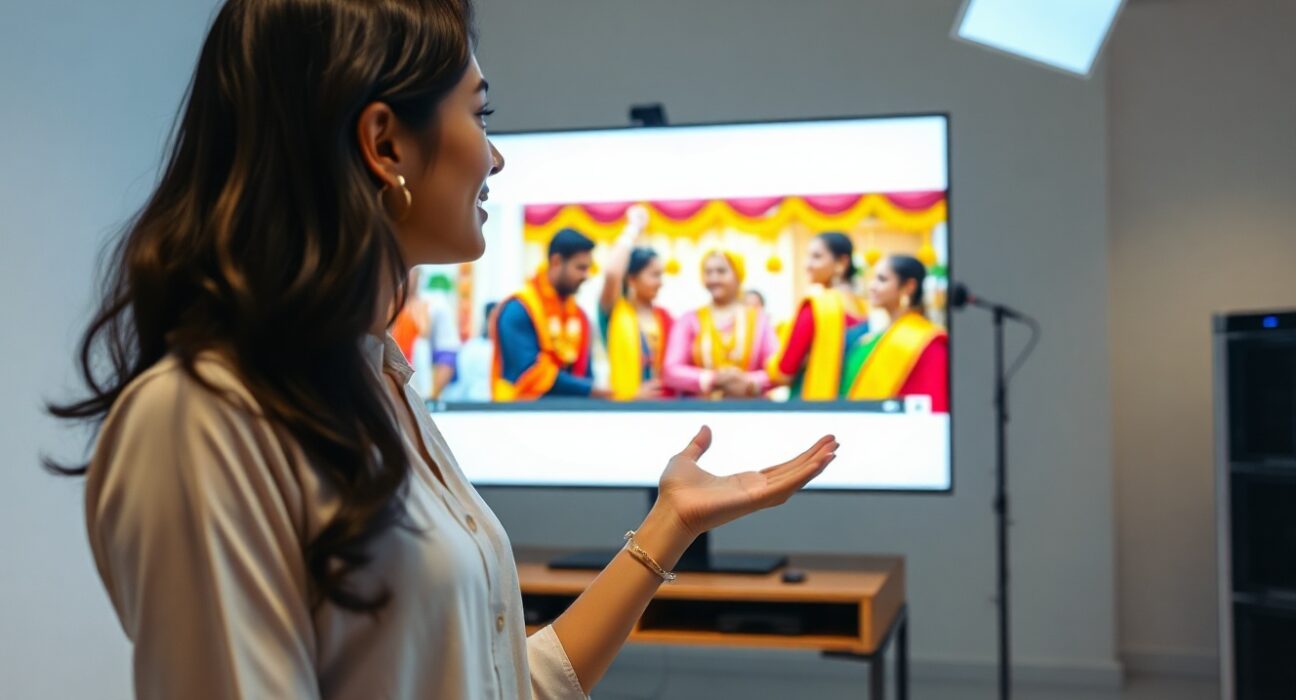
India’s AI model development has lagged behind the U.S., Europe, and China, with only a handful of startups releasing models — mostly large language or voice systems. To accelerate progress, the Indian government launched the India AI Mission, a roughly $1.2 billion initiative that provides selected startups with subsidized GPU compute in exchange for releasing their models publicly. One of the 12 startups chosen for this program, Peak XV-backed Avataar AI, has now unveiled a new video generation model called Varya, designed specifically to understand local cultural context — from festivals and food to clothing and architecture.
A leaner, faster approach to video generation
Avataar, which specializes in video tools for e-commerce, didn’t build Varya from scratch. Instead, the team started with Wan 2.2, a publicly available video generation model released by Alibaba, and applied a technique called distillation. This process compresses the larger model’s capabilities into a much leaner, faster version optimized for Avataar’s specific use cases. The result is a model that generates video in just four steps, compared to Wan 2.2’s 50, producing output roughly 10 times faster at a fraction of the cost.
To put those numbers in concrete terms: using an NVIDIA H200 GPU, Varya can generate a 5-second 720p clip in 45 seconds, while Wan 2.2 requires 1,230 seconds for the same task. That speed difference is critical for real-world applications at scale.
Pricing that changes the equation
The most striking aspect of Varya may be its price. Avataar plans to charge ₹0.48 ($0.005) per second of video on its hosted service — far cheaper than competitors like Veo, Kling, Luma, and Runway, which typically charge $0.10 or more per second. That represents a roughly 20x price reduction.
“India is a video-first market. We see this across every large consumer internet product in India: video wins over text. Current AI video models are too expensive for population-scale use in India,” Peak XV managing director Rajan Anandan told Bitcoin World. “If video AI is going to reach students, teachers, MSMEs, creators, enterprises, and public services, costs have to come down dramatically. Cost is the biggest unlock for AI adoption in India.”
Cultural nuance as a core feature
Image and video generation models often miss cultural nuances, producing stereotyped or generic outputs — a problem that has been widely reported. Avataar says it has used curated training data to teach Varya to recognize and accurately depict culturally specific elements, including regional food, clothing, architectural styles, and festivals. This makes the model more useful for Indian creators, businesses, and educators who need contextually appropriate visuals.
Open release and government alignment
Varya will be released as an open-weight model on India’s AI Kosh portal — the government’s centralized repository for publicly available AI models and datasets — along with its training data. This means developers can self-host or modify the model for their own needs. Avataar also plans to make the model available to its enterprise customers and says it is open to partnerships with video tools including Higgsfield and Adobe Firefly. Anyone can try it now on its website using text prompts or reference images.
What this means for India’s AI ambitions
Varya’s launch reflects a fundamental tradeoff in India’s AI strategy. Industry veterans have noted that India can make its mark by creating applications and a robust developer ecosystem rather than competing directly on foundation models. There is a pragmatic reason for that approach: model development has been slower in India due to limited compute and scarce high-quality data.
The India AI Mission is part of a broader government push to close that gap. Last year, it selected 12 startups — Avataar among them — to develop AI models with cost-efficient compute. Earlier this year, IT minister Ashwini Vaishnaw said India aims to attract $200 billion in AI investment by 2028 and more than double its GPU capacity within six months.
Conclusion
Avataar’s Varya model demonstrates a practical path forward for AI in India: leveraging existing open-source models, optimizing them for speed and cost, and tailoring them to local cultural contexts. By combining a 20x price reduction with open-weight availability and government backing, the startup is positioning itself as a key player in making AI video generation accessible at India’s scale. Whether this approach can compete with the foundation models being built elsewhere remains to be seen, but for now, it addresses a clear and urgent need in one of the world’s largest video-first markets.
FAQs
Q1: What is Varya and who built it?
Varya is a video generation model built by Avataar AI, a Peak XV-backed startup focused on e-commerce video tools. It was developed using a distillation technique on Alibaba’s Wan 2.2 model to make it faster and cheaper.
Q2: How much does Varya cost compared to other models?
Varya charges ₹0.48 ($0.005) per second of video, which is roughly 20 times cheaper than competitors like Veo, Kling, Luma, and Runway, which typically charge $0.10 or more per second.
Q3: Will Varya be available for developers to modify?
Yes. Varya will be released as an open-weight model on India’s AI Kosh portal, along with its training data, allowing developers to self-host or customize it for their own applications.
Disclaimer: The information provided is not trading advice, Bitcoinworld.co.in holds no liability for any investments made based on the information provided on this page. We strongly recommend independent research and/or consultation with a qualified professional before making any investment decisions.
