

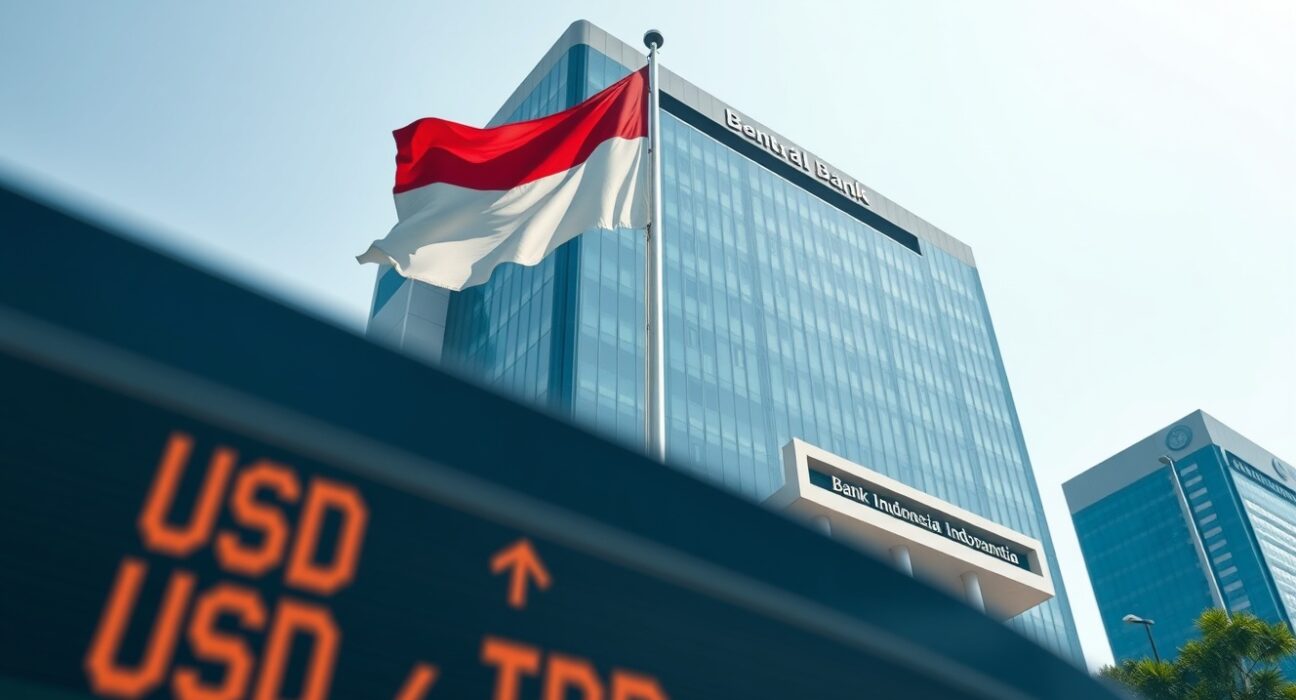
JAKARTA, Indonesia – Bank Indonesia maintained its benchmark interest rate at 6.00% during its March 2025 policy meeting, implementing a strategic pause to defend the Indonesian rupiah (IDR) against mounting global financial pressures. Consequently, the central bank prioritizes currency stability over additional monetary tightening, according to analysis from ING, the Dutch multinational banking firm. This decision follows months of volatility in emerging market currencies, particularly affecting Southeast Asian economies.
Bank Indonesia’s Strategic Policy Hold
Bank Indonesia’s Governing Board unanimously decided to maintain the 7-Day Reverse Repo Rate at 6.00%. Furthermore, the central bank kept the Deposit Facility and Lending Facility rates unchanged at 5.25% and 6.75%, respectively. This policy stance represents the third consecutive hold after a series of aggressive rate hikes throughout 2023 and 2024. Governor Perry Warjiyo emphasized the decision reflects a balanced approach between controlling inflation and supporting economic growth.
The Indonesian rupiah has faced significant pressure from multiple global factors. Specifically, a stronger US dollar, elevated US Treasury yields, and geopolitical tensions have driven capital outflows from emerging markets. Additionally, commodity price fluctuations continue to impact Indonesia’s trade balance. Bank Indonesia’s foreign exchange reserves stood at $146.2 billion as of February 2025, providing substantial buffers for market intervention.
ING’s Analysis of Currency Defense Strategy
ING economists highlight Bank Indonesia’s multi-pronged approach to rupiah stabilization. The strategy combines interest rate policy with direct foreign exchange market intervention and macroprudential measures. According to ING’s Southeast Asia Chief Economist, “The central bank demonstrates a clear preference for using its substantial reserves first, while keeping rate hikes as a last resort.” This approach aims to minimize the negative impact of higher borrowing costs on Indonesia’s economic recovery.
The analysis reveals several key defensive mechanisms currently deployed:
- Triple Intervention Policy: Simultaneous action in spot, domestic non-deliverable forward, and bond markets
- Foreign Exchange Supply Management: Requiring exporters to retain proceeds onshore for specific periods
- Bond Market Stabilization: Strategic purchases of government securities during volatility episodes
- Currency Swap Agreements: Utilizing bilateral arrangements with regional central banks
Global Context and Regional Comparisons
Bank Indonesia’s policy decisions occur within a complex global monetary environment. The US Federal Reserve maintains a restrictive stance, while other major central banks exhibit divergent approaches. This divergence creates challenges for emerging market policymakers attempting to balance domestic and external considerations. Regional comparisons illustrate Indonesia’s relative position:
| Central Bank | Policy Rate | 2025 Currency Performance | Inflation Rate |
|---|---|---|---|
| Bank Indonesia | 6.00% | -3.2% vs USD | 3.1% |
| Bangko Sentral ng Pilipinas | 6.50% | -4.8% vs USD | 4.2% |
| Bank of Thailand | 2.50% | -2.1% vs USD | 2.3% |
| Bank Negara Malaysia | 3.00% | -2.9% vs USD | 2.8% |
Indonesia’s relatively higher policy rate provides some interest rate differential protection. However, this advantage comes with potential costs for economic growth and government debt servicing. The rupiah’s performance, while negative year-to-date, shows relative resilience compared to regional peers facing similar pressures.
Economic Impacts and Market Reactions
The policy hold decision immediately affected Indonesian financial markets. The rupiah strengthened slightly following the announcement, trading at 15,850 per US dollar compared to 15,920 before the decision. Meanwhile, the Jakarta Composite Index gained 0.8% as investors interpreted the pause as supportive for corporate earnings. Government bond yields showed mixed movements, with shorter-tenor securities experiencing modest declines.
Several economic sectors benefit directly from currency stability. Specifically, import-dependent industries like manufacturing and technology gain from predictable exchange rates. Additionally, companies with substantial foreign currency debt experience reduced repayment pressures. Conversely, exporters face competitive challenges when the rupiah appreciates, particularly in commodity sectors like palm oil and coal.
Inflation Management and Growth Considerations
Bank Indonesia maintains its inflation target range of 2.5% to 4.5% for 2025. Current inflation readings remain comfortably within this band, providing policy flexibility. Core inflation, which excludes volatile food and energy prices, has stabilized around 3.0%. This stability allows the central bank to focus on external sector vulnerabilities without immediate domestic price pressures.
Economic growth projections remain moderate but positive. The government forecasts 5.2% GDP expansion for 2025, supported by domestic consumption and infrastructure investment. Monetary policy stability supports this outlook by maintaining predictable financing conditions. However, global economic slowdown risks and trade fragmentation present ongoing challenges to Indonesia’s export-oriented growth model.
Forward Guidance and Policy Trajectory
Bank Indonesia’s forward guidance emphasizes data dependency and flexibility. The central bank commits to monitoring several key indicators:
- Global financial market developments and risk sentiment
- Commodity price movements and terms of trade
- Domestic inflation expectations and core inflation trends
- Rupiah volatility and capital flow patterns
- Economic growth indicators across sectors
ING projects a prolonged pause in Indonesia’s monetary policy cycle. The analysis suggests rate cuts remain unlikely before late 2025 or early 2026. This timeline depends significantly on Federal Reserve policy adjustments and global risk appetite recovery. Should rupiah pressures intensify substantially, Bank Indonesia maintains readiness to implement additional stabilization measures, including possible rate hikes.
Conclusion
Bank Indonesia’s decision to hold interest rates reflects a strategic prioritization of currency stability amid challenging global conditions. The central bank’s multi-faceted approach to defending the Indonesian rupiah combines policy tools and substantial reserves. Consequently, Indonesia maintains relative monetary policy stability while navigating external volatility. This balanced strategy supports economic growth objectives while containing inflation and managing external vulnerabilities. The rupiah’s performance will continue influencing monetary policy decisions throughout 2025, with Bank Indonesia prepared to adjust its stance as global and domestic conditions evolve.
FAQs
Q1: Why did Bank Indonesia decide to hold interest rates steady?
Bank Indonesia maintained rates to defend the Indonesian rupiah against global volatility while balancing inflation control and economic growth support. The central bank utilizes its foreign exchange reserves for market intervention before considering rate adjustments.
Q2: How does Indonesia’s policy compare to other Southeast Asian central banks?
Indonesia maintains one of the region’s highest policy rates at 6.00%, providing interest rate differential protection. This contrasts with Thailand’s 2.50% and Malaysia’s 3.00%, reflecting different inflation dynamics and currency pressures.
Q3: What tools does Bank Indonesia use to stabilize the rupiah?
The central bank employs a triple intervention policy in spot, forward, and bond markets, along with foreign exchange supply management, bond market stabilization, and currency swap agreements with regional partners.
Q4: How does currency stability affect Indonesia’s economy?
Rupiah stability benefits import-dependent industries and companies with foreign currency debt by providing predictable costs. However, exporters face competitive challenges when the currency appreciates, particularly in commodity sectors.
Q5: What factors might trigger Bank Indonesia to change its policy stance?
Significant rupiah depreciation, sustained capital outflows, rising inflation expectations, or major shifts in Federal Reserve policy could prompt Bank Indonesia to adjust rates. The central bank emphasizes data-dependent decision-making.
Disclaimer: The information provided is not trading advice, Bitcoinworld.co.in holds no liability for any investments made based on the information provided on this page. We strongly recommend independent research and/or consultation with a qualified professional before making any investment decisions.
