

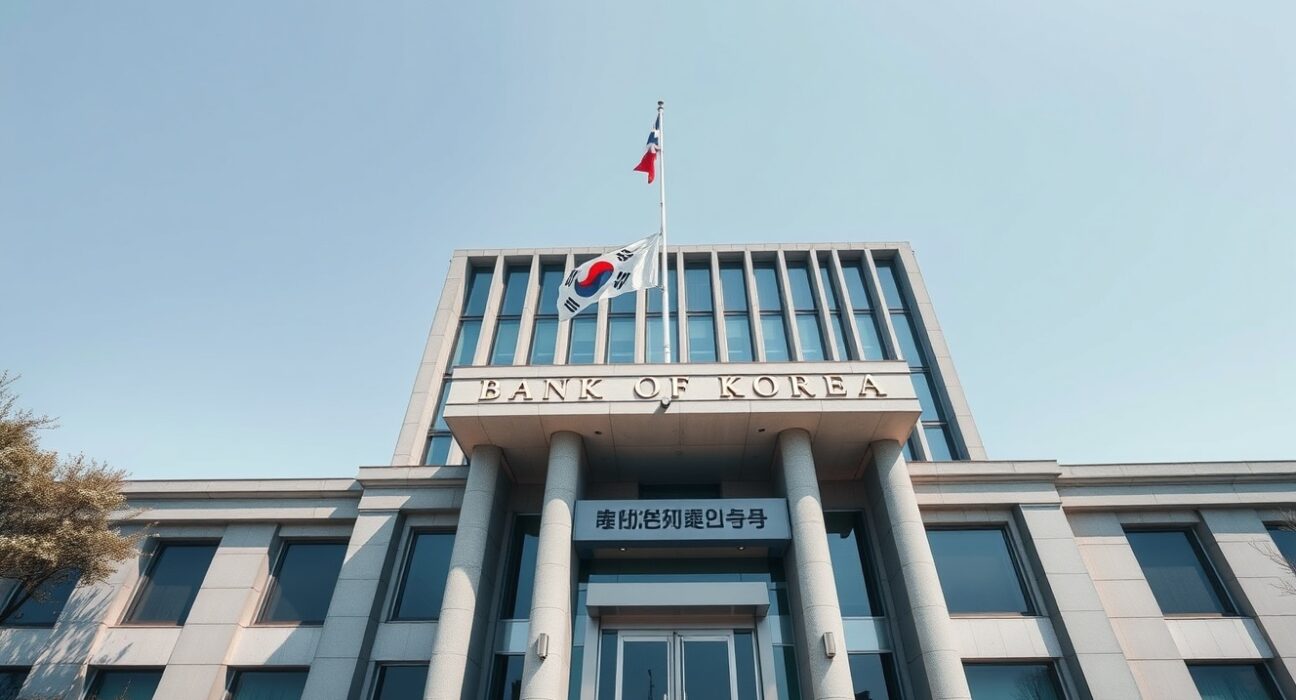
The Bank of Korea has kept its benchmark interest rate unchanged at 2.50% for the eighth consecutive policy meeting, maintaining its cautious stance amid persistent economic uncertainties. The decision, announced following the central bank’s latest rate-setting session, extends a pause that began in July last year.
Extended Pause Reflects Balancing Act
The central bank has now held rates steady since July 2023, with subsequent freezes in August, September, October, and November of last year, followed by similar decisions in January, February, and April of this year. The consistent hold signals the bank’s effort to balance inflationary pressures against the need to support a slowing economy.
South Korea’s economy has faced headwinds from subdued domestic demand, a cooling property market, and global trade uncertainties. Meanwhile, inflation, though moderating from its 2022 peaks, has remained above the central bank’s 2% target, limiting room for rate cuts.
What This Means for Borrowers and the Economy
For households and businesses carrying variable-rate debt, the prolonged rate freeze offers some predictability, though borrowing costs remain elevated compared to the ultra-low rates seen during the pandemic. The Bank of Korea’s decision suggests policymakers are waiting for clearer signs that inflation is sustainably converging toward its target before considering any shift.
Market Reaction and Forward Guidance
Financial markets had widely anticipated the hold. Analysts now focus on the central bank’s forward guidance for clues about the timing of a potential rate cut later this year. Governor Rhee Chang-yong has emphasized a data-dependent approach, with the bank closely monitoring inflation trends, household debt levels, and external risks such as geopolitical tensions and global monetary policy shifts.
Conclusion
The Bank of Korea’s eighth consecutive rate hold underscores its cautious approach to monetary policy in an uncertain economic environment. While the freeze provides short-term stability, the central bank’s next move will hinge on incoming data, particularly inflation and growth indicators. Borrowers and investors should watch for signals in the bank’s future statements for any hint of a policy pivot.
FAQs
Q1: Why has the Bank of Korea held rates steady for eight consecutive meetings?
The central bank is balancing the need to control inflation, which remains above its 2% target, with supporting an economy facing headwinds from weak domestic demand and global uncertainties. The hold allows policymakers to assess economic data before making a change.
Q2: When might the Bank of Korea cut rates?
Analysts expect a potential rate cut later this year if inflation continues to moderate and economic growth weakens further. However, the timing depends on incoming data, including inflation figures, household debt levels, and global economic conditions.
Q3: How does the rate hold affect South Korean borrowers?
For borrowers with variable-rate loans, the freeze means monthly payments remain unchanged at current elevated levels. While this offers predictability, it does not provide the relief that a rate cut would deliver. Fixed-rate borrowers are largely unaffected.
Disclaimer: The information provided is not trading advice, Bitcoinworld.co.in holds no liability for any investments made based on the information provided on this page. We strongly recommend independent research and/or consultation with a qualified professional before making any investment decisions.
