

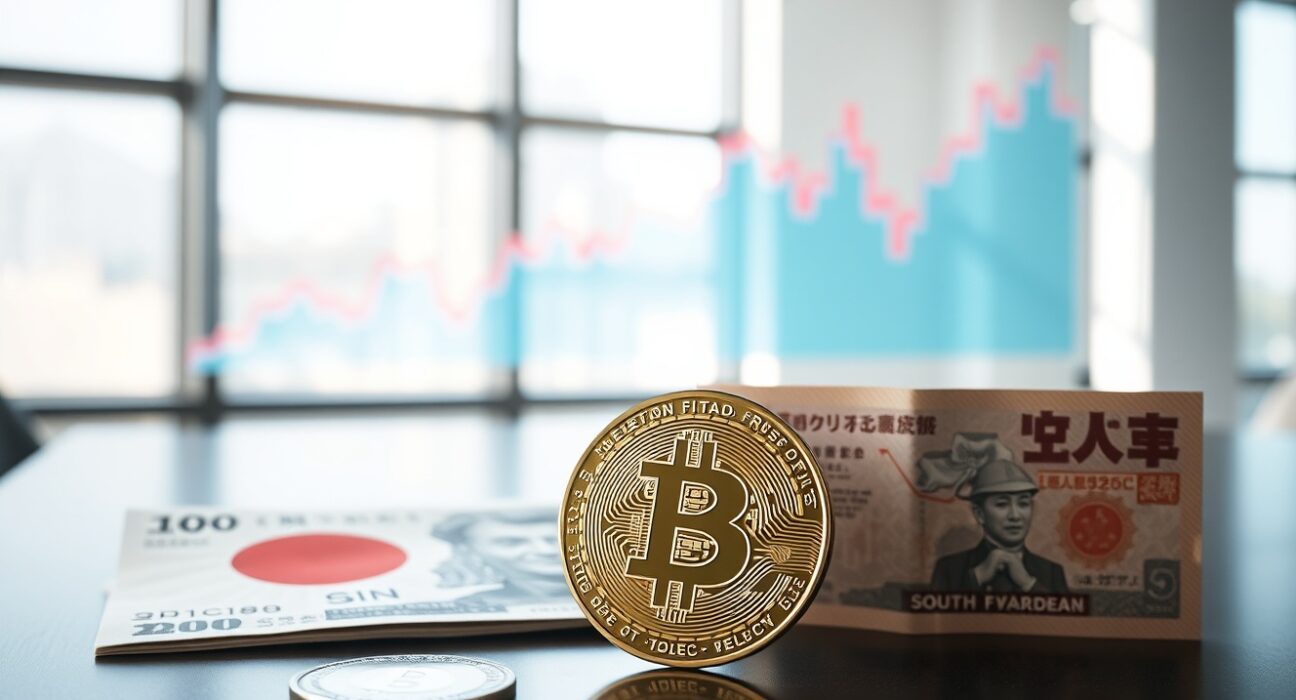
Bitcoin has posted stronger gains on Japanese exchanges compared to South Korean platforms in July, as the Japanese yen weakened to its lowest level in four decades, according to a report from Maeil Business Newspaper. On bitFlyer, one of Japan’s largest cryptocurrency exchanges, Bitcoin rose 14.57% during the month, while on South Korea’s Upbit, the gain was a more modest 9.21%.
Yen weakness drives divergence
The disparity in Bitcoin performance between the two Asian markets is closely tied to currency movements. The dollar-yen exchange rate climbed from 161 yen to 163.16 yen this month, marking a continued depreciation of the Japanese currency. In contrast, the dollar-won rate fell to 1,480 won from 1,552 won, reflecting relative strength in the South Korean won.
For Japanese investors, a weaker yen increases the local-currency value of dollar-denominated assets like Bitcoin, effectively amplifying returns when measured in yen. This dynamic has historically contributed to a “Japan premium” for Bitcoin during periods of yen depreciation.
Market context and implications
The yen’s slide to levels not seen since 1986 has been driven by the Bank of Japan’s continued ultra-loose monetary policy, which stands in contrast to higher interest rates in the United States and other major economies. This policy divergence has encouraged carry trades and put sustained downward pressure on the yen.
For South Korean investors, the won’s relative stability has muted the currency-driven boost to Bitcoin returns. Additionally, South Korea’s regulatory environment for cryptocurrency trading remains stringent, with strict know-your-customer (KYC) rules and a ban on institutional participation, which may also influence local market dynamics.
What this means for traders
The widening spread between Japanese and South Korean Bitcoin prices highlights how macroeconomic factors—particularly currency policy—can create arbitrage opportunities and regional price divergence. Traders monitoring cross-border crypto flows may find the Japan premium a useful signal of yen sentiment and capital movement.
However, the premium also reflects differing investor bases. Japan has a more mature, retail-heavy crypto market, while South Korea’s market is known for higher volatility driven by retail speculation. The combination of currency trends and local market structure is likely to sustain the divergence as long as the yen remains under pressure.
Conclusion
Bitcoin’s stronger performance in Japan versus South Korea this month is a direct consequence of the yen’s historic weakness, not a fundamental shift in Bitcoin’s value. The episode underscores the importance of local currency dynamics in shaping regional cryptocurrency prices and offers a real-world example of how macroeconomic policy affects digital asset markets.
FAQs
Q1: Why did Bitcoin gain more in Japan than in South Korea?
The primary reason is the Japanese yen’s sharp depreciation. A weaker yen increases the local-currency value of Bitcoin, which is priced globally in US dollars. This currency effect boosted Bitcoin’s yen-denominated return compared to the won-denominated return in South Korea.
Q2: Is the Japan premium a common phenomenon?
Yes, Bitcoin has historically traded at a premium in Japan during periods of yen weakness or when Japanese investors face limited alternatives for hedging currency risk. The premium tends to shrink or reverse when the yen stabilizes or strengthens.
Q3: Does this mean Bitcoin is more expensive in Japan?
In yen terms, Bitcoin’s price has risen faster, but the underlying US dollar price is the same globally. The divergence is purely a function of exchange rate movements and local market demand, not a fundamental difference in Bitcoin’s value.
Disclaimer: The information provided is not trading advice, Bitcoinworld.co.in holds no liability for any investments made based on the information provided on this page. We strongly recommend independent research and/or consultation with a qualified professional before making any investment decisions.
