

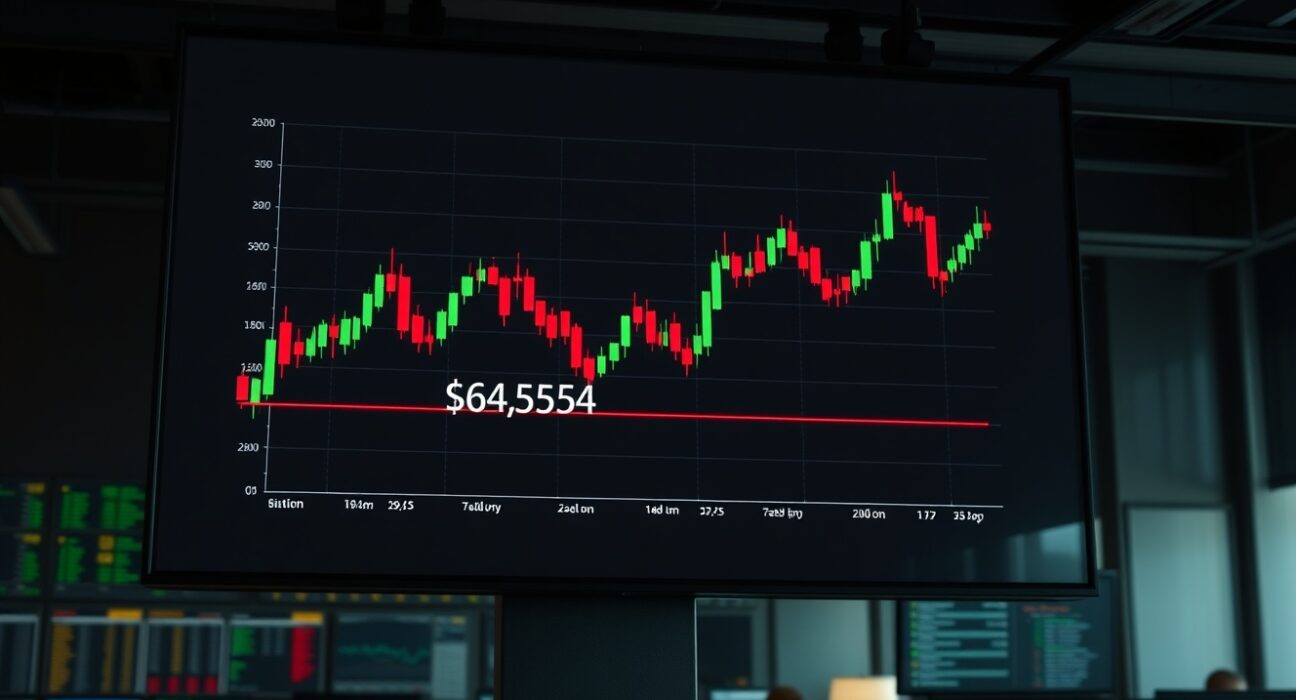
Bitcoin faces a significant liquidation risk if its price falls below the $64,554 mark, with data from CoinGlass indicating that approximately $272.35 million in long positions could be forcibly closed across major centralized exchanges. Conversely, a breakout above $65,865 would trigger an estimated $184.30 million in short liquidations.
Understanding the Liquidation Threshold
Liquidation occurs when a trader’s leveraged position is automatically closed by an exchange due to insufficient margin. The data, aggregated from platforms including Binance, OKX, and Bybit, highlights a concentration of long positions with liquidation prices clustered near $64,554. This zone represents a critical support level, as a breach could trigger a cascading effect of forced selling, potentially accelerating downward price momentum.
The $65,865 level, meanwhile, serves as a resistance point where short sellers are heavily positioned. A sustained move above this price would likely force short positions to cover, adding upward pressure to Bitcoin’s price.
Market Context and Implications
These liquidation levels come amid a period of heightened volatility for Bitcoin, which has been trading in a wide range following recent macroeconomic events and regulatory developments. The concentration of leverage around these price points suggests that the market is primed for a sharp move in either direction, depending on which level breaks first.
For traders, these zones represent both opportunity and risk. Long holders should be aware of the potential for a rapid sell-off below $64,554, while short sellers face similar risks above $65,865. The data underscores the importance of risk management in leveraged trading, as liquidation cascades can amplify price swings beyond what fundamentals alone would suggest.
Why This Matters to Investors
For longer-term investors and those not using leverage, these liquidation levels may seem less directly relevant. However, the mechanics of forced liquidations can create significant short-term price dislocations that affect all market participants. A cascade below $64,554 could present a buying opportunity for those with cash reserves, while a squeeze above $65,865 might signal renewed bullish momentum.
It is also worth noting that liquidation data is dynamic and changes rapidly as traders open and close positions. The figures provided by CoinGlass are a snapshot in time and should be used as a guide rather than a precise prediction.
Conclusion
The $64,554 and $65,865 levels represent critical inflection points for Bitcoin in the near term, with over $450 million in combined potential liquidations at stake. Traders should monitor these zones closely, as a breach in either direction could lead to increased volatility and rapid price movements. As always, the use of leverage carries inherent risks, and market participants are advised to trade responsibly.
FAQs
Q1: What does it mean when a long position is liquidated?
A long position is liquidated when the price of the asset falls below a certain threshold, causing the exchange to automatically close the trade to prevent further losses. This typically happens when the trader’s margin is exhausted.
Q2: How accurate is CoinGlass liquidation data?
CoinGlass aggregates data from major exchanges, but it is not real-time and may have slight delays. The figures represent a snapshot of open positions and should be considered estimates rather than exact predictions.
Q3: Can liquidation levels affect the broader crypto market?
Yes, large-scale liquidations can create cascading effects, amplifying price movements and increasing volatility across the market. This can impact even those not directly involved in leveraged trading.
Disclaimer: The information provided is not trading advice, Bitcoinworld.co.in holds no liability for any investments made based on the information provided on this page. We strongly recommend independent research and/or consultation with a qualified professional before making any investment decisions.
