

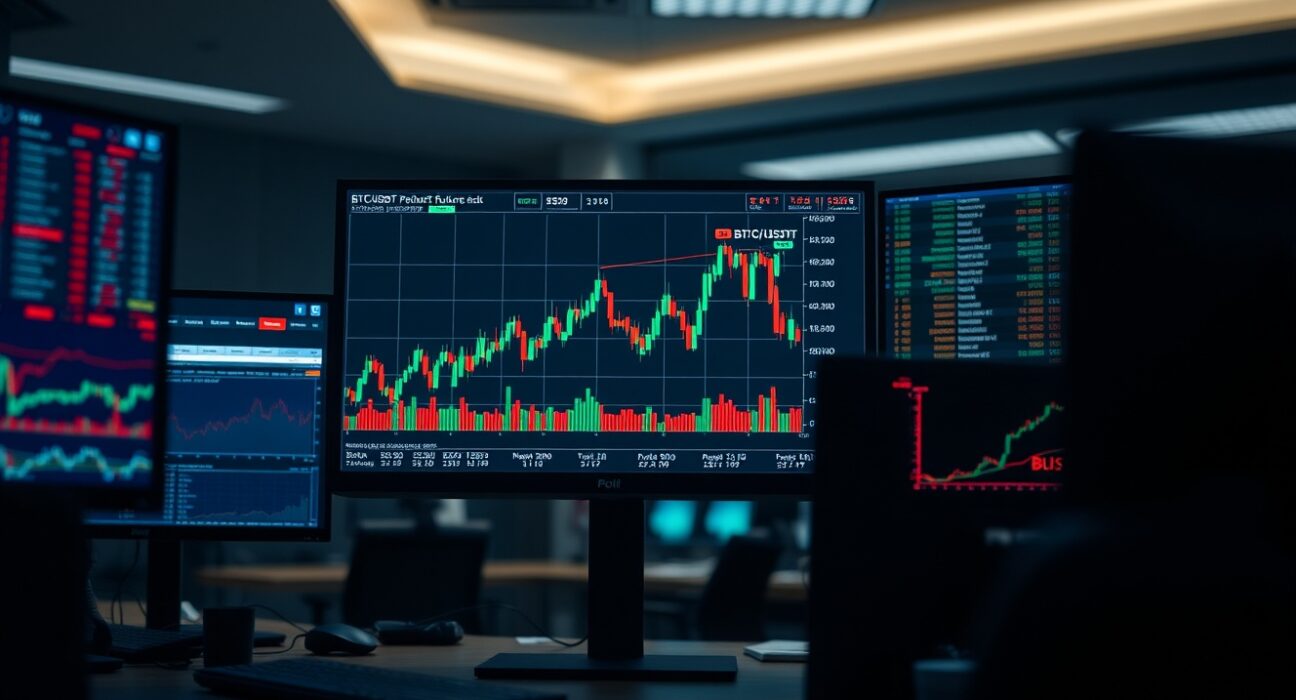
Data from the three largest cryptocurrency futures exchanges by open interest reveals that Bitcoin perpetual futures markets are currently exhibiting a remarkably balanced sentiment. As of the latest 24-hour reading, the overall long/short ratio stands at 50.06% long versus 49.94% short, indicating that traders are nearly evenly split on the direction of Bitcoin’s next price move.
Exchange-Level Breakdown
A closer look at individual platforms shows slight variations in positioning. On Binance, the world’s largest crypto exchange by volume, the ratio is 49.86% long and 50.14% short, reflecting a marginal bearish tilt. OKX shows a similar pattern at 49.73% long and 50.27% short. Bybit, another major derivatives venue, reports the most pronounced lean toward shorts, with 49.32% long positions against 50.68% short positions.
While these differences are small, they suggest that retail and professional traders on each platform may be reacting to slightly different signals or employing distinct strategies. The near-unanimous slight bearish bias across all three exchanges is noteworthy, as it contrasts with the overall neutral aggregate figure.
What This Means for Traders
The long/short ratio is a widely watched sentiment indicator in the crypto derivatives space. A reading near 50/50 typically signals indecision and can precede a period of heightened volatility as the market picks a direction. The current data suggests that neither bulls nor bears have established a clear advantage, leaving Bitcoin vulnerable to sharp moves in either direction.
Traders should note that extreme readings—where one side is heavily favored—often act as contrarian signals. The present near-neutral stance, however, offers no such clear warning. Instead, it points to a market awaiting a catalyst, whether from macroeconomic data, regulatory developments, or on-chain activity.
Context and Limitations
It is important to understand what the long/short ratio measures. It represents the proportion of open positions—contracts that have not yet been closed or settled—that are long (betting on a price increase) versus short (betting on a price decrease). This data is derived from perpetual futures, which are popular among traders for their ability to use leverage. The ratio does not account for the size of each position, meaning a small number of large trades can have an outsized impact on the figures.
Additionally, the ratio reflects only the three exchanges listed. While Binance, OKX, and Bybit dominate the market, other venues like Deribit, Bitget, and Kraken may show different sentiment, and their exclusion limits the completeness of the picture.
Conclusion
The current Bitcoin perpetual futures long/short ratios paint a picture of a market in equilibrium, with traders evenly divided on the next move. The slight bearish bias on individual exchanges is consistent but not extreme. For market participants, this suggests a period of watchful waiting, where the next significant price move may catch a large portion of traders off guard. As always, leverage trading carries substantial risk, and sentiment indicators should be used as one tool among many in a comprehensive trading strategy.
FAQs
Q1: What is a perpetual futures contract?
A perpetual futures contract is a type of derivative that allows traders to speculate on the price of an asset like Bitcoin without an expiration date. Unlike traditional futures, perpetuals use a funding rate mechanism to keep the contract price close to the spot price.
Q2: How is the long/short ratio calculated?
The ratio is calculated by dividing the number of long positions (or their value) by the number of short positions (or their value) among all open contracts on a given exchange. A ratio above 50% means more long positions, while below 50% means more short positions.
Q3: Does a high long/short ratio guarantee a price drop?
No. While extreme long/short ratios can sometimes signal a crowded trade and a potential reversal, they are not predictive on their own. Many other factors, including market depth, order flow, and fundamental news, influence price direction.
Disclaimer: The information provided is not trading advice, Bitcoinworld.co.in holds no liability for any investments made based on the information provided on this page. We strongly recommend independent research and/or consultation with a qualified professional before making any investment decisions.
