

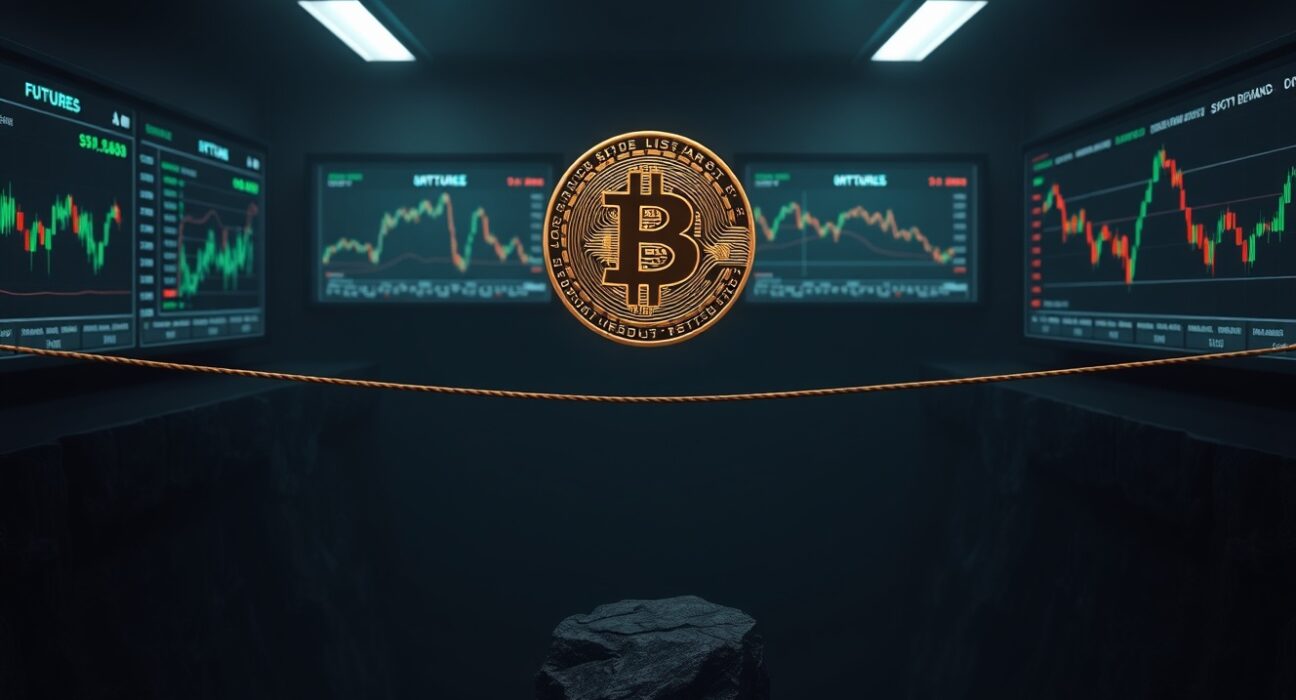
Bitcoin’s recent price increase has raised questions about the rally’s durability. According to a report from CoinDesk, the upward movement is sustained by leverage demand rather than genuine spot market buying. This divergence suggests a lack of underlying market confidence. Analysts warn that such conditions often create a fragile environment. History shows that similar patterns frequently lead to sharp downturns.
Bitcoin Rally Leverage vs. Spot Demand: A Key Divergence
CoinDesk’s analysis highlights a critical trend. Last month, Bitcoin’s price climbed primarily due to futures market activity. Simultaneously, spot demand weakened. This imbalance indicates that traders are using borrowed funds to push prices higher. Spot demand, which reflects actual ownership transfer, remained flat or declined. This scenario is a classic sign of a leveraged rally.
The report notes that this pattern has occurred multiple times in the past. Each instance resulted in a fragile market structure. When prices rise on leverage, they become susceptible to rapid reversals. A sudden shift in trader sentiment or a slowdown in capital inflows can trigger a sell-off. The current rally lacks the robust foundation that spot buying provides.
Understanding Leverage-Driven Market Dynamics
Leverage allows traders to control larger positions with less capital. In the futures market, this amplifies both gains and losses. When a rally is leverage-driven, it often lacks broad-based participation. Spot markets, where buyers take direct ownership, reflect genuine demand. Without this, the rally is vulnerable.
Data from derivatives exchanges shows open interest in Bitcoin futures has risen sharply. This indicates increased speculative activity. However, spot trading volumes have not kept pace. The divergence is a red flag for market health. Experienced traders view this as a warning sign. They often reduce exposure during such periods.
Historical Precedents of Leverage-Driven Rallies
CoinDesk references past market cycles. In 2021, a similar leverage-driven rally preceded a significant correction. The pattern repeated in early 2023. Each time, the initial gains were impressive. However, the lack of spot support led to sharp reversals. The current situation mirrors these historical examples.
Market participants should consider this context. The rally’s sustainability depends on a shift in demand structure. Without increased spot buying, the upward trend remains precarious. The report emphasizes that leverage can extend a rally temporarily. But it cannot replace genuine investor confidence.
Implications for Bitcoin Market Confidence
The current market sentiment reflects caution. Despite price gains, many investors remain wary. The reliance on leverage undermines confidence. Spot demand is a more reliable indicator of long-term interest. When it lags, the market is at risk.
Institutional investors often prefer spot exposure. Their participation signals confidence. The current lack of spot buying suggests hesitation. This could be due to regulatory uncertainty or macroeconomic factors. Regardless, the effect on market stability is clear.
Key Factors Influencing the Rally
- Futures Open Interest: Rising rapidly, indicating speculative activity.
- Spot Volume: Flat or declining, showing weak direct demand.
- Funding Rates: Elevated in perpetual swaps, suggesting leveraged longs.
- Exchange Inflows: Low, implying holders are not selling but also not buying.
These factors paint a mixed picture. The rally has momentum, but it is built on a shaky foundation. A sudden shift in any of these metrics could trigger a correction. Traders should monitor them closely.
Potential Market Scenarios and Risks
If spot demand fails to pick up, the rally may stall. A slowdown in capital inflows could accelerate a reversal. Alternatively, a positive catalyst could attract spot buyers. This would strengthen the rally’s foundation. However, the current data suggests the former scenario is more likely.
CoinDesk’s analysis points to a fragile environment. The market could react sensitively to news or positioning shifts. Leverage-driven rallies often end abruptly. The risk of a sharp downturn is elevated. Investors should prepare for increased volatility.
What Traders Should Watch
- Spot Volume Trends: A sustained increase would signal renewed confidence.
- Open Interest Changes: A decline could indicate unwinding of leveraged positions.
- Funding Rate Normalization: Falling rates would reduce pressure on longs.
- Macroeconomic News: Rate decisions or regulatory updates could shift sentiment.
These indicators will provide clues about the market’s direction. The current setup favors caution. Traders should avoid over-leveraging in this environment.
Conclusion
The Bitcoin rally sustained by leverage, not spot demand, signals weak market confidence. CoinDesk’s report highlights a fragile structure prone to reversal. While further gains are possible, the risk of a sharp downturn is significant. Investors should prioritize risk management. Monitoring spot demand and leverage metrics is essential. The market’s true strength will only be revealed when spot buying returns.
FAQs
Q1: What does it mean when a Bitcoin rally is leverage-driven?
A leverage-driven rally means price increases are fueled by borrowed funds in futures markets, not by direct spot buying. This creates a fragile structure because positions can be liquidated quickly.
Q2: Why is spot demand important for Bitcoin’s price stability?
Spot demand reflects genuine investor interest and ownership transfer. It provides a solid foundation for price increases. Without it, rallies are more vulnerable to sudden reversals.
Q3: How can traders identify a leverage-driven rally?
Traders can monitor futures open interest, funding rates, and spot trading volumes. Rising open interest with flat spot volumes is a key sign of leverage-driven price action.
Q4: What historical examples show the risks of leverage-driven rallies?
In 2021 and early 2023, Bitcoin experienced similar patterns. Rallies fueled by leverage led to sharp corrections when spot demand failed to materialize.
Q5: What should investors do during a leverage-driven rally?
Investors should reduce leverage, monitor spot volume trends, and prepare for increased volatility. Diversifying positions and setting stop-losses can help manage risk.
Disclaimer: The information provided is not trading advice, Bitcoinworld.co.in holds no liability for any investments made based on the information provided on this page. We strongly recommend independent research and/or consultation with a qualified professional before making any investment decisions.
