

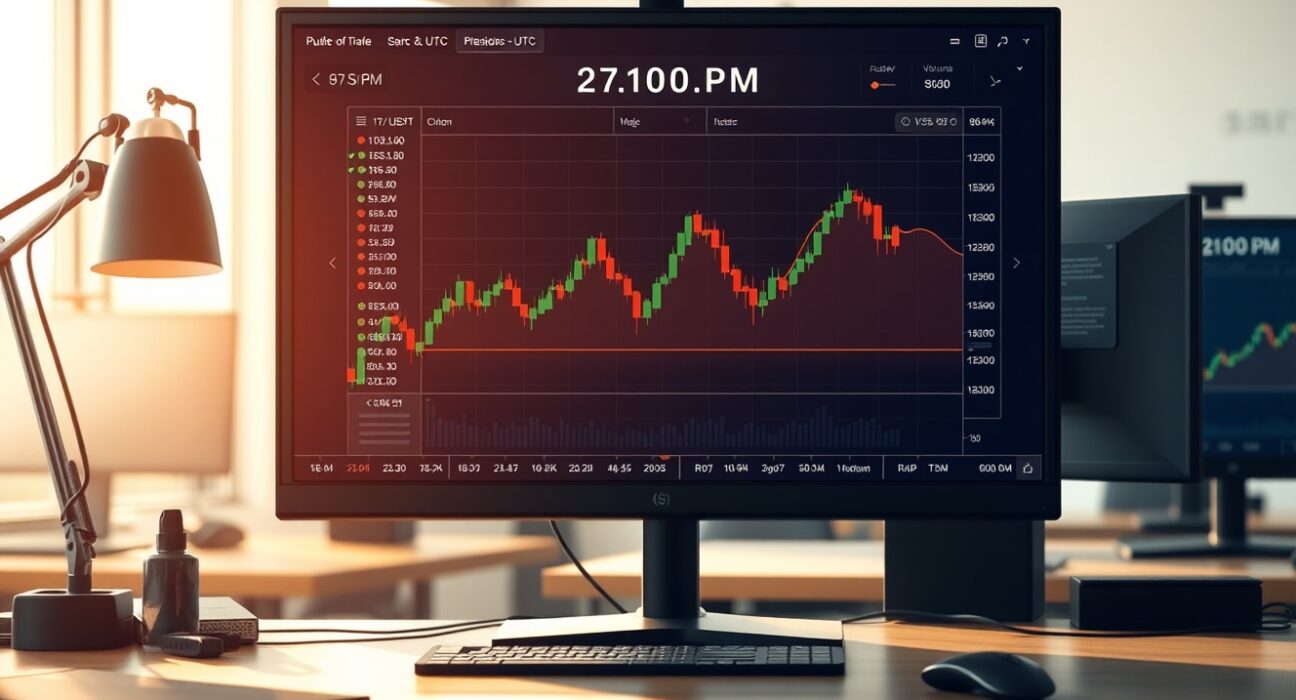
Market analysts closely examined the BTC/USDT spot Cumulative Volume Delta chart at 4 p.m. UTC on April 21, revealing significant insights into Bitcoin’s underlying market structure. This detailed analysis provides traders with crucial information about order flow dynamics and potential support and resistance levels. The chart’s dual-component display offers a comprehensive view of market participation across different order sizes.
Understanding the BTC/USDT Spot CVD Chart Structure
The Cumulative Volume Delta chart represents a sophisticated analytical tool for cryptocurrency traders. Specifically, it tracks the BTC/USDT spot trading pair’s order book activity with remarkable precision. This instrument separates into two distinct sections that work together to provide market intelligence. The upper portion displays a volume heatmap, while the lower section visualizes the CVD indicator. Together, these components create a complete picture of market participation.
Professional traders rely on this chart type for several important reasons. First, it reveals hidden market dynamics that simple price charts cannot show. Second, it identifies areas of concentrated trading activity that often precede significant price movements. Third, the chart helps traders understand whether buying or selling pressure dominates specific price ranges. Market analysts consider these insights essential for informed trading decisions.
The Technical Components Explained
The volume heatmap occupies the chart’s upper section, tracking trading volume at precise price levels. This visualization technique uses color intensity to represent trading activity concentration. Brighter areas indicate where the price has spent considerable time or where significant trading volume occurred. These bright zones frequently transform into important technical levels that influence future price action.
Meanwhile, the CVD indicator occupies the lower chart portion, categorizing buy and sell orders by size. Each colored line represents a specific order size category, with the line’s movement indicating net order flow direction. For instance, the yellow line tracks orders between $100 and $1,000, while the brown line monitors large transactions between $1 million and $10 million. This segmentation allows analysts to distinguish between retail and institutional activity.
Volume Heatmap Analysis and Market Implications
The volume heatmap provides critical information about market structure and potential turning points. When price lingers within a specific range, the heatmap displays brighter coloring at those levels. These areas often develop into future support or resistance zones because they represent price points where substantial trading previously occurred. Market participants remember these levels and frequently react when price returns to them.
Significant price movements also create distinctive patterns on the volume heatmap. Rapid price advances or declines typically produce vertical bright bands, indicating concentrated trading during the move. These bands can serve as important reference points for technical analysis. Additionally, the heatmap reveals accumulation and distribution zones where institutional players might establish or unwind positions.
| Color Intensity | Trading Activity | Market Implication |
|---|---|---|
| Dark/Low | Minimal trading | Low interest or consolidation |
| Medium | Moderate activity | Normal market conditions |
| Bright/High | Heavy concentration | Potential support/resistance |
CVD Indicator: Decoding Order Flow by Size
The Cumulative Volume Delta indicator offers unprecedented visibility into market participation across different investor categories. Each colored line represents a specific order size bracket, allowing analysts to monitor distinct market segments simultaneously. The yellow line ($100-$1,000 orders) typically reflects retail trader activity, while the brown line ($1M-$10M orders) represents institutional or whale movements.
When a CVD line rises steadily, it indicates net buying pressure within that order size category. Conversely, a declining line shows net selling pressure. By comparing different lines, analysts can identify whether retail or institutional traders drive market movements. This distinction proves particularly valuable during market turning points, as institutional activity often precedes significant trend changes.
Practical Applications for Traders
Professional traders utilize CVD charts for several practical applications. First, they identify divergence between price action and order flow. For example, if price rises while CVD declines, it suggests weak buying pressure that might precede a reversal. Second, traders watch for convergence across different order size categories. When retail and institutional CVD lines move together, it indicates broad market consensus.
Third, analysts monitor extreme readings on CVD lines. Exceptionally high or low values often signal overbought or oversold conditions. Fourth, traders use CVD to confirm breakout or breakdown movements. Genuine breakouts typically show supporting CVD movement, while false breakouts display contradictory order flow. These applications make CVD analysis an essential component of comprehensive market assessment.
Historical Context and Market Evolution
Cumulative Volume Delta analysis has evolved significantly since its introduction to cryptocurrency markets. Originally developed for traditional financial markets, CVD adapted to crypto’s unique 24/7 trading environment and higher volatility characteristics. The indicator gained prominence during Bitcoin’s 2017 bull market when traders sought better tools to understand unprecedented market movements.
Market infrastructure improvements further enhanced CVD’s utility over time. Increased exchange transparency, better API access, and more sophisticated charting platforms all contributed to broader CVD adoption. Today, professional trading firms routinely incorporate CVD analysis into their decision-making processes. The indicator’s ability to reveal hidden market dynamics makes it particularly valuable in cryptocurrency’s often-opaque trading environment.
Comparative Analysis with Traditional Indicators
CVD differs fundamentally from conventional technical indicators in several important ways. Unlike moving averages or oscillators that derive from price data alone, CVD analyzes order flow directly. This distinction provides earlier signals about potential market direction changes. Additionally, CVD offers granular visibility into specific market segments, whereas most traditional indicators provide only aggregate market views.
However, experienced traders typically combine CVD with other analytical tools for optimal results. Volume profile analysis complements CVD by showing volume distribution across price levels. Order book depth analysis provides real-time supply and demand visualization. Technical pattern recognition identifies chart formations that might influence future price action. Together, these tools create a multidimensional market understanding.
Market Impact and Future Implications
The widespread adoption of CVD analysis influences cryptocurrency market behavior in measurable ways. First, it increases market efficiency by revealing previously hidden information. Second, it reduces information asymmetry between different market participant categories. Third, CVD data contributes to more accurate price discovery by quantifying genuine buying and selling pressure.
Looking forward, CVD analysis will likely evolve alongside market development. Machine learning algorithms may enhance pattern recognition within CVD data. Real-time CVD visualization could become standard across trading platforms. Additionally, cross-market CVD analysis might emerge, comparing Bitcoin’s order flow with traditional asset classes. These developments will further refine market participants’ understanding of cryptocurrency dynamics.
Conclusion
The BTC/USDT spot CVD chart provides invaluable insights into cryptocurrency market structure and participant behavior. The volume heatmap identifies potential support and resistance levels through trading concentration analysis. The CVD indicator reveals order flow dynamics across different investor categories. Together, these tools help traders make more informed decisions based on comprehensive market understanding. As cryptocurrency markets mature, sophisticated analytical tools like CVD charts will become increasingly essential for successful navigation of this dynamic trading environment.
FAQs
Q1: What exactly does Cumulative Volume Delta measure in cryptocurrency trading?
The Cumulative Volume Delta measures the net difference between buying and selling volume over time. It tracks whether buyers or sellers control market momentum by analyzing order flow rather than just price movement.
Q2: How reliable are volume heatmaps for identifying support and resistance levels?
Volume heatmaps provide strong indications of potential support and resistance areas because they show where significant trading previously occurred. However, traders should confirm these levels with additional technical analysis since market conditions constantly evolve.
Q3: Can retail traders effectively use CVD analysis without institutional tools?
Yes, many retail trading platforms now offer CVD indicators and volume heatmaps. While institutional tools provide more granular data, retail traders can still gain valuable insights from commonly available charting software with proper interpretation.
Q4: How does the 4 p.m. UTC time specifically matter for CVD analysis?
The 4 p.m. UTC timeframe coincides with the overlap of European afternoon and North American morning trading sessions. This period often sees increased trading volume and liquidity, making CVD readings particularly significant for assessing broader market sentiment.
Q5: What are the main limitations of relying solely on CVD for trading decisions?
CVD analysis focuses exclusively on order flow without considering fundamental factors, news events, or broader market context. Successful traders combine CVD with other analytical methods and risk management strategies for comprehensive decision-making.
Disclaimer: The information provided is not trading advice, Bitcoinworld.co.in holds no liability for any investments made based on the information provided on this page. We strongly recommend independent research and/or consultation with a qualified professional before making any investment decisions.
