
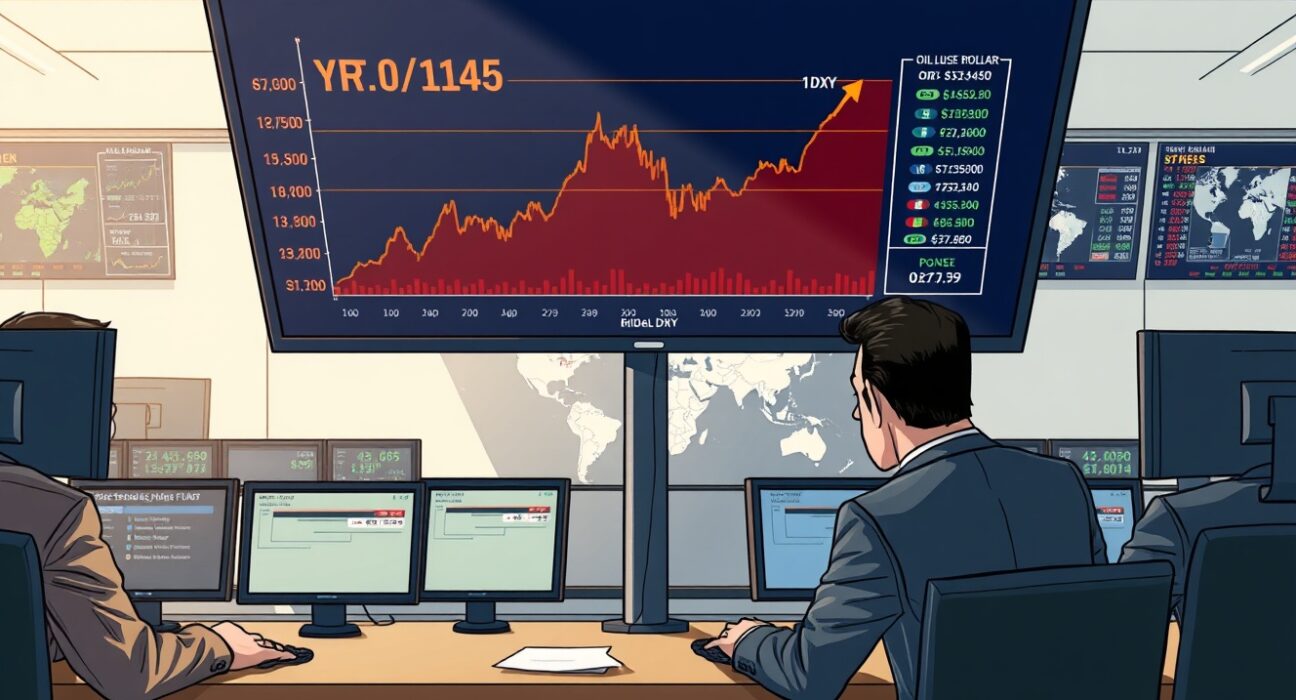
Global financial markets experienced significant turbulence on Thursday as the US dollar strengthened sharply against major currencies while oil prices surged to multi-month highs, driven by escalating military conflict in Iran that threatens Middle Eastern energy supplies and global economic stability.
Dollar Strengthens Against Major Currencies
The US dollar index (DXY) rose 1.8% to reach 106.5, marking its strongest single-day gain in three months. This significant movement represents a notable shift in global currency dynamics. The dollar strengthened particularly against the euro, which fell 1.5% to 1.0650, and the Japanese yen, which weakened to 155.50 against the dollar. Market analysts attribute this dollar strength to several interconnected factors.
Firstly, investors typically seek the US dollar as a safe-haven currency during periods of geopolitical uncertainty. Secondly, higher oil prices often benefit the dollar because crude oil trades predominantly in US dollars globally. Thirdly, expectations that the Federal Reserve may maintain higher interest rates for longer to combat potential inflationary pressures from energy costs have supported dollar demand.
Oil Prices Rise to Critical Levels
Brent crude futures surged 4.2% to $92.85 per barrel, while West Texas Intermediate (WTI) climbed 4.5% to $88.70. These price movements represent the highest levels since November 2023. The escalation follows confirmed reports of military strikes on Iranian nuclear facilities and subsequent retaliatory actions in the Strait of Hormuz. This critical waterway handles approximately 20% of global oil shipments.
Market participants express particular concern about potential supply disruptions. Iran currently produces about 3.2 million barrels per day of crude oil. Furthermore, neighboring countries including Saudi Arabia, Iraq, and the United Arab Emirates collectively export over 15 million barrels daily through the Persian Gulf. Any significant disruption to these flows could create substantial global supply shortages.
Historical Context of Middle East Conflicts
Previous Middle Eastern conflicts have demonstrated clear patterns in oil and currency markets. During the 1990-1991 Gulf War, oil prices doubled within months. Similarly, the 2019 attacks on Saudi Arabian oil facilities caused the largest single-day price spike in history. The current situation shows concerning parallels with these historical precedents. However, today’s market structure differs significantly with increased US shale production and strategic petroleum reserves in major consuming nations.
Global Economic Impacts and Market Reactions
The simultaneous dollar strengthening and oil price rise create complex challenges for global economies. Emerging markets face particular vulnerability due to their dependence on dollar-denominated debt and energy imports. Countries like India, which imports over 80% of its oil needs, could experience significant current account pressures. Meanwhile, European nations already grappling with energy security concerns since the Ukraine conflict face renewed inflationary risks.
Financial markets reacted with pronounced volatility across multiple asset classes:
- Equity Markets: Global stock indices declined, with energy sectors outperforming while airlines and transportation companies underperformed
- Bond Markets: US Treasury yields rose as inflation expectations increased, while European government bond prices fell
- Commodity Markets: Gold prices rose 1.2% as investors sought traditional safe-haven assets alongside the dollar
Central Bank Policy Implications
The Federal Reserve faces renewed challenges in its inflation management strategy. Higher energy prices typically feed through to broader consumer prices within 3-6 months. Consequently, market expectations for interest rate cuts in 2025 have diminished significantly. The European Central Bank and Bank of England similarly confront difficult policy decisions, balancing growth concerns against inflationary pressures from both energy costs and currency weakness against the dollar.
Geopolitical Developments and Energy Security
The conflict escalation follows months of heightened tensions between Iran and regional powers. Military actions have targeted critical infrastructure including oil processing facilities and shipping channels. International responses have varied, with some nations calling for immediate de-escalation while others consider additional sanctions. The situation remains fluid with diplomatic efforts continuing alongside military preparations.
Energy analysts highlight several critical risk factors:
- Potential closure of the Strait of Hormuz to commercial shipping
- Damage to critical oil infrastructure in Iran and neighboring countries
- Disruption to natural gas flows through regional pipelines
- Increased insurance costs for Middle Eastern shipping routes
Global Strategic Petroleum Reserves
Major oil-consuming nations maintain strategic petroleum reserves precisely for such supply emergencies. The United States holds approximately 700 million barrels in its Strategic Petroleum Reserve (SPR), while International Energy Agency (IEA) members collectively maintain over 4 billion barrels. These reserves could temporarily offset supply disruptions, but sustained conflict would eventually deplete buffer stocks and require production increases from other regions.
Currency Market Dynamics and Trading Patterns
The dollar’s strength reflects complex intermarket relationships. Typically, rising oil prices pressure currencies of major oil importers while benefiting exporters. However, the dollar’s unique status as the global reserve currency creates different dynamics. Historical data shows the dollar often strengthens during oil price spikes despite the United States being a net energy exporter since 2019.
Trading volumes in currency markets reached 150% of normal levels, indicating heightened institutional activity. Hedge funds and asset managers reportedly increased dollar positions while reducing exposure to emerging market currencies. Carry trade strategies involving borrowing in low-yield currencies to invest in higher-yield assets faced particular pressure as volatility increased.
Conclusion
The simultaneous dollar strengthening and oil price surge amid escalating Iran conflict demonstrates the interconnected nature of global financial markets and geopolitical events. These developments threaten to reverse recent progress on inflation while challenging central bank policies worldwide. Market stability depends heavily on conflict resolution and energy supply security. Investors should monitor diplomatic developments alongside traditional economic indicators, as geopolitical risks now represent primary drivers of financial market movements. The dollar’s role as a safe-haven currency continues to evolve amid changing global power dynamics and energy market structures.
FAQs
Q1: Why does the dollar strengthen when oil prices rise?
The dollar strengthens during oil price increases because crude oil trades globally in US dollars, creating higher dollar demand. Additionally, investors often seek the dollar as a safe-haven currency during geopolitical uncertainty that typically accompanies oil price spikes.
Q2: How does the Iran conflict specifically affect oil prices?
Iran produces approximately 3.2 million barrels of oil daily and sits adjacent to the Strait of Hormuz, through which 20% of global oil shipments pass. Conflict escalation raises concerns about supply disruptions from both Iranian production and regional shipping routes.
Q3: What countries are most affected by these market movements?
Major oil importers with dollar-denominated debt face particular challenges, including India, Turkey, and several African nations. European countries also experience pressure due to energy security concerns and currency weakness against the strengthening dollar.
Q4: How long do oil price effects typically take to impact consumer inflation?
Higher oil prices usually feed through to broader consumer prices within 3-6 months, affecting transportation costs, manufacturing expenses, and ultimately retail prices across multiple sectors.
Q5: Can strategic petroleum reserves offset supply disruptions?
Strategic reserves can temporarily offset supply shortages, but sustained conflict would require production increases from other regions. The United States maintains approximately 700 million barrels, while IEA members collectively hold over 4 billion barrels for emergency use.
Disclaimer: The information provided is not trading advice, Bitcoinworld.co.in holds no liability for any investments made based on the information provided on this page. We strongly recommend independent research and/or consultation with a qualified professional before making any investment decisions.