
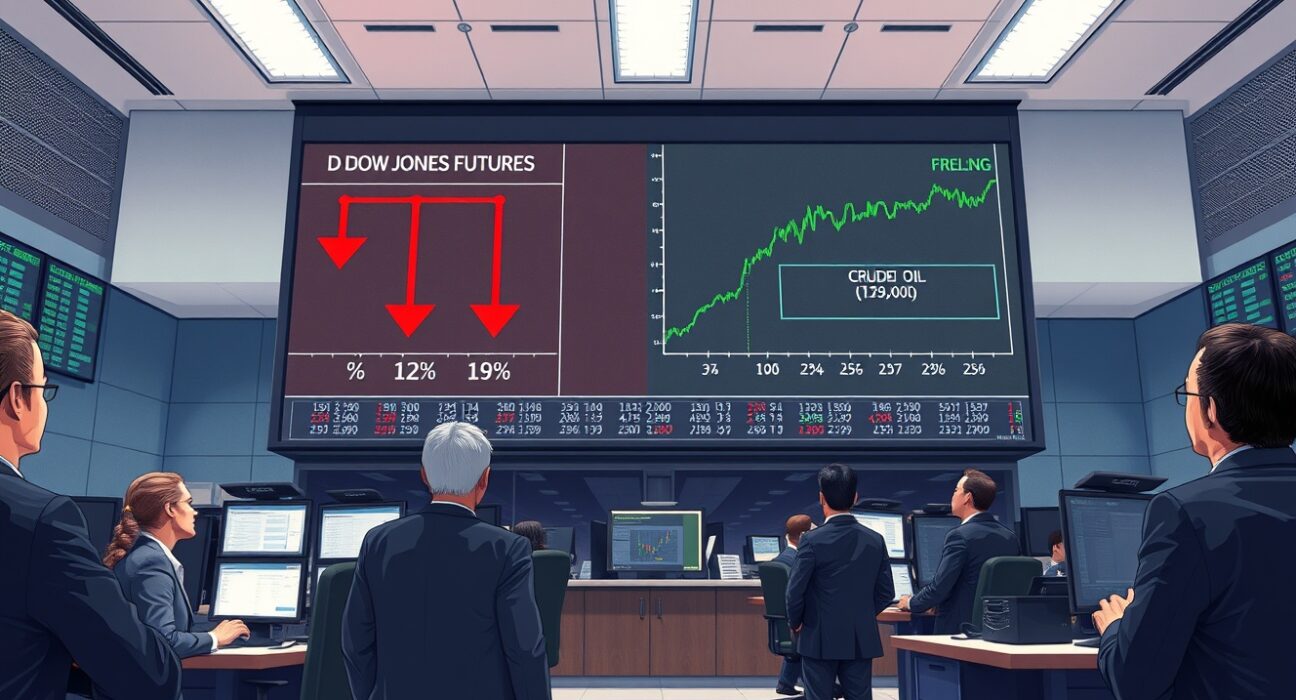
NEW YORK, March 2025 – Dow Jones Industrial Average futures opened sharply lower in overnight trading, extending a recent pattern of volatility directly tied to a significant surge in global crude oil benchmarks. This correlation highlights the persistent sensitivity of equity markets to energy costs, a key driver of inflation and corporate earnings expectations. Consequently, investors are closely monitoring the situation for potential impacts on the Federal Reserve’s monetary policy path.
Dow Jones Futures React to Energy Market Pressure
As of the latest data, Dow Jones futures contracts expiring in June 2025 traded down approximately 320 points, representing a decline of nearly 0.9%. This movement occurred simultaneously with Brent crude oil futures surpassing $92 per barrel, a multi-month high. The synchronous shift underscores a fundamental market relationship. Rising energy prices increase operational costs for a vast array of companies, from manufacturers to transportation firms. Therefore, analysts project potential margin compression across several S&P 500 sectors if the trend continues.
Historical data consistently shows an inverse relationship between sharp oil price spikes and broad market indices during periods of economic uncertainty. For instance, similar dynamics preceded market corrections in 2018 and 2022. Currently, the market’s reaction is amplified by existing concerns about stubborn core inflation readings. Market participants are now reassessing the timeline for potential interest rate cuts, which had been a primary bullish narrative for equities earlier in the year.
The Mechanics of Oil Price Inflation
The recent ascent in oil prices stems from a confluence of geopolitical and supply-side factors. Primary drivers include renewed production discipline among OPEC+ members and ongoing supply disruptions in key transit regions. Furthermore, stronger-than-expected demand data from emerging economies has tightened the global supply-demand balance. This combination creates upward pressure that transmits through the entire economy.
The transmission mechanism is straightforward yet powerful. Higher crude costs lead directly to increased prices for gasoline, diesel, and jet fuel. Subsequently, these increases raise transportation and logistics expenses for virtually all goods. This phenomenon, often called ‘cost-push inflation,’ erodes consumer purchasing power and can dampen economic growth. The following table illustrates the recent price trajectory:
| Commodity | Price (March 2025) | Change (Month-over-Month) |
|---|---|---|
| Brent Crude (per barrel) | $92.15 | +8.2% |
| WTI Crude (per barrel) | $88.70 | +7.8% |
| U.S. Regular Gasoline (per gallon) | $3.68 | +5.1% |
Expert Analysis on Market Correlations
Financial strategists emphasize the nuanced relationship between equities and oil. “While energy sector stocks may benefit from higher prices, the net effect on the broader Dow Jones is typically negative,” notes Dr. Anya Sharma, Chief Economist at the Global Markets Institute. “The input cost shock outweighs the sector-specific gains, particularly for industrials, consumer discretionary, and transportation companies that form the backbone of the index.” Her analysis points to rising breakeven levels for many businesses, potentially impacting future earnings guidance.
Additionally, fixed-income markets are reacting in tandem. Yields on the 10-year U.S. Treasury note have edged higher, reflecting expectations that the Federal Reserve may maintain a restrictive stance for longer to combat inflationary pressures reignited by energy. This shift in the interest rate outlook further pressures equity valuations, as future corporate cash flows are discounted at a higher rate. Consequently, growth-oriented technology stocks within the index are also facing headwinds.
Sector-by-Sector Impact and Investor Sentiment
The market decline is not uniform across all thirty Dow components. A clear divergence is emerging based on sector exposure. Companies with high energy consumption or extensive logistics networks are underperforming. Conversely, shares of major integrated oil companies are posting gains, providing some offset to the index’s downward move. This sector rotation indicates investors are actively repositioning portfolios to hedge against prolonged energy inflation.
Key factors investors are monitoring include:
- Consumer Spending Resilience: Higher fuel costs act as a tax on household budgets, potentially reducing discretionary spending.
- Corporate Guidance: Upcoming Q1 earnings reports will be scrutinized for mentions of energy cost pressures and margin forecasts.
- Federal Reserve Communication: Any shift in rhetoric acknowledging energy-driven inflation could alter market rate-cut expectations.
- Strategic Petroleum Reserve (SPR): Market speculation about potential U.S. government intervention to release reserves and cap prices.
Market volatility indices, such as the VIX, have risen in response to the uncertainty. This reflects increased demand for options protection among institutional investors. The current environment favors a selective, fundamentally-driven investment approach over broad index tracking.
Historical Context and Forward-Looking Scenarios
Examining past episodes provides a framework for potential outcomes. Historically, markets have absorbed oil shocks more effectively when they are driven by strong global demand rather than acute supply shortages. The present scenario appears to contain elements of both. Analysts are modeling several forward-looking scenarios based on the persistence of current price levels.
A sustained period above $90 per barrel could lead to a recalibration of full-year GDP growth estimates and corporate earnings projections. However, some economists argue that the transition to renewable energy and improved efficiency may have reduced the overall economy’s oil intensity compared to previous decades. This structural change might dampen the macroeconomic impact, though the short-term market reaction remains pronounced.
Conclusion
The decline in Dow Jones futures serves as a stark reminder of the equity market’s enduring sensitivity to energy prices. The direct link between oil prices and inflation expectations continues to be a primary driver of short-term volatility and longer-term monetary policy speculation. While sector rotations may offer some insulation, the broader index faces headwinds from rising input costs and shifting interest rate forecasts. Investors should prepare for continued volatility as the market digests energy market dynamics and their implications for corporate profitability and economic growth in 2025.
FAQs
Q1: Why do rising oil prices cause Dow Jones futures to fall?
A1: Rising oil prices increase operational and transportation costs for many companies, squeezing profit margins. They also fuel inflation concerns, which can lead to expectations of higher interest rates for longer. Both factors negatively impact future corporate earnings and equity valuations.
Q2: Which sectors within the Dow are most negatively affected by high oil prices?
A2: Industrials (e.g., Boeing, Caterpillar), transportation (e.g., United Parcel Service), consumer discretionary (e.g., Nike, Disney), and airlines are typically most vulnerable due to their direct exposure to fuel and logistics costs.
Q3: Could this drop in futures lead to a bear market?
A3: A single-day move in futures does not define a bear market. However, a sustained period of high oil prices that meaningfully slows economic growth and corporate earnings could contribute to a broader market downturn. Current conditions suggest elevated volatility rather than an imminent bear market.
Q4: How do oil prices influence the Federal Reserve’s decisions?
A4: The Fed monitors headline inflation, which includes energy prices. A persistent surge in oil costs can keep overall inflation elevated, potentially delaying planned interest rate cuts. This tightening of financial conditions is a key mechanism through which oil affects equities.
Q5: What should investors watch to gauge if this trend will continue?
A5: Key indicators include weekly U.S. crude inventory reports, OPEC+ production announcements, geopolitical developments in oil-producing regions, and monthly Consumer Price Index (CPI) reports to see how energy costs are translating into broader inflation.
Disclaimer: The information provided is not trading advice, Bitcoinworld.co.in holds no liability for any investments made based on the information provided on this page. We strongly recommend independent research and/or consultation with a qualified professional before making any investment decisions.