
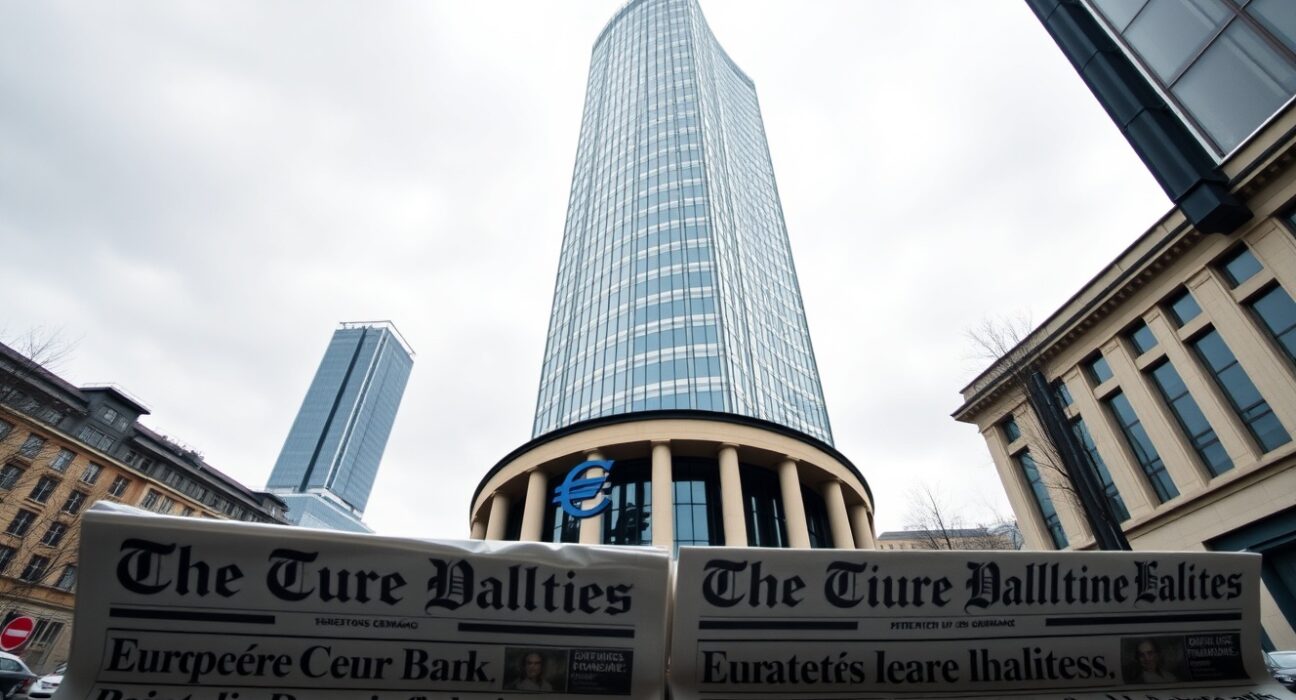
FRANKFURT, Germany — The European Central Bank maintained its key interest rates unchanged today, confronting mounting inflation pressures stemming from escalating Middle East tensions. Policymakers face a complex balancing act between persistent price stability concerns and fragile economic growth across the Eurozone. This decision arrives amid significant market volatility and geopolitical uncertainty that threatens to derail the region’s delicate recovery trajectory.
European Central Bank Maintains Cautious Stance on Rates
The ECB Governing Council kept its three main interest rates steady during today’s monetary policy meeting. Consequently, the deposit facility rate remains at 3.75%, while the main refinancing operations rate stays at 4.25%. Additionally, the marginal lending facility rate holds at 4.50%. This pause follows ten consecutive rate hikes between July 2022 and September 2023, representing the most aggressive tightening cycle in the institution’s history.
President Christine Lagarde emphasized data-dependent decision-making during her subsequent press conference. She specifically highlighted concerns about second-round inflation effects from energy markets. Furthermore, she noted persistent services inflation and elevated wage growth pressures across several member states. The ECB’s latest staff projections now indicate slightly higher inflation forecasts for 2025 compared to previous estimates.
Geopolitical Tensions Drive Inflation Concerns
Escalating conflict between Iran and Israel represents the primary external risk to Eurozone price stability. Specifically, the Strait of Hormuz serves as a critical chokepoint for global oil shipments. Approximately 20% of the world’s petroleum passes through this narrow waterway daily. Any disruption could trigger immediate energy price spikes across European markets.
Recent developments have already impacted commodity markets significantly. Brent crude futures have surged 18% over the past month. Meanwhile, European natural gas prices have increased 22% during the same period. These movements directly affect transportation costs, manufacturing inputs, and household energy bills throughout the continent.
| Commodity | Price Change (1 Month) | Impact on Eurozone Inflation |
|---|---|---|
| Brent Crude Oil | +18% | Direct 0.4-0.6% CPI increase |
| European Natural Gas | +22% | 0.3-0.5% CPI effect |
| Industrial Metals Index | +8% | Manufacturing cost pressures |
| Agricultural Commodities | +5% | Food price transmission |
Energy inflation represents just one transmission channel for geopolitical shocks. Supply chain disruptions also threaten to re-emerge as regional conflicts intensify. Shipping insurance premiums have doubled for vessels operating near conflict zones. Simultaneously, alternative transportation routes increase both costs and delivery times for European importers.
Expert Analysis on Monetary Policy Challenges
Former ECB Chief Economist Peter Praet described the current situation as “exceptionally challenging for policymakers.” He explained that central banks must distinguish between temporary supply shocks and persistent inflationary pressures. Praet emphasized that premature easing could anchor higher inflation expectations among businesses and consumers.
Conversely, Isabel Schnabel, current ECB Executive Board member, recently warned about overtightening risks. She noted that the Eurozone economy shows clear signs of weakening demand. Manufacturing PMI readings have remained below the expansion threshold for fourteen consecutive months. Moreover, consumer confidence indicators have deteriorated across major economies including Germany, France, and Italy.
Economic Impacts Across European Nations
The ECB’s monetary policy decision carries different implications across member states. Germany’s export-oriented economy faces particular vulnerability to energy price increases. The Bundesbank recently revised its 2025 growth forecast downward by 0.8 percentage points. Similarly, France confronts dual challenges of slowing domestic consumption and rising production costs.
Southern European nations experience additional complications from today’s decision. Italy’s debt-to-GDP ratio exceeds 140%, making borrowing costs particularly sensitive to rate movements. Spain’s tourism-dependent economy remains exposed to consumer spending reductions. Meanwhile, smaller economies like Portugal and Greece continue grappling with elevated unemployment rates despite recent improvements.
Key economic indicators demonstrate the policy environment’s complexity:
- Eurozone inflation: Currently at 3.2%, above the 2% target
- Core inflation: Remains elevated at 3.8%, excluding energy and food
- Quarterly GDP growth: Registered just 0.1% in Q4 2024
- Unemployment rate: Stable at 6.5% but showing early warning signs
- Business investment: Declined for three consecutive quarters
Market Reactions and Future Policy Expectations
Financial markets responded cautiously to the ECB’s announcement. The Euro initially strengthened against the US dollar before paring gains. European government bond yields exhibited mixed movements, reflecting uncertainty about future policy direction. Equity markets showed sector-specific reactions, with energy stocks outperforming while consumer discretionary shares declined.
Analysts now debate the timing of potential rate cuts. Money markets currently price approximately 50 basis points of easing by year-end. However, this expectation remains highly dependent on geopolitical developments. Any escalation in Middle East hostilities could delay monetary policy normalization indefinitely.
The ECB’s next policy meeting in June assumes critical importance. Updated economic projections will incorporate more complete data on conflict impacts. Additionally, second-quarter wage negotiations across major Eurozone economies will provide crucial information about domestic price pressures. The central bank maintains its commitment to bringing inflation back to target in a timely manner.
Conclusion
The European Central Bank’s decision to maintain current interest rates reflects extraordinary caution amid geopolitical uncertainty. Policymakers balance inflation risks from Middle East conflicts against weakening economic activity across the Eurozone. Future monetary policy decisions will depend heavily on conflict resolution and energy market stabilization. The ECB faces continued challenges in navigating between price stability and economic growth objectives throughout 2025.
FAQs
Q1: Why did the European Central Bank keep interest rates unchanged?
The ECB maintained rates due to conflicting pressures from geopolitical inflation risks and slowing economic growth. Policymakers require more data before determining their next policy move.
Q2: How does the Iran conflict affect European inflation?
The conflict threatens global oil supplies through the Strait of Hormuz, potentially increasing energy prices that directly impact European transportation, manufacturing, and household costs.
Q3: What are the main risks to the Eurozone economy?
Primary risks include persistent inflation from energy shocks, weakening consumer demand, manufacturing slowdowns, and divergent economic conditions across member states.
Q4: When might the ECB cut interest rates?
Most analysts expect potential rate cuts in late 2025, contingent on inflation returning toward the 2% target and geopolitical tensions easing.
Q5: How do different European countries experience this policy?
Germany faces export challenges from energy costs, southern Europe contends with high debt burdens, while all nations confront potential consumer spending reductions.
Disclaimer: The information provided is not trading advice, Bitcoinworld.co.in holds no liability for any investments made based on the information provided on this page. We strongly recommend independent research and/or consultation with a qualified professional before making any investment decisions.