
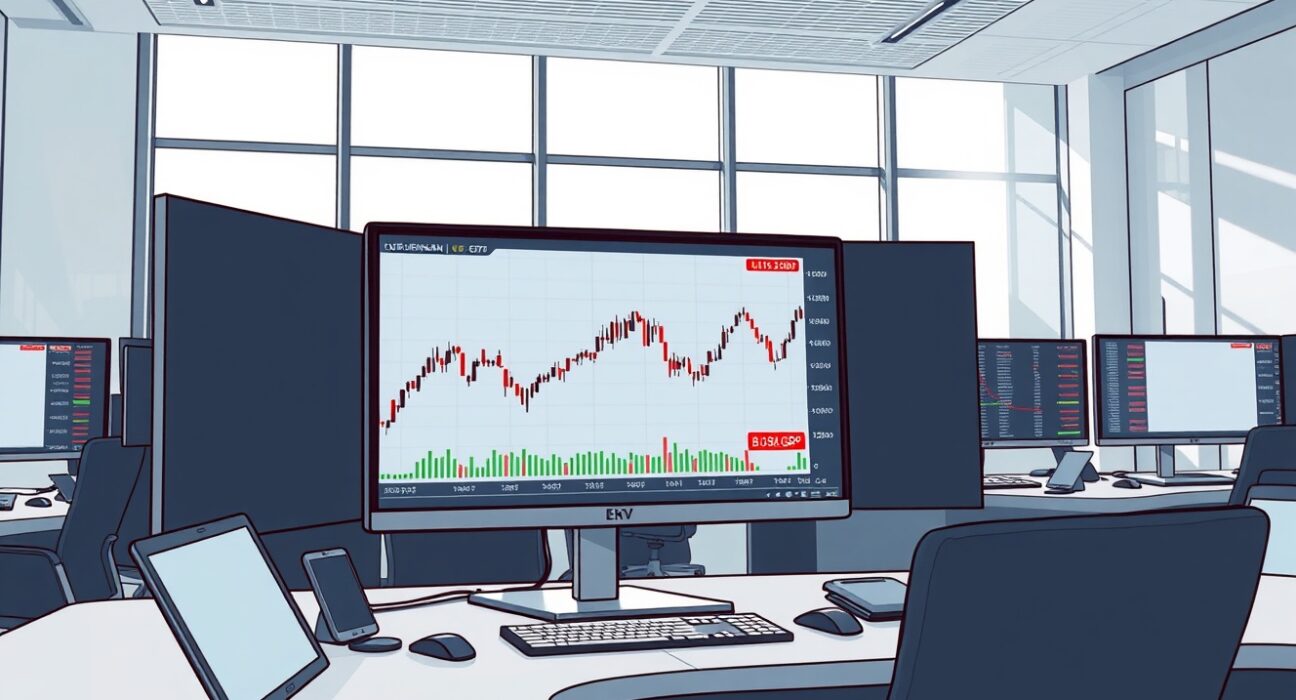
The EUR/GBP currency pair demonstrates notable resilience, stabilizing near the 0.8650 level as global financial markets adopt a defensive posture. This cautious stance directly responds to escalating geopolitical tensions in the Middle East, which are injecting significant volatility into traditional safe-haven flows. London and Frankfurt, March 18, 2025 – traders are meticulously reassessing risk exposure across major currency crosses. Consequently, the Euro and British Pound are experiencing constrained movement against each other, even as they face broader pressure from a strengthening US Dollar. This article provides a detailed analysis of the underlying market mechanics, historical precedents, and potential trajectories for the EUR/GBP cross.
EUR/GBP Technical Analysis and Current Market Position
The EUR/GBP pair’s consolidation around 0.8650 represents a critical technical juncture. Market analysts identify this zone as a confluence of several key factors. Firstly, it aligns with a 50-day moving average, a level closely watched by algorithmic trading systems. Secondly, it sits above a recent support cluster established in late February. The pair’s inability to break decisively lower, despite clear risk-off sentiment, suggests underlying support for the Euro relative to the Pound. However, the lack of upward momentum equally highlights the pervasive caution among market participants. Daily trading volumes have increased by approximately 15% this week, indicating heightened activity without a clear directional bias.
Several technical indicators currently paint a mixed picture for the EUR/GBP exchange rate:
- Relative Strength Index (RSI): Reading of 48, indicating neutral momentum.
- Bollinger Bands: Price action is hovering near the middle band, signaling consolidation.
- Key Resistance: Immediate ceiling seen at the 0.8680-0.8700 zone.
- Key Support: Firm floor established between 0.8620 and 0.8600.
Expert Insight on Forex Market Sentiment
Dr. Anya Sharma, Chief Currency Strategist at Global Macro Advisors, provides context for the current stalemate. “Forex markets are currently in a classic ‘wait-and-see’ mode,” she explains. “The Middle East situation creates a binary outcome risk that paralyzes directional bets. Traders are not selling EUR/GBP aggressively because the conflict also pressures the UK’s energy import outlook. Simultaneously, they are not buying it because the Eurozone’s geographic proximity to instability presents its own vulnerabilities. The result is this tight, technically-driven range.” This analysis underscores how geopolitical events can create offsetting pressures within specific currency pairs.
Geopolitical Context: Middle East Conflict and Market Mechanics
The current phase of Middle East tensions, which escalated sharply following incidents in the Strait of Hormuz last week, has a demonstrable historical impact on currency markets. Typically, such events trigger a flight to safety, benefiting the US Dollar (USD), Swiss Franc (CHF), and, to a lesser extent, the Japanese Yen (JPY). However, the EUR/GBP cross-correlation with these classic safe havens is often weak. The direct impact comes through two primary channels: energy prices and regional economic stability. Europe is a major importer of crude oil and natural gas, and price spikes can negatively affect the trade balance and inflation expectations for both the Eurozone and the UK.
The following table compares recent key drivers for the Euro and Pound:
| Factor | Impact on Euro (EUR) | Impact on Pound (GBP) |
|---|---|---|
| Middle East Energy Disruption Risk | Negative (High import dependency) | Negative (High import dependency) |
| Domestic Central Bank Policy Stance | Hawkish hold from ECB | Dovish tilt from BoE |
| Current Account Balance | Surplus (~2.1% of GDP) | Deficit (~-3.8% of GDP) |
| Relative Exposure to Regional Trade | Higher direct exposure | Lower direct exposure |
As the table illustrates, both currencies face headwinds from rising energy costs, creating a neutralizing effect on their exchange rate. Meanwhile, the European Central Bank’s marginally more hawkish rhetoric compared to the Bank of England provides a subtle undercurrent of support for the Euro. This policy divergence is a critical factor containing the pair’s downside.
Broader Market Impacts and Trader Positioning
Commitments of Traders (COT) reports from major exchanges reveal a distinct shift in positioning. Leveraged funds, often representative of hedge fund activity, have reduced their net long positions in EUR/GBP futures by nearly 30% over the past two weeks. This reduction clearly indicates a de-risking behavior. Conversely, asset managers, including pension funds and insurers, have shown modest increases in long-dated forward contracts, suggesting some institutions view the current dip as a strategic entry point for longer-term holdings. This dichotomy between short-term tactical traders and long-term strategic investors is a hallmark of markets navigating geopolitical uncertainty.
Furthermore, implied volatility for EUR/GBP options has spiked, particularly for contracts expiring in one to three months. This rise in the “fear gauge” for the pair shows that while the spot price is steady, the market is pricing in a higher probability of significant future moves. Traders are paying higher premiums for options that protect against both a sharp rally and a sudden decline, a strategy known as a “straddle.” This activity financially embodies the market’s prevailing caution and expectation of a volatile breakout once the geopolitical fog clears.
The Role of Intermarket Analysis
Understanding EUR/GBP requires looking beyond the direct pair. The correlation between Brent Crude prices and the pair has turned positive in recent days, a deviation from its sometimes-inverse relationship. Typically, higher oil prices hurt the Eurozone’s terms of trade. However, because the UK is also a net energy importer, the pain is shared. Currently, the market appears to be judging that sustained high oil prices could force a more aggressive monetary response from the ECB than the BoE, given the Eurozone’s greater sensitivity to energy-driven inflation. This complex intermarket dynamic is a key reason for the pair’s stability.
Historical Precedents and Potential Scenarios
Historical analysis provides a framework for potential outcomes. During similar periods of Middle East tension in 2019 and 2020, the EUR/GBP pair exhibited initial stability followed by a decisive move once a clearer path emerged. The direction of that move was largely determined by the relative monetary policy paths and economic data resilience of the two blocs in the weeks following the crisis peak. For instance, if the conflict disrupts supply chains affecting German manufacturing more severely than UK services, the Pound could gain an edge. Conversely, if the crisis leads to a sustained surge in natural gas prices that overwhelms the UK’s current account, the Euro may find stronger footing.
Market participants are currently modeling three primary scenarios:
- De-escalation Scenario: A rapid diplomatic resolution leads to a relief rally in risk assets. EUR/GBP could then trend higher towards 0.8750 as focus returns to the ECB’s hawkish stance versus the BoE’s caution.
- Status Quo Scenario: Persistent, contained tensions maintain the current risk-off, range-bound environment. The pair likely continues trading between 0.8600 and 0.8700, driven by micro-data releases and technical flows.
- Escalation Scenario: A significant broadening of the conflict triggers a violent flight to safety. While both currencies would likely fall against the USD, the EUR could underperform GBP if the Eurozone’s immediate economic exposure is perceived as greater, potentially testing the 0.8550 support level.
Conclusion
The EUR/GBP exchange rate’s steadiness near 0.8650 is a direct manifestation of calculated trader caution in the face of Middle East conflict. This equilibrium results from offsetting fundamental forces: shared energy vulnerability, nuanced central bank policy divergence, and balanced technical positioning. The market’s current behavior, characterized by elevated volatility pricing and reduced speculative bets, indicates a preparedness for a significant move once the geopolitical picture clarifies. Ultimately, the trajectory of the EUR/GBP pair will be determined not by the conflict alone, but by the relative economic resilience and policy responses of the Eurozone and United Kingdom in its aftermath. For now, stability reflects not calm, but a tense and watchful balance.
FAQs
Q1: Why is the EUR/GBP pair steady when there is a geopolitical crisis?
It is steady because the crisis creates opposing pressures on both currencies. Both the Eurozone and UK are major energy importers, so rising oil prices hurt both economies somewhat equally, neutralizing a key driver of divergence. This creates a temporary balance.
Q2: How does Middle East conflict typically affect the Euro and Pound?
Typically, it pressures both currencies against traditional safe havens like the US Dollar. The direct impact comes through higher energy import costs, which can worsen trade balances and inflation. The relative performance depends on which economy is seen as more vulnerable to these specific shocks.
Q3: What key level are traders watching for EUR/GBP?
Traders are closely watching the 0.8600 support level and the 0.8700 resistance level. A sustained break below 0.8600 could signal a bearish shift, potentially targeting 0.8550. A clear break above 0.8700 could open a path toward 0.8750, especially if geopolitical fears ease.
Q4: What is the main difference between ECB and BoE policy affecting the pair?
The European Central Bank (ECB) has maintained a slightly more hawkish, inflation-focused rhetoric, suggesting less urgency to cut rates. The Bank of England (BoE) has signaled greater concern about economic growth, leading markets to price in slightly earlier rate cuts. This difference provides underlying support for the Euro against the Pound.
Q5: What would cause the EUR/GBP to break out of its current range?
A decisive breakout would likely require a clear change in the geopolitical situation (either escalation or de-escalation) or a major divergence in economic data from the Eurozone and UK that alters interest rate expectations. Until then, range-bound trading driven by technical factors is the most probable outcome.
Disclaimer: The information provided is not trading advice, Bitcoinworld.co.in holds no liability for any investments made based on the information provided on this page. We strongly recommend independent research and/or consultation with a qualified professional before making any investment decisions.