

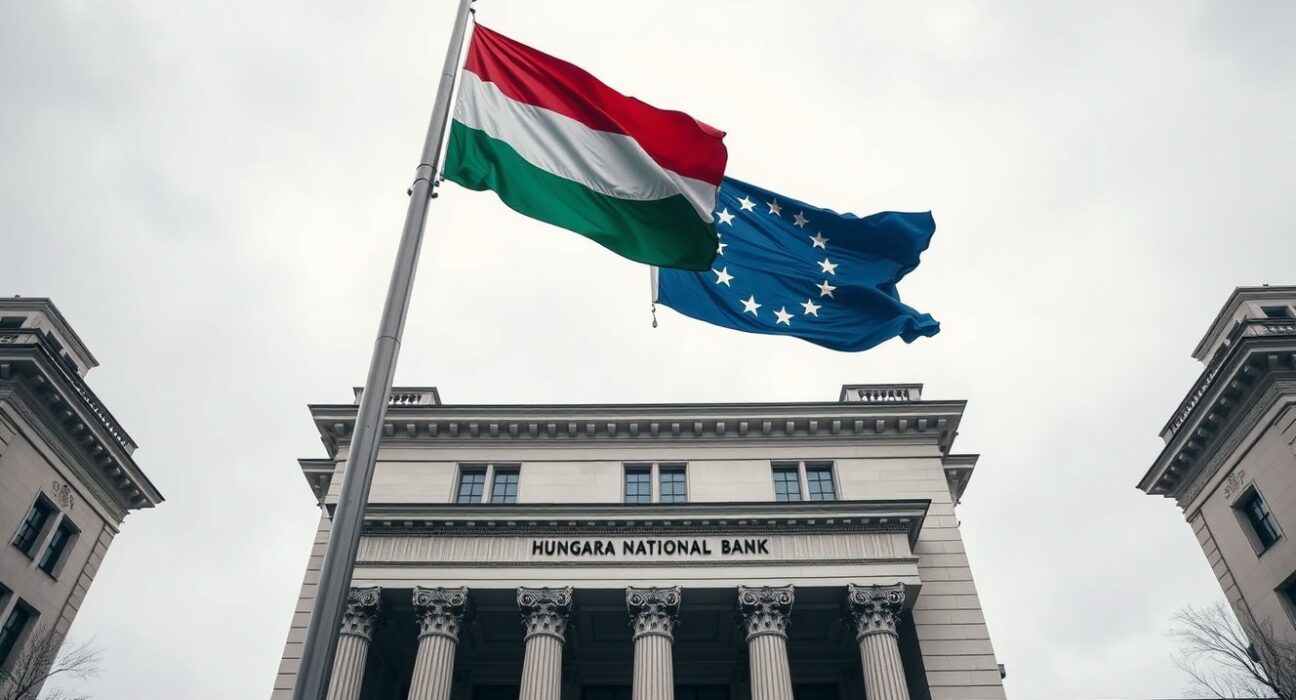
The Hungarian National Bank (MNB) has decided to hold its key interest rate steady, a move that comes amid escalating geopolitical risks in the region. This decision, analyzed by ING, directly impacts the EUR/HUF exchange rate and the broader Hungarian economy. Investors and forex traders now seek clarity on the forint’s future trajectory.
MNB Holds Rates: A Detailed Look at the Decision
The MNB’s Monetary Council voted to maintain the base rate at its current level. This decision reflects a careful balancing act. On one hand, the central bank aims to control persistent inflationary pressures. On the other hand, it must support economic growth in a challenging external environment. Geopolitical risks, particularly the ongoing conflict in neighboring Ukraine and tensions in the Middle East, heavily influence this decision.
ING analysts point out that the MNB is prioritizing stability. The central bank fears that a rate cut could weaken the forint further. Conversely, a rate hike might stifle an already slowing economy. Therefore, the “hold” position represents a cautious middle ground.
The Role of Geopolitical Risks in the MNB’s Decision
Geopolitical uncertainty directly impacts investor sentiment toward emerging markets like Hungary. When risks rise, investors often flee to safe-haven currencies. This capital outflow puts downward pressure on the Hungarian forint. The MNB’s decision to hold rates aims to mitigate this pressure by keeping real interest rates relatively attractive.
ING’s report emphasizes that the forint remains highly sensitive to external shocks. Any escalation in regional conflicts could trigger a sharp depreciation. Consequently, the MNB must remain vigilant and prepared to intervene if necessary.
EUR/HUF Exchange Rate: Current Dynamics and Forecast
The EUR/HUF pair currently trades near key psychological levels. The MNB’s rate hold provides some support, but the upside remains capped by the risk-off sentiment. ING forecasts that the pair will likely remain range-bound in the near term. However, a break above resistance could occur if geopolitical tensions escalate further.
Key factors influencing the EUR/HUF rate include:
- European Union fund disbursements: Hungary’s access to EU recovery funds remains a critical factor. Delays in these payments weaken the forint.
- Inflation data: Headline inflation in Hungary has eased but remains above the MNB’s target range. Core inflation persists, limiting the central bank’s flexibility.
- Global risk appetite: The forint is a risk-sensitive currency. A deterioration in global risk sentiment directly pressures the EUR/HUF rate.
ING’s Expert Analysis on the Forint’s Path
ING’s currency strategists provide a nuanced view. They argue that the MNB’s current stance is appropriate but not sufficient to drive sustained forint strength. The central bank needs a clear catalyst, such as a concrete EU funding deal, to change the narrative.
“The MNB is in a holding pattern,” an ING analyst explains. “They are waiting for external conditions to improve before signaling any policy shift. This leaves the forint vulnerable to sudden shocks.”
The analysis also highlights that the Hungarian economy faces structural challenges. High fiscal deficits and external debt levels make the country more susceptible to external shocks than its regional peers.
Broader Implications for the Hungarian Economy
The MNB’s rate decision has significant implications beyond the forex market. A stable or appreciating forint helps to lower import costs. This benefits consumers and businesses that rely on imported goods and raw materials. Conversely, a weak forint fuels inflation by making imports more expensive.
Key economic indicators to watch include:
- GDP growth: Hungary’s economy is slowing. High interest rates and weak external demand are taking a toll.
- Inflation: The MNB targets inflation of 3% with a tolerance band of +/- 1 percentage point. Current inflation is above this target.
- Trade balance: Hungary runs a trade surplus, which provides some buffer against external shocks.
Comparing Hungary with Regional Peers
Hungary’s monetary policy stance is broadly in line with other central banks in Central and Eastern Europe (CEE). The Czech National Bank (CNB) has also held rates steady. The National Bank of Poland (NBP) is similarly cautious. This regional alignment suggests that the MNB is not acting in isolation.
However, Hungary faces unique challenges. Its strained relationship with the European Union over rule-of-law issues has delayed access to billions of euros in funding. This political risk adds an extra layer of uncertainty for the forint.
Timeline of Key Events Impacting EUR/HUF
A chronological view of recent events helps to contextualize the current situation:
| Date | Event | Impact on EUR/HUF |
|---|---|---|
| October 2023 | MNB cuts rates by 75 bps | Forint weakens sharply |
| December 2023 | EU blocks funds over rule-of-law concerns | Forint hits new lows |
| March 2024 | MNB pauses rate cuts | Forint stabilizes |
| June 2024 | Geopolitical tensions escalate in Ukraine | Forint comes under pressure |
| Current | MNB holds rates | Forint remains range-bound |
Conclusion
The MNB’s decision to hold rates underscores the delicate balance the central bank must maintain. EUR/HUF remains under the influence of geopolitical risks and domestic economic fundamentals. ING’s analysis provides a clear framework for understanding these dynamics. For investors and traders, staying informed about EU fund negotiations and regional security developments is crucial. The forint’s path forward depends on a resolution of these external factors. Until then, the MNB will likely continue its cautious approach, prioritizing stability over aggressive policy moves.
FAQs
Q1: Why did the MNB decide to hold interest rates?
The MNB held rates due to persistent inflation risks and high geopolitical uncertainty. A rate cut could weaken the forint, while a hike might slow economic growth. Holding rates maintains stability.
Q2: How do geopolitical risks affect the EUR/HUF exchange rate?
Geopolitical risks, such as the war in Ukraine, reduce investor appetite for emerging market assets. This leads to capital outflows from Hungary, weakening the forint against the euro.
Q3: What is ING’s forecast for the Hungarian forint?
ING forecasts the forint will remain range-bound in the near term. A clear catalyst, such as an EU funding deal, is needed for sustained forint appreciation.
Q4: How does the MNB’s decision compare with other central banks in the region?
The MNB’s cautious stance is similar to the Czech National Bank and the National Bank of Poland. All three central banks are prioritizing stability amid global uncertainty.
Q5: What key factors should investors watch for the EUR/HUF pair?
Investors should monitor EU fund disbursements, Hungarian inflation data, global risk sentiment, and any escalation in regional geopolitical tensions.
Disclaimer: The information provided is not trading advice, Bitcoinworld.co.in holds no liability for any investments made based on the information provided on this page. We strongly recommend independent research and/or consultation with a qualified professional before making any investment decisions.
