

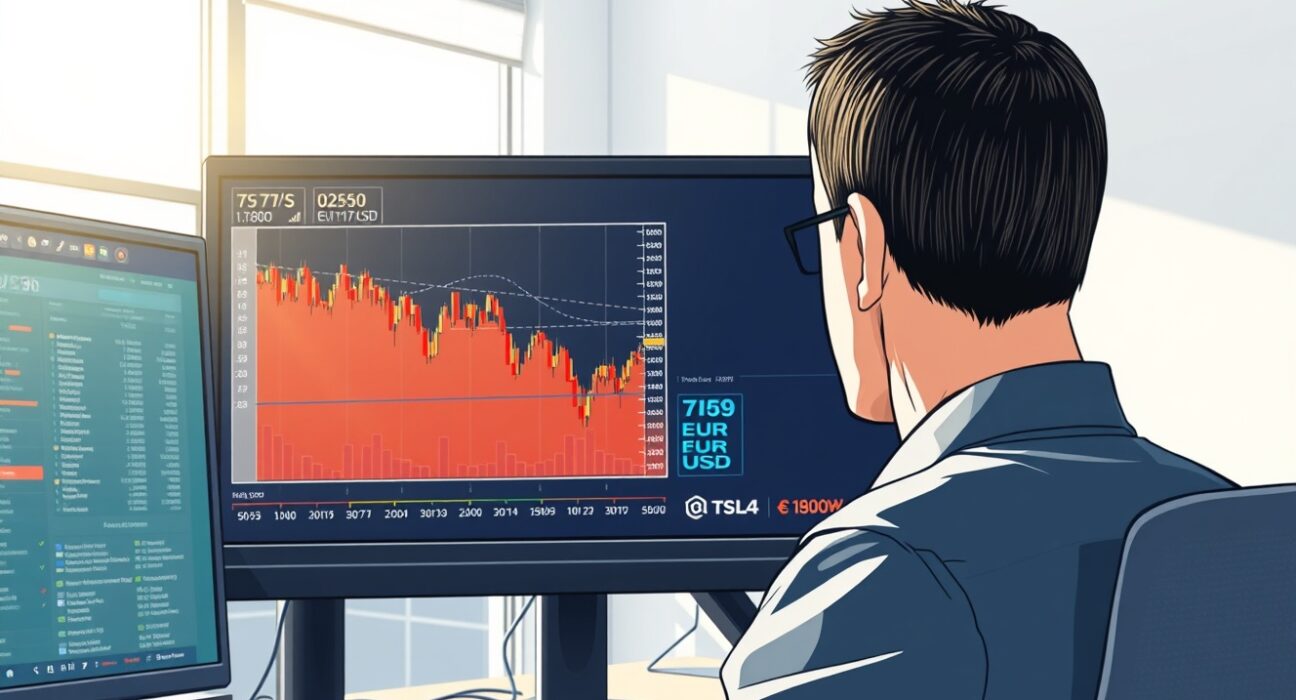
LONDON, January 15, 2025 – The EUR/USD currency pair experienced significant downward pressure during Wednesday’s trading session, decisively breaking below the psychologically important 1.1800 level. Market analysts primarily attribute this movement to renewed geopolitical uncertainty surrounding ceasefire negotiations between Iran and international stakeholders. Consequently, traders shifted toward traditional safe-haven assets, applying sustained selling pressure on the euro.
EUR/USD Technical Breakdown and Market Reaction
The EUR/USD pair opened the European session near 1.1825 before encountering persistent selling. Subsequently, it breached multiple technical support levels throughout the morning. Market data from major trading platforms shows the pair touching a daily low of 1.1783, representing its weakest position in over two weeks. Trading volume spiked approximately 35% above the 30-day average, indicating strong institutional participation in the move.
Forex analysts immediately identified several key factors driving the sell-off:
- Risk-Off Sentiment: Uncertainty triggered a classic flight to safety.
- Dollar Strength: The U.S. dollar index (DXY) rallied 0.4%.
- Yield Differentials: U.S. Treasury yields rose relative to German Bunds.
- Options Activity: Increased demand for euro put options below 1.1800.
Technical charts reveal the 1.1800 level previously acted as both support and resistance multiple times throughout late 2024. A sustained break below this handle often signals further bearish momentum. Meanwhile, the 50-day moving average at 1.1840 now serves as immediate resistance.
Geopolitical Context: The Iran Ceasefire Impasse
The immediate catalyst stems from conflicting reports emerging from Vienna, where indirect negotiations regarding a renewed nuclear accord and regional ceasefire have stalled. Early Tuesday, diplomatic sources suggested a tentative agreement was imminent. However, by Wednesday morning, officials from a major European power cited “unresolved fundamental issues” regarding verification protocols.
This geopolitical development carries significant implications for global energy markets and European security. Iran’s oil exports directly influence global crude prices, which subsequently affect inflation expectations and central bank policies. The European Union, as a key diplomatic participant and regional neighbor, faces direct economic exposure to instability in the Persian Gulf.
A timeline of recent events clarifies the situation’s rapid evolution:
| Date | Event | Market Impact |
|---|---|---|
| Jan 10 | Reports of constructive talks surface | EUR/USD gains 0.3% |
| Jan 13 | Parties announce “final round” of negotiations | Markets price in resolution |
| Jan 14 (Late) | Leaked draft shows disagreements | Asian session sees early euro selling |
| Jan 15 (AM) | Official confirms impasse | Break below 1.1800 accelerates |
Energy analysts note that a failed agreement could reverse recent declines in European natural gas prices. Europe still relies on stable global energy flows, and renewed sanctions on Iranian exports would tighten supply.
Expert Analysis on Currency Correlations
Dr. Anya Sharma, Chief Strategist at Global Forex Advisors, provided context during a Bloomberg interview. “The euro often functions as a proxy for regional geopolitical stability within its sphere of influence,” Sharma explained. “Today’s price action demonstrates this correlation clearly. Traders are not just pricing the direct economic impact but also the increased risk premium for European assets.”
Sharma further highlighted the differential impact on monetary policy expectations. “The European Central Bank remains more sensitive to energy-driven inflation than the Federal Reserve. Therefore, renewed energy price volatility complicates the ECB’s projected rate path more than the Fed’s, creating a relative policy divergence that weighs on EUR/USD.”
Historical data supports this analysis. During previous periods of Middle East tension in 2023, the euro underperformed the dollar by an average of 1.8% over the following month. Meanwhile, the correlation between oil price volatility and EUR/USD movements has strengthened significantly over the past year.
Broader Market Impacts and Sector Performance
The currency move triggered cascading effects across global financial markets. European equity indices traded lower, with the Euro Stoxx 50 falling 0.9%. Sectors most exposed to energy costs and international trade underperformed. Conversely, European government bond yields edged lower as some capital sought safety within the region.
In commodity markets, Brent crude oil futures initially jumped 2.1% on the news before paring gains. Gold, another traditional safe haven, rallied to a one-week high. This collective market movement confirms a broad-based reassessment of geopolitical risk among institutional investors.
Foreign exchange reserves managers also face decisions. Several central banks in Asia and the Middle East hold significant euro reserves. Prolonged weakness may prompt portfolio rebalancing, adding further technical pressure on the currency pair.
Technical Outlook and Trader Positioning
According to Commitment of Traders (COT) reports released last Friday, speculative net long positions on the euro had reached a four-month high before this week’s developments. This crowded positioning created conditions for a sharp reversal when the news catalyst emerged. Many leveraged funds were likely forced to exit long positions, exacerbating the downward move.
Looking ahead, technical analysts identify the next major support zone between 1.1750 and 1.1765, which aligns with the late-December 2024 lows and the 100-day moving average. A break below this zone could open a path toward 1.1700. On the upside, any recovery must reclaim the 1.1820 level to neutralize the immediate bearish bias.
Implied volatility in euro options has increased markedly, reflecting trader expectations for continued price swings. The one-week volatility gauge rose to its highest level since November 2024.
Conclusion
The EUR/USD decline below 1.1800 underscores the profound sensitivity of currency markets to geopolitical developments. The uncertainty surrounding the Iran ceasefire negotiations has acted as a potent catalyst, shifting risk sentiment and driving capital flows. While technical factors and prior positioning amplified the move, the core driver remains the reassessment of regional stability and its implications for European economic prospects. Market participants will now closely monitor diplomatic channels and energy prices, as these factors will likely dictate the currency pair’s direction in the coming sessions. The breach of 1.1800 represents a significant technical and psychological development for the EUR/USD, setting the stage for heightened volatility as the geopolitical situation evolves.
FAQs
Q1: Why does Iran ceasefire news affect the EUR/USD exchange rate?
The euro is sensitive to geopolitical stability in its neighboring regions. Uncertainty can increase the risk premium for European assets, trigger safe-haven flows into the U.S. dollar, and impact energy prices that influence European inflation and ECB policy.
Q2: What is the significance of the 1.1800 level for EUR/USD?
The 1.1800 level is a major psychological and technical benchmark. It has repeatedly served as both strong support and resistance. A sustained break below it often signals a bearish shift in market structure and can trigger automated selling.
Q3: How might this impact the European Central Bank’s policy?
Increased geopolitical risk and potential energy market volatility complicate the inflation outlook. This could make the ECB more cautious about signaling future rate cuts, but it also highlights downside growth risks, creating a policy dilemma.
Q4: Are other currency pairs affected by this development?
Yes. Safe-haven flows typically strengthen the U.S. dollar, Swiss franc, and Japanese yen broadly. Pairs like GBP/USD and AUD/USD often move in correlation with EUR/USD during risk-off events, though the magnitude varies.
Q5: What should traders watch next regarding this situation?
Traders should monitor official statements from negotiating capitals, updates from the International Atomic Energy Agency (IAEA), oil price movements, and any shifts in U.S. diplomatic rhetoric. Technical levels around 1.1750 will also be critical for near-term direction.
Disclaimer: The information provided is not trading advice, Bitcoinworld.co.in holds no liability for any investments made based on the information provided on this page. We strongly recommend independent research and/or consultation with a qualified professional before making any investment decisions.
