
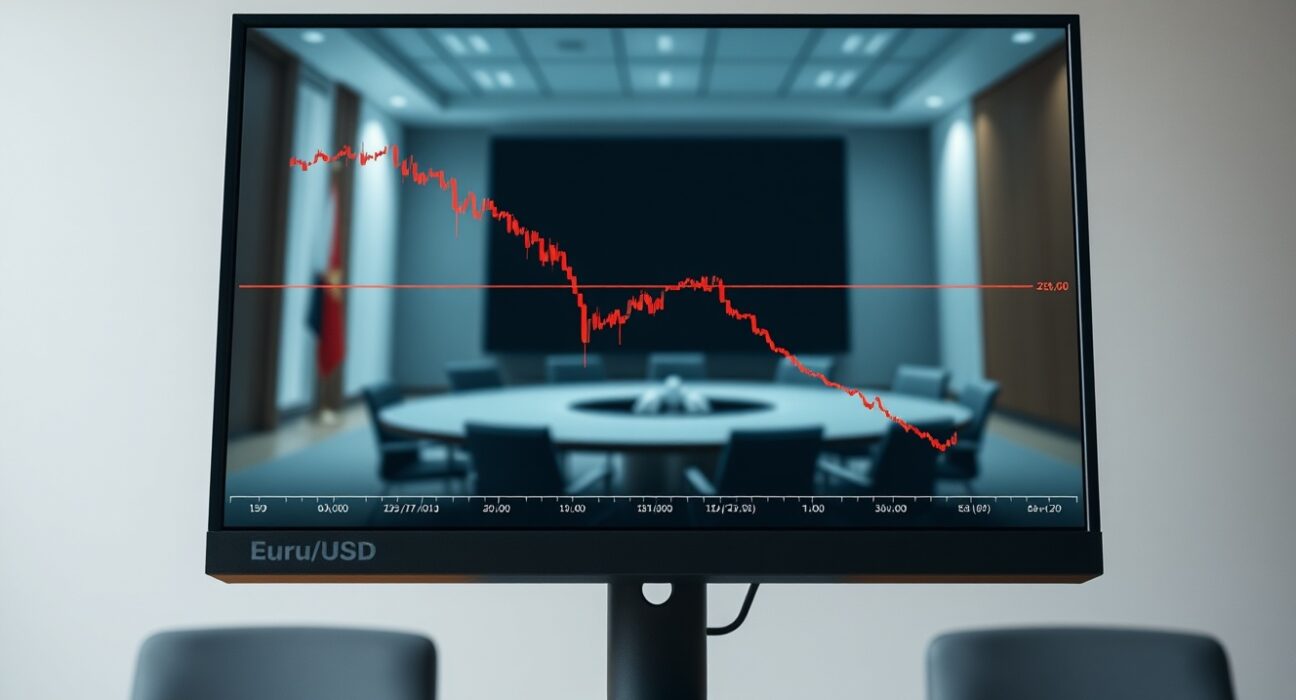
LONDON, March 12, 2025 – The EUR/USD currency pair experienced a significant retreat in Wednesday’s trading session, dropping to a key technical level of 1.1685. This movement reflects growing market apprehension surrounding the stability of the Iran nuclear peace process. Consequently, traders are rapidly reassessing risk across major financial markets.
EUR/USD Retreats on Geopolitical Headwinds
The Euro lost ground against the US Dollar throughout the Asian and European sessions. Market analysts immediately linked the sell-off to emerging reports from Vienna. Diplomatic sources indicated new hurdles in the ongoing JCPOA review talks. These developments triggered a classic flight to safety among institutional investors.
Furthermore, the US Dollar Index (DXY) strengthened by 0.4% concurrently. This inverse correlation highlights the Dollar’s enduring role as a primary safe-haven asset. The price action saw the EUR/USD break below several short-term moving averages. Key support levels at 1.1720 and 1.1700 offered little resistance during the decline.

Technical Breakdown of the Move
A swift analysis of the price chart reveals critical details. The pair failed to sustain momentum above the 1.1750 psychological barrier earlier this week. Selling pressure accelerated following a bearish engulfing candlestick pattern on the 4-hour chart. Market sentiment data from the CFTC also showed Euro longs were at extended levels, increasing vulnerability to a correction.
Iran Peace Process Faces Mounting Uncertainty
The core catalyst for this forex volatility stems from geopolitics. Negotiations aimed at reviving the 2015 nuclear accord have encountered fresh obstacles. European mediators reportedly expressed frustration over Iran’s latest demands concerning sanctions relief and verification protocols. This stalemate introduces substantial uncertainty into global energy markets.
Oil prices reacted with immediate volatility. Brent crude futures initially spiked before paring gains. The market’s confused response underscores the complex implications. A failed process could lead to renewed tensions and potential supply disruptions. Conversely, a sudden breakthrough would likely depress oil prices and alter inflation expectations globally.
- Sanctions Timeline: Key waivers for Iranian oil imports are set for review next month.
- Regional Stability: Gulf Cooperation Council (GCC) states have voiced concerns about the agreement’s scope.
- US Congress: Legislative hurdles remain for any presidential administration to rejoin the pact fully.
Expert Analysis on Market Linkages
Dr. Anya Petrova, Head of Geopolitical Strategy at Global Macro Advisors, provided context. “Currency markets are acting as a real-time barometer for diplomatic risk,” she explained. “The EUR/USD is particularly sensitive because the Eurozone has more immediate economic exposure to Middle Eastern stability through energy imports and trade corridors.” Petrova’s research indicates a 0.8% average swing in the pair for every major headline shift in the Iran talks since 2023.
Broader Impacts on European and Global Economics
The implications of a weaker Euro are multifaceted for the European economy. A depreciated currency typically boosts export competitiveness. However, in this context, the cause is negative risk sentiment, not positive growth dynamics. The European Central Bank (ECB) faces a complicated scenario. Rising energy import costs due to geopolitical risk could feed into persistent inflation, potentially delaying rate cuts.
Comparative Table: Market Reactions to Iran Diplomacy (2023-2025)
| Event | EUR/USD Reaction | Brent Crude Reaction | Key Driver |
|---|---|---|---|
| Interim Deal (June 2023) | +1.2% | -3.5% | Supply Expectations |
| Inspection Dispute (Nov 2024) | -0.7% | +2.1% | Verification Risk |
| Current Stalemate (Mar 2025) | -0.9% | Volatile | Process Doubt |
Meanwhile, the US Federal Reserve’s policy path remains a dominant background factor. Strong US economic data has supported the Dollar broadly. This creates a dual headwind for the Euro, pressured by both domestic ECB caution and external geopolitical shocks. The current situation tests the resilience of the Eurozone’s economic recovery framework.
Historical Context and Forward-Looking Scenarios
Historical data reveals a persistent correlation between Middle Eastern geopolitical stress and Euro weakness. The 2018 withdrawal of the US from the JCPOA saw the EUR/USD fall over 5% in the subsequent quarter. Markets are now pricing in a spectrum of outcomes. The base case appears to be a prolonged negotiation period, maintaining a risk premium in oil and supporting the Dollar.
Several forward-looking scenarios are now on analysts’ radars:
- Breakdown Scenario: A complete collapse of talks likely propels the Dollar higher and pressures global equities.
- Breakthrough Scenario: A surprise agreement could trigger a rapid Euro rebound and a sell-off in oil markets.
- Delay Scenario: Extended negotiations maintain current volatility ranges, with data-driven Fed policy becoming the primary EUR/USD driver.
Market participants will closely monitor statements from the International Atomic Energy Agency (IAEA). Additionally, positioning data from futures markets will indicate whether the current Euro sell-off has further room to run. The 1.1650 level is now viewed as the next critical support zone for the EUR/USD pair.
Conclusion
The EUR/USD retreat to 1.1685 serves as a clear example of modern financial market interconnectedness. Geopolitical events, particularly surrounding Iran’s peace process, directly translate into currency market volatility. This move underscores the Euro’s vulnerability to external risk shocks despite improving regional fundamentals. Traders and policymakers alike must now navigate an environment where diplomatic headlines carry immediate economic consequences. The path of the EUR/USD will remain tethered to developments in Vienna, demonstrating that in today’s markets, politics and finance are inextricably linked.
FAQs
Q1: Why does the Iran peace process affect the EUR/USD exchange rate?
The process directly impacts global oil prices and regional stability. Europe is highly dependent on energy imports, and uncertainty threatens economic forecasts, weakening the Euro as investors seek the safer US Dollar.
Q2: What is the key support level for EUR/USD following this drop?
Technical analysts identify the 1.1650 level as the next major support zone. A break below this could signal a deeper correction towards 1.1600.
Q3: How does a weaker Euro affect the European economy?
It can boost exports by making them cheaper for foreign buyers. However, if caused by geopolitical risk, it also increases the cost of essential energy imports, potentially worsening inflation.
Q4: What role does the US Federal Reserve play in this situation?
The Fed’s interest rate policy is a primary driver of the US Dollar’s strength. A “higher for longer” rate stance in the US amplifies the Dollar’s appeal during times of global uncertainty, adding downward pressure on EUR/USD.
Q5: What should traders watch next regarding this issue?
Traders should monitor official statements from the IAEA, diplomatic communiques from Vienna, and weekly CFTC positioning data to gauge market sentiment and potential for further Euro weakness or a rebound.
Disclaimer: The information provided is not trading advice, Bitcoinworld.co.in holds no liability for any investments made based on the information provided on this page. We strongly recommend independent research and/or consultation with a qualified professional before making any investment decisions.