

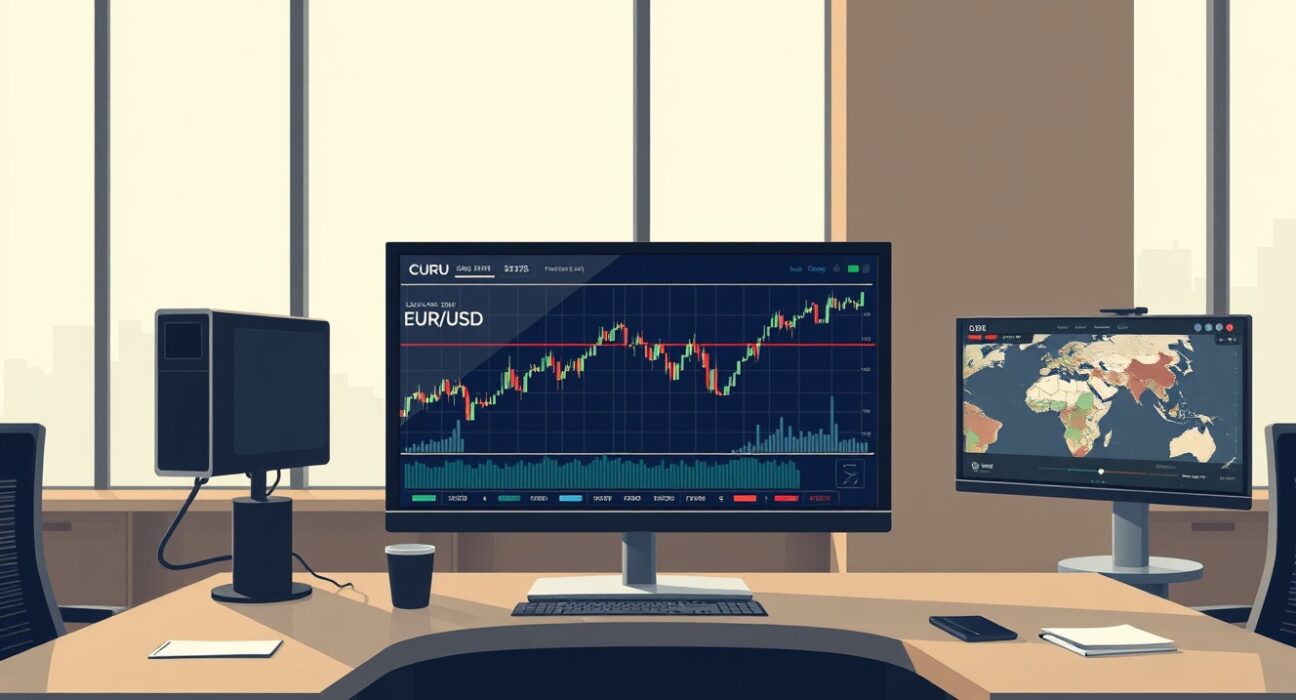
LONDON, March 2025 – The EUR/USD currency pair registered a slight uptick in early trading sessions, a subtle move that nonetheless underscores the profound caution gripping global financial markets. This measured rise occurs against a backdrop of escalating military conflict between the United States and Iran, a geopolitical flashpoint that continues to inject significant volatility and uncertainty into investor sentiment worldwide. Consequently, traders are parsing every data point and headline, balancing traditional economic fundamentals against the unpredictable currents of war.
EUR/USD Movement Amidst Geopolitical Turmoil
The EUR/USD pair, often considered the world’s most liquid financial instrument, serves as a critical barometer for global risk appetite. Its recent price action reveals a market in a delicate balancing act. On one hand, the euro has found marginal support from its perceived role as a potential safe-haven alternative to the US dollar during periods of America-centric geopolitical stress. Conversely, the US dollar’s status as the world’s primary reserve currency provides underlying strength, creating a tense equilibrium. This dynamic results in the pair’s characteristic ‘cautious rise,’ where gains are incremental and easily reversed by fresh headlines from the conflict zone.
Market analysts point to several immediate technical and fundamental factors driving this cautious sentiment. Firstly, energy prices, particularly crude oil, remain highly sensitive to disruptions in the Strait of Hormuz. Secondly, central bank policies are now under intense scrutiny, with expectations for interest rate trajectories being recalibrated daily based on war-related inflationary pressures. Finally, capital flows are shifting subtly, with some institutional investors diversifying away from pure dollar assets, albeit in a limited and risk-managed fashion.
Historical Context and Market Psychology
Understanding the current market behavior requires a glance at historical precedents. Geopolitical events typically trigger a ‘flight to safety,’ where capital rushes into assets like the US Treasury bonds, the Swiss franc, and gold. However, the unique nature of the US-Iran conflict, where the US is a direct belligerent, complicates this pattern. Historically, when the US is involved in a major military engagement, the dollar can experience short-term weakness due to concerns over fiscal spending and geopolitical overreach, before ultimately strengthening on its safe-haven status.
The current psychology is one of ‘wait-and-see.’ For instance, algorithmic trading systems are being dialed back for higher volatility settings, while human traders are demanding wider bid-ask spreads to compensate for increased headline risk. This collective caution manifests in lower trading volumes for speculative positions and a higher premium for options that protect against sudden, sharp currency moves.
Expert Analysis on Currency Correlations
Senior strategists from major investment banks emphasize the breakdown of traditional correlations. Typically, the EUR/USD has an inverse relationship with global risk aversion. However, in this scenario, both currencies are seeing nuanced flows. “We are observing a bifurcation in dollar demand,” notes a lead forex strategist at a European bank, whose analysis is frequently cited by financial institutions. “There is strong demand for dollar liquidity from corporations and banks managing global operations, which is supportive. Yet, there is simultaneous selling pressure from sovereign wealth funds and central banks lightly rebalancing reserves, which provides a ceiling.” This expert viewpoint highlights the complex, multi-layered forces currently acting on the pair.
Furthermore, the European Central Bank’s (ECB) communication strategy has become paramount. Any hint that the ECB views the conflict as a sustained threat to European energy security and inflation could prompt a more hawkish stance, potentially offering more sustained support for the euro. Market participants are therefore scrutinizing ECB commentary with unprecedented intensity, looking for clues about policy resilience in the face of external shocks.
Impact on Global Trade and Commodities
The conflict’s ripple effects extend far beyond forex screens, directly impacting global trade flows and commodity markets. These secondary effects, in turn, feedback into currency valuations. A key transmission channel is the European Union’s trade balance.
- Energy Imports: Europe remains a major importer of energy. Sustained high oil and gas prices, fueled by Middle East instability, worsen the EU’s terms of trade, acting as a drag on the euro over the medium term.
- Export Competitiveness: A slightly stronger euro, if sustained, could dampen the competitiveness of European exports at a sensitive time for the regional economy.
- Supply Chain Reassessment: Companies are accelerating plans for nearshoring and friend-shoring, which may alter long-term currency demand patterns as investment flows shift.
The table below summarizes the primary channels of impact:
| Channel | Impact on EUR | Impact on USD |
|---|---|---|
| Energy Prices | Negative (via import cost) | Mixed (producer benefit vs. consumer inflation) |
| Safe-Haven Flows | Mildly Positive | Strongly Positive |
| Central Bank Policy Divergence | Dependent on ECB reaction | Dependent on Fed reaction to war-driven inflation |
Technical Outlook and Key Levels to Watch
From a charting perspective, the EUR/USD’s slight rise keeps it within a well-defined consolidation range that has dominated trading for the past several weeks. Technical analysts identify two critical thresholds. Firstly, a sustained break above the 1.0950 resistance level could signal a shift in momentum, potentially targeting a move toward 1.1080. Conversely, a breakdown below the key support at 1.0720 would likely indicate a failure of the current cautious optimism, opening the path for a test of the yearly lows. Volume analysis shows that moves on conflict-related news are sharp but often lack follow-through, confirming the market’s indecisive state.
Conclusion
In conclusion, the slight rise in the EUR/USD pair is a microcosm of the broader financial landscape in early 2025: defined by extreme caution and reactive trading. The ongoing US-Iran war acts as a powerful overlay, distorting standard economic models and forcing a constant reassessment of risk. While the immediate trend for EUR/USD is tentatively higher, its trajectory remains inextricably linked to geopolitical developments that are, by nature, unpredictable. Market participants should prepare for continued volatility, where disciplined risk management and attention to shifting capital flows will be more valuable than directional conviction. The pair’s movement will ultimately hinge on the conflict’s duration, scale, and its subsequent influence on global growth and central bank policies.
FAQs
Q1: Why would the EUR/USD rise during a war that involves the US?
The euro can see marginal safe-haven inflows when the US is directly involved in a conflict, as some investors seek to diversify away from dollar-centric risk. Additionally, concerns about massive US fiscal spending to fund military operations can temporarily weigh on the dollar.
Q2: How does the US-Iran war specifically affect currency markets?
It primarily affects markets through the channel of energy prices (oil and gas), which impact inflation and growth forecasts globally. This forces central banks like the Fed and ECB to adjust their policy outlooks, which directly influences currency valuations.
Q3: What is the biggest risk for the EUR/USD pair in this environment?
The biggest risk is a sudden escalation or expansion of the conflict that triggers a classic, broad-based flight to safety. In such a scenario, the US dollar would likely surge overwhelmingly against all major currencies, including the euro, breaking the current cautious balance.
Q4: Are other currency pairs reacting similarly?
Not exactly. Pairs like USD/CHF (US Dollar vs. Swiss Franc) and USD/JPY (US Dollar vs. Japanese Yen) often show more pronounced safe-haven dynamics. The EUR/USD reaction is more nuanced due to the Eurozone’s geographic and economic exposure to Middle Eastern energy supplies.
Q5: What should traders monitor most closely in the coming weeks?
Traders should monitor: 1) Key technical support and resistance levels for EUR/USD, 2) Statements from the Federal Reserve and European Central Bank regarding inflation and growth, and 3) Any diplomatic or military developments that could alter the trajectory of the US-Iran conflict.
Disclaimer: The information provided is not trading advice, Bitcoinworld.co.in holds no liability for any investments made based on the information provided on this page. We strongly recommend independent research and/or consultation with a qualified professional before making any investment decisions.
