
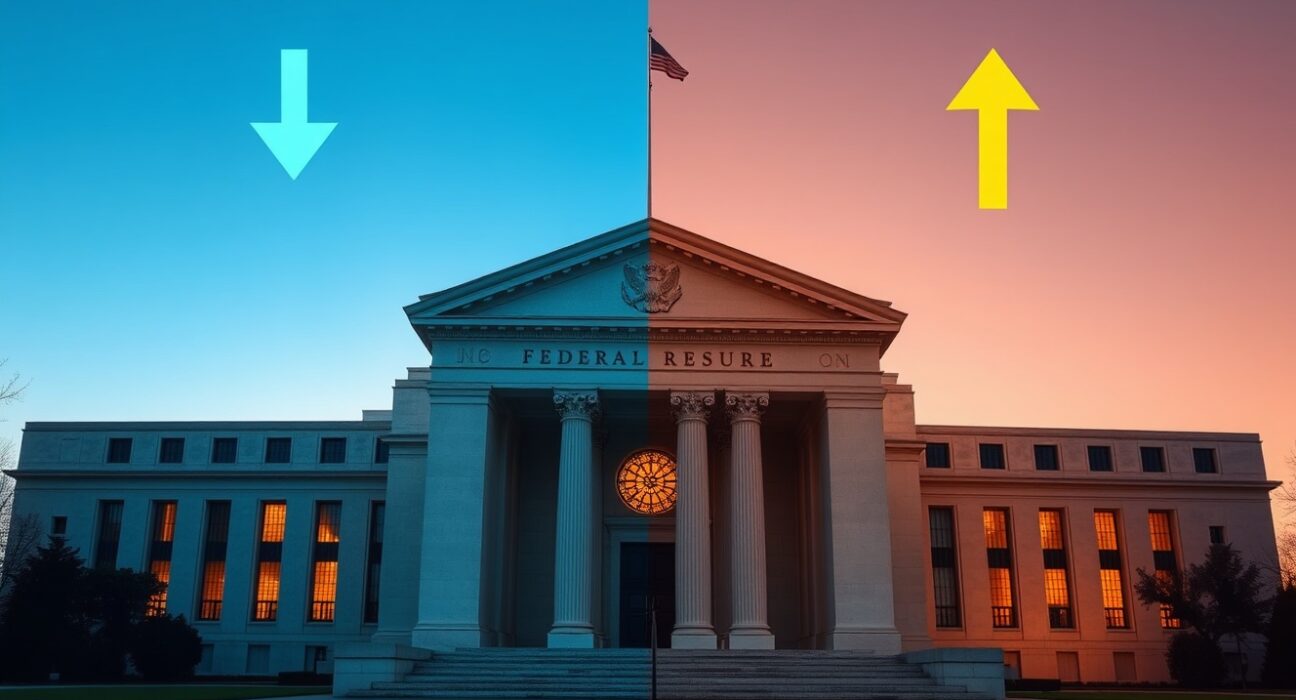
WASHINGTON, D.C. — April 8, 2025 — Federal Reserve officials revealed a stark division in their March meeting minutes, highlighting what they termed a ‘two-way risk’ scenario for the U.S. economy stemming from the ongoing conflict in Iran. The Federal Open Market Committee (FOMC) minutes released today show policymakers grappling with contradictory economic signals that could push monetary policy in opposite directions. This unprecedented situation creates significant uncertainty for financial markets and the broader economy.
Fed’s March Minutes Reveal Deep Policy Division
The Federal Reserve maintained its benchmark interest rate in the 3.50-3.75% range during the March meeting. However, the newly released minutes expose substantial disagreement among committee members about future policy direction. According to the detailed account, a majority of participants expressed concern that the Iran conflict could weaken the labor market, potentially necessitating rate cuts to support economic activity. Simultaneously, another majority pointed to inflation risks that could require rate hikes to maintain price stability.
This unusual ‘two-way risk’ assessment represents a significant departure from recent Fed communications. Typically, the central bank identifies either inflationary or recessionary risks as dominant. The current situation presents policymakers with the challenging prospect of needing to respond to opposing economic threats. The minutes specifically note that ‘some participants felt there was sufficient reason to describe future policy decisions as having two-way risk.’
Historical Context of Geopolitical Economic Shocks
The Federal Reserve has historically navigated numerous geopolitical crises, but the current Iran conflict presents unique challenges. Unlike previous Middle Eastern conflicts that primarily affected oil prices, the current situation involves broader supply chain disruptions, regional instability affecting multiple trading partners, and potential secondary effects on global financial markets. The Fed’s response to the 1990 Gulf War, the 2001 September 11 attacks, and the 2014 oil price collapse provide relevant historical parallels.
Previous geopolitical events typically produced clearer directional signals for monetary policy. For instance, the 1973 oil embargo created unambiguous inflationary pressure, while the 2008 financial crisis presented clear recessionary risks. The current Iran conflict’s ‘two-way risk’ represents a more complex scenario requiring nuanced policy responses.
Inflation Versus Employment: The Fed’s Dual Mandate Challenge
The Federal Reserve operates under a dual mandate to maintain price stability and maximum employment. The Iran conflict creates tension between these two objectives. On one hand, supply chain disruptions and potential oil price increases could accelerate inflation beyond the Fed’s 2% target. On the other hand, reduced business confidence and potential trade disruptions could weaken labor markets and economic growth.
The minutes state clearly: ‘An overwhelming majority of attendees assessed that both upside risks to inflation and downside risks to employment were elevated.’ This assessment reflects the unusual economic environment where traditional indicators provide conflicting signals. Key factors contributing to this situation include:
- Energy market volatility: Iran’s position as a major oil producer creates uncertainty about global supply
- Shipping disruptions: Critical trade routes through the Strait of Hormuz face potential disruption
- Business investment uncertainty: Companies may delay expansion plans amid geopolitical instability
- Consumer confidence impact: Rising energy costs could reduce discretionary spending
Regional Economic Impacts and Global Spillover Effects
The Middle East conflict extends beyond Iran’s borders, affecting neighboring economies and global trade patterns. Countries in the region face direct economic consequences, while major trading partners experience secondary effects. The European Union, China, and India maintain significant economic ties with the region, creating potential transmission channels for economic disruption.
Global financial markets have shown increased volatility since the conflict’s escalation. Currency markets, commodity prices, and equity valuations reflect growing uncertainty about economic outcomes. Central banks worldwide monitor the situation closely, with several already adjusting their policy outlooks in response to developing conditions.
Post-Meeting Developments and Policy Outlook
Since the March meeting, Federal Reserve officials have reportedly leaned toward maintaining current interest rates while assessing the conflict’s evolving impact. This ‘wait-and-see’ approach allows policymakers to gather additional data before committing to policy changes. Several Fed representatives have made public statements emphasizing data dependence and careful monitoring of economic indicators.
The Federal Reserve faces several critical decisions in upcoming meetings. Key considerations include:
| Factor | Potential Impact | Monitoring Indicators |
|---|---|---|
| Oil Price Movements | Direct inflation pressure | WTI crude prices, gasoline costs |
| Employment Data | Labor market health | Unemployment rate, job creation |
| Consumer Spending | Economic growth momentum | Retail sales, consumer confidence |
| Business Investment | Future economic capacity | Capital expenditure, equipment orders |
Market participants currently price in approximately 50 basis points of rate cuts by year-end, though this expectation remains highly sensitive to geopolitical developments. The Fed’s communication strategy will prove crucial in managing market expectations amid ongoing uncertainty.
Expert Analysis and Economic Forecasting
Economic analysts offer varied interpretations of the Fed’s position. Some experts emphasize the inflationary risks, noting that previous Middle Eastern conflicts typically produced sustained price increases. Others highlight potential growth concerns, pointing to reduced business confidence and potential trade disruptions. Most agree that the situation requires careful monitoring and flexible policy responses.
The Congressional Budget Office recently updated its economic projections to account for Middle Eastern instability. Private sector forecasters have similarly adjusted their models, though consensus remains elusive given the conflict’s evolving nature. Academic research on previous geopolitical shocks provides useful frameworks but limited predictive power for the current unique situation.
Conclusion
The Federal Reserve’s March minutes reveal an unprecedented ‘two-way risk’ assessment stemming from the Iran conflict, creating significant policy uncertainty. Officials remain divided between concerns about inflationary pressures and worries about employment weakness. This unusual situation requires careful navigation of the Fed’s dual mandate amid conflicting economic signals. Future policy decisions will depend heavily on evolving geopolitical developments and their economic impacts. The Federal Reserve’s approach will likely emphasize data dependence and policy flexibility as it manages this complex ‘two-way risk’ scenario.
FAQs
Q1: What does ‘two-way risk’ mean in Federal Reserve terminology?
The term describes a situation where economic conditions could reasonably develop in opposite directions, requiring either interest rate increases to combat inflation or decreases to support growth. The Fed typically identifies dominant risks in one direction, making this balanced two-way assessment unusual.
Q2: How does the Iran conflict specifically create economic risks for the United States?
The conflict creates risks through multiple channels: potential oil price increases affecting inflation, supply chain disruptions impacting production, reduced business confidence affecting investment, and financial market volatility influencing asset prices and economic stability.
Q3: What historical precedents exist for Fed policy during Middle Eastern conflicts?
The Federal Reserve responded to the 1990 Gulf War with temporary rate cuts, addressed the 1973 oil embargo with anti-inflation measures, and managed the 2014 oil price collapse with accommodative policy. Each situation presented different economic dynamics than the current Iran conflict.
Q4: How are financial markets reacting to the Fed’s ‘two-way risk’ assessment?
Markets show increased volatility and uncertainty, with interest rate expectations fluctuating based on geopolitical developments. Equity markets exhibit sector-specific impacts, while currency markets reflect shifting risk perceptions and potential safe-haven flows.
Q5: What economic indicators will the Fed monitor most closely in coming months?
Key indicators include monthly employment reports, consumer price index readings, business investment data, consumer confidence surveys, and energy price movements. The Fed will also monitor geopolitical developments and their secondary economic effects.
Disclaimer: The information provided is not trading advice, Bitcoinworld.co.in holds no liability for any investments made based on the information provided on this page. We strongly recommend independent research and/or consultation with a qualified professional before making any investment decisions.