

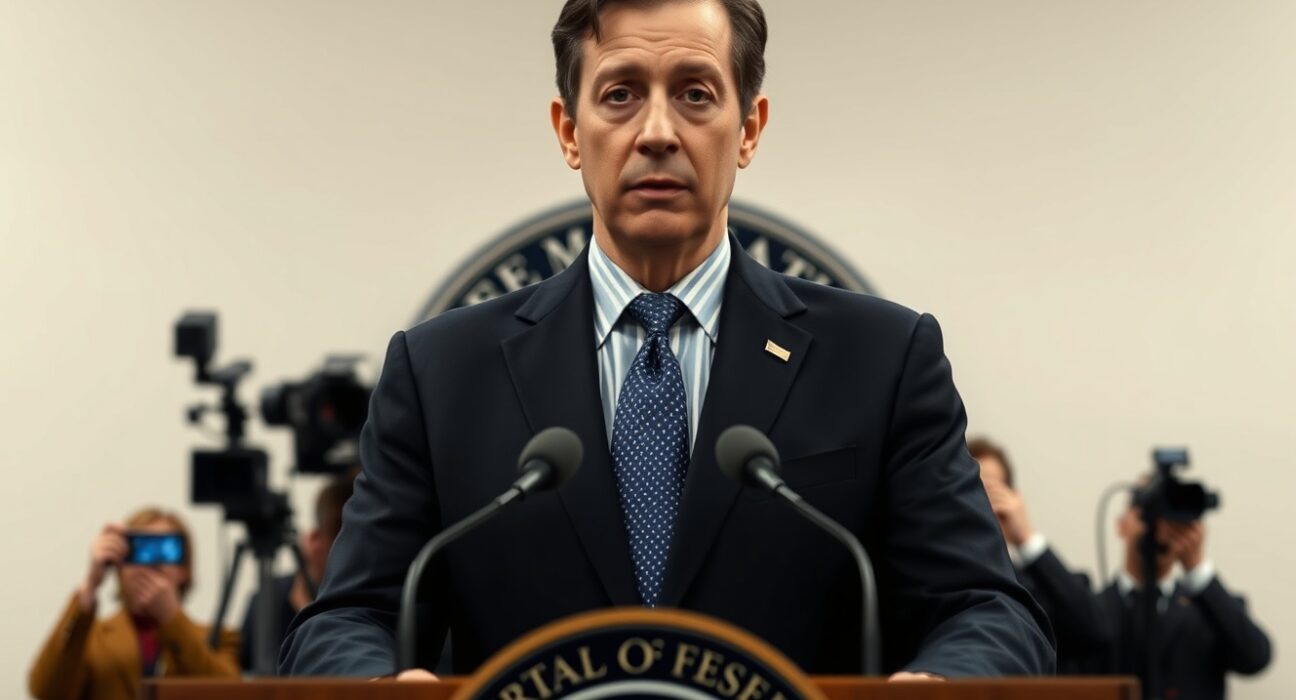
WASHINGTON, D.C. – March 15, 2025 – In a pivotal statement today, Federal Reserve Director Mirlan delivered a crucial signal to global markets, indicating that the central bank may implement only three interest rate cuts for the remainder of the year. This projection, grounded in the current economic outlook, immediately recalibrated expectations on Wall Street and among policymakers worldwide. Consequently, investors are now reassessing their strategies for the coming months. Furthermore, this announcement provides critical insight into the Fed’s cautious approach to monetary policy normalization.
Federal Reserve’s Measured Path on Rate Cuts
Director Mirlan’s remarks clarify the Federal Open Market Committee’s (FOMC) current thinking. The central bank is navigating a complex economic landscape. Persistent service-sector inflation and a resilient labor market are key factors. Therefore, the Fed is prioritizing a gradual reduction in its benchmark federal funds rate. Historically, the Fed has adjusted rates in increments of 25 basis points. Three cuts would therefore total a 0.75 percentage point decrease by year’s end.
This pace is notably slower than some market participants had anticipated earlier in the cycle. Recent Consumer Price Index (CPI) and Personal Consumption Expenditures (PCE) data support this prudent stance. The core PCE price index, the Fed’s preferred inflation gauge, remains above the long-term 2% target. As a result, policymakers emphasize the need for continued vigilance.
Analyzing the Economic Context for 2025
The projected three rate cuts emerge from a specific set of economic conditions. First, GDP growth has moderated but remains positive, avoiding a recession. Second, unemployment stays near historic lows, sustaining wage pressures. Third, global supply chain stability has improved, yet geopolitical tensions pose ongoing risks. The Fed’s dual mandate of maximum employment and price stability guides every decision.
Comparatively, the current tightening cycle began in 2022 to combat surging inflation. The Fed raised rates aggressively over two years. Now, the shift to a cutting cycle requires equal precision. A misstep could reignite inflation or unnecessarily stifle growth. Director Mirlan’s statement aims to provide clear, forward guidance to prevent market volatility.
Expert Perspectives on the Monetary Policy Shift
Economists from major institutions have analyzed the implications. For instance, a former Fed governor noted that “three cuts represent a middle path.” This approach acknowledges progress on inflation without declaring victory prematurely. Meanwhile, market strategists highlight the impact on Treasury yields and the US dollar. Bond markets had priced in a slightly more aggressive easing schedule. Consequently, short-term yields may adjust upward.
The table below outlines the potential timeline based on the remaining FOMC meetings in 2025:
| Potential Meeting | Action | Rationale |
|---|---|---|
| June | First Cut | Assess Q1 data, confirm inflation trend. |
| September | Second Cut | Mid-year review, labor market assessment. |
| December | Third Cut | Year-end adjustment, set 2026 tone. |
This schedule is not official but reflects common analyst interpretation. The Fed remains data-dependent, meaning any meeting could see a pause.
Immediate Market Reactions and Sector Impacts
Financial markets responded swiftly to Director Mirlan’s guidance. Initially, equity futures dipped as traders adjusted to a “higher for longer” rate reality. However, banking stocks showed relative strength. Higher net interest margins could persist longer than expected. Conversely, the real estate sector faces continued headwinds. Mortgage rates may not fall as quickly as hoped by prospective homebuyers.
The US dollar index (DXY) strengthened modestly on the news. A slower easing cycle makes dollar-denominated assets more attractive. Internationally, central banks in Europe and Asia will factor this Fed path into their own decisions. Global capital flows often follow US monetary policy signals. Therefore, emerging markets may experience currency volatility.
The Critical Role of Inflation Data
Future inflation reports will be the ultimate arbiter. The Fed has identified several key indicators:
- Core Services Inflation: Excluding housing, this measure remains sticky.
- Wage Growth: Average hourly earnings must continue to moderate.
- Inflation Expectations: Surveys must show public confidence in the 2% target.
Any significant upside surprise in these metrics could reduce the number of cuts. Conversely, a rapid cooling of the economy might prompt more aggressive action. Director Mirlan explicitly stated the outlook is “conditional on the evolving data.” This phrase underscores the Fed’s flexible, non-automatic approach.
Long-Term Implications for Consumers and Businesses
For the average American, the three-cut projection has tangible effects. Borrowing costs for auto loans and credit cards will decline slowly. Savers, however, may enjoy elevated yields on savings accounts and CDs for several more months. Business investment decisions hinge on the cost of capital. A gradual decline supports planned expansions without overheating demand.
The federal government’s debt servicing costs are also a major consideration. With national debt at record levels, higher rates increase budgetary pressure. A measured cutting cycle provides more predictability for Treasury issuance. State and local governments financing projects similarly benefit from stable expectations.
Conclusion
Federal Reserve Director Mirlan’s guidance for potentially just three rate cuts in 2025 establishes a clear, cautious framework for monetary policy. This path balances the need to support economic activity with the imperative to fully anchor inflation. Markets now have a crucial benchmark against which to evaluate incoming economic data. The Fed’s commitment to a data-dependent approach ensures flexibility. Ultimately, this measured strategy aims to secure a sustainable economic expansion without reigniting inflationary pressures, a delicate task for policymakers in the year ahead.
FAQs
Q1: What did Federal Reserve Director Mirlan actually say?
Director Mirlan stated that, based on the current economic outlook, interest rate cuts for the remainder of 2025 may be limited to three. This is a projection, not a commitment, and remains dependent on incoming data.
Q2: How does this change the previous market expectation for rate cuts?
Prior to this statement, some market pricing and analyst forecasts had suggested the possibility of four or more rate cuts in 2025. Mirlan’s comments have tempered those expectations, aligning them more closely with the Fed’s own cautious, data-dependent outlook.
Q3: What economic factors are causing the Fed to limit rate cuts to three?
Key factors include persistent inflation in service sectors, a still-tight labor market with solid wage growth, and economic growth that remains above trend. The Fed wants clear, sustained evidence that inflation is returning to its 2% target before accelerating the pace of easing.
Q4: How will this affect mortgage rates and the housing market?
Mortgage rates, which are influenced by long-term Treasury yields and Fed policy expectations, are likely to decline more gradually than if the Fed were cutting more aggressively. This may prolong affordability challenges in the housing market but could also prevent a destabilizing bubble.
Q5: Could the Fed still cut rates more or less than three times this year?
Absolutely. Director Mirlan and the Fed have emphasized that their policy is “data-dependent.” If inflation falls faster than expected or the labor market weakens significantly, more cuts are possible. Conversely, if inflation stalls or rebounds, fewer cuts—or even pauses—could occur.
Disclaimer: The information provided is not trading advice, Bitcoinworld.co.in holds no liability for any investments made based on the information provided on this page. We strongly recommend independent research and/or consultation with a qualified professional before making any investment decisions.
