

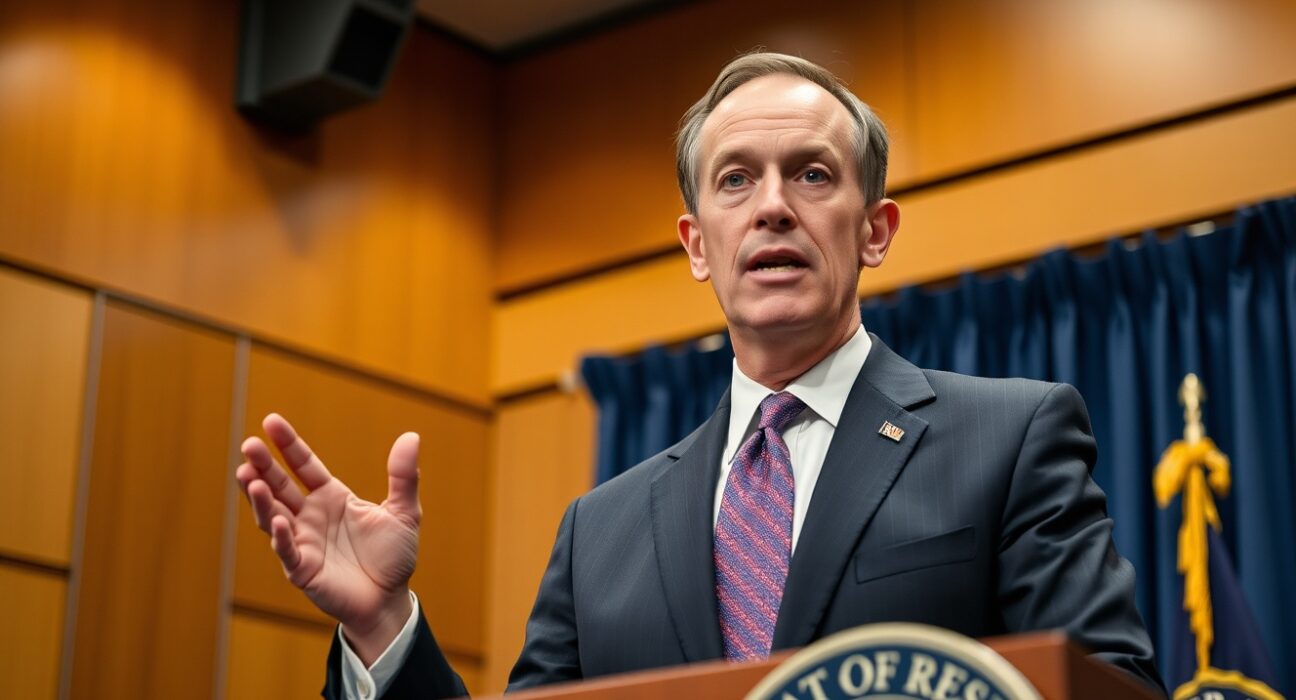
Federal Reserve Bank of Chicago President Austan Goolsbee said Monday that the U.S. labor market remains fundamentally solid, pushing back against growing fears that the economy is heading toward a sharp downturn. Speaking at an event in Chicago, Goolsbee acknowledged that job growth has slowed from its post-pandemic pace but stressed that there is “not a lot of evidence” that the job market is falling apart.
Goolsbee’s Full Remarks on the Labor Market
Goolsbee, a voting member of the Federal Open Market Committee this year, noted that while the pace of hiring has moderated, layoffs remain historically low and wage growth is gradually normalizing. He pointed to steady consumer spending and business investment as signs that the broader economy is not contracting sharply.
“We are seeing a cooling, yes. But cooling is not collapsing,” Goolsbee said. He emphasized that the Fed needs to watch incoming data carefully before making any decisions on rate cuts, warning against overreacting to a single month of weaker-than-expected payroll numbers.
Market Expectations and Policy Implications
Financial markets have been pricing in a higher probability of rate cuts in the second half of 2026, partly driven by recent softness in manufacturing data and a slight uptick in initial jobless claims. Goolsbee’s comments suggest the Fed is not yet convinced that the labor market requires immediate stimulus.
His remarks align with those of other Fed officials who have urged patience, including Governor Christopher Waller and New York Fed President John Williams. The central bank has held its benchmark interest rate steady at 4.25%-4.50% since January, after a series of cuts in late 2025.
What This Means for Borrowers and Investors
For consumers and businesses waiting for lower borrowing costs, Goolsbee’s stance implies that rate cuts may not come as quickly as some hope. Mortgage rates, credit card APRs, and business loan costs are likely to remain elevated in the near term unless the labor market deteriorates more significantly.
Investors should watch upcoming employment reports, particularly the monthly nonfarm payrolls and the JOLTS job openings data, for clearer signals. If hiring holds steady above 150,000 per month, the Fed is likely to maintain its wait-and-see approach.
Conclusion
Austan Goolsbee’s latest remarks reinforce the Fed’s current posture: cautious, data-dependent, and not yet ready to declare an emergency in the labor market. While the economy is clearly slowing from its post-pandemic highs, the central bank sees no immediate need to rush into rate cuts. For now, the message is one of patience—both for policymakers and for markets.
FAQs
Q1: Did Goolsbee rule out a rate cut in 2026?
No. He said the Fed will act if the data clearly shows the labor market weakening further, but he does not see evidence of that yet.
Q2: What specific labor market data is the Fed watching?
Key indicators include monthly nonfarm payrolls, the unemployment rate, average hourly earnings, initial jobless claims, and the JOLTS job openings rate.
Q3: How does Goolsbee’s view compare to other Fed officials?
His view is broadly in line with the majority of FOMC members, who have emphasized patience and data-dependence. A minority have called for earlier cuts, but Goolsbee’s remarks represent the consensus center.
Disclaimer: The information provided is not trading advice, Bitcoinworld.co.in holds no liability for any investments made based on the information provided on this page. We strongly recommend independent research and/or consultation with a qualified professional before making any investment decisions.
