
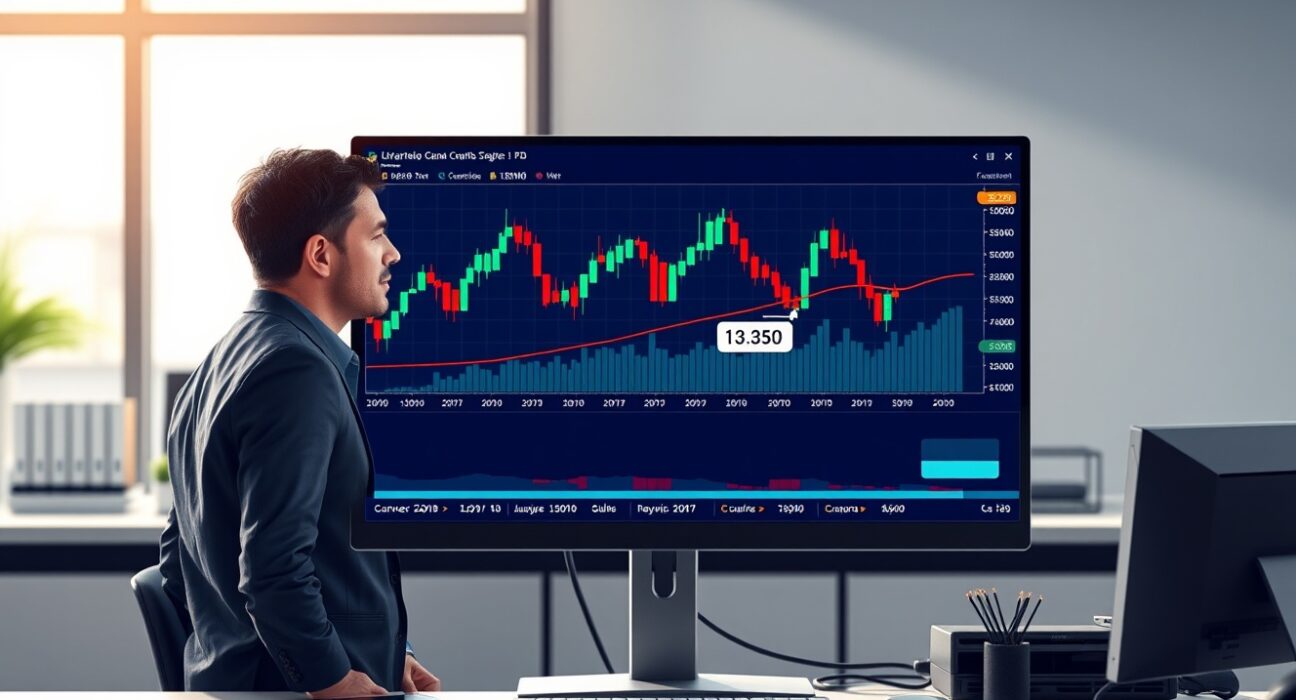
In the dynamic world of foreign exchange, the GBP/USD currency pair commands significant attention, and recent analysis from United Overseas Bank (UOB) highlights a crucial technical juncture. The bank’s strategists identify a persistent negative bias for the pair, yet they emphasize a formidable cap at the 1.3350 resistance level. This analysis, grounded in detailed chart patterns and market structure, provides a critical framework for understanding the pound sterling’s potential trajectory against the US dollar amidst a complex global economic backdrop.
Decoding the GBP/USD Technical Landscape
Technical analysis serves as a vital tool for forex traders, offering insights derived from price action and historical patterns. United Overseas Bank’s assessment of GBP/USD centers on the interplay between bearish momentum and key technical barriers. The identified 1.3350 level is not an arbitrary figure; it represents a confluence of previous resistance zones and moving averages that collectively form a significant supply area. Consequently, any upward movement faces intense selling pressure at this threshold.
Market participants closely monitor these levels because they often trigger automated trading algorithms and influence institutional order flow. Furthermore, the “negative bias” mentioned by UOB suggests underlying weakness in the pair’s structure, potentially driven by fundamental divergences between the UK and US economies. This technical perspective provides a measurable context for the pair’s short-term directional risks.
The Fundamental Backdrop Driving Currency Flows
Technical levels do not exist in a vacuum; they interact powerfully with fundamental drivers. The Bank of England’s monetary policy path remains a primary influence on sterling valuation. Markets continuously assess the timing and scale of potential interest rate adjustments in response to UK inflation data and growth indicators. Conversely, the US Federal Reserve’s policy stance directly impacts the dollar’s strength, creating a push-pull dynamic for GBP/USD.
Additionally, relative economic performance metrics, such as GDP growth comparisons and trade balance figures, contribute to long-term currency trends. Political stability and fiscal policy announcements in both nations also generate immediate volatility. Therefore, the 1.3350 cap identified by UOB exists within a fluid environment where economic data releases can swiftly alter market sentiment and technical probabilities.
Expert Insight: Interpreting Resistance and Support
Financial institutions like UOB base their technical forecasts on rigorous chart analysis methodologies. The concept of a “cap” or resistance level implies that multiple tests of a price point have failed to produce a sustained breakout, establishing it as a reliable barrier. Analysts examine volume profiles, candlestick patterns like pin bars or engulfing patterns near these levels, and momentum oscillators such as the Relative Strength Index (RSI) to gauge conviction.
For instance, if the pair approaches 1.3350 on low volume and with declining momentum, it reinforces the resistance case. Alternatively, a high-volume breach could signal a paradigm shift. This analytical rigor provides traders with a disciplined framework for risk management, allowing them to set strategic entry and exit points around these validated technical landmarks.
Historical Context and Comparative Analysis
Placing the current 1.3350 level in historical context reveals its significance. A review of the GBP/USD chart over the past several years shows this area has acted as both support and resistance during different market cycles. This “role reversal” is a common technical phenomenon where a broken support level becomes future resistance, and vice-versa. Understanding this history helps traders anticipate market psychology and potential price reactions.
The following table outlines key technical indicators relevant to the current GBP/USD analysis:
| Indicator | Observation | Implied Bias |
|---|---|---|
| 200-Day Moving Average | Price trading below | Long-term Bearish |
| RSI (14-period) | Neutral territory (~45-55) | No extreme overbought/oversold |
| Key Resistance | 1.3350 (UOB cited) | Strong Selling Zone |
| Immediate Support | Near 1.3200 | Potential Buying Zone |
This confluence of factors creates a defined range, with 1.3350 as the upper boundary. Breakouts from such consolidations typically require a strong fundamental catalyst.
Market Impact and Trader Positioning
The identification of a clear technical cap influences real-world trading behavior. Institutional desks often place sell orders clustered around these levels, creating a self-fulfilling prophecy. Retail trader sentiment, as measured by surveys and futures positioning data, can also become excessively bullish or bearish at these junctures, often acting as a contrarian indicator. The Commitment of Traders (COT) report, published by regulatory bodies, shows how large speculators are positioned in the currency futures market, offering another layer of insight.
Moreover, volatility tends to compress as price approaches a major technical level, often followed by an expansionary move upon a decisive break or rejection. Options markets reflect this through pricing, with implied volatility often rising for strike prices near key technical barriers like 1.3350. This ecosystem of analysis and positioning underscores the practical importance of UOB’s technical observation for active market participants.
The Role of Intermarket Analysis
GBP/USD does not trade in isolation. Its price action frequently correlates with other asset classes. For example, the pair often has an inverse relationship with the USD/CHF or a positive correlation with global equity market risk appetite. Additionally, the price of key commodities like oil can influence the pound due to the UK’s economic structure. A comprehensive analysis, therefore, considers these cross-asset dynamics. A sudden shift in bond yields or a sharp move in the FTSE 100 index could provide the impetus needed for GBP/USD to challenge or respect the 1.3350 cap identified by UOB’s charts.
Conclusion
The GBP/USD analysis from United Overseas Bank, pinpointing a negative bias capped at 1.3350, provides a clear and actionable technical framework. This perspective synthesizes chart patterns, market structure, and the prevailing fundamental backdrop to outline the pair’s immediate risk parameters. While the bias leans negative, the strength of the 1.3350 resistance level remains the critical focal point for traders. A sustained break above could invalidate the bearish outlook, whereas a rejection would reinforce it. Ultimately, navigating the GBP/USD pair requires respecting these technical signposts while remaining acutely aware of the evolving economic data and central bank rhetoric that drive long-term currency valuation.
FAQs
Q1: What does a “negative bias capped at 1.3350” mean for GBP/USD?
This means UOB analysts see more downward pressure than upward momentum on the currency pair, but they believe any decline will be limited or paused if the price falls, and any rally will likely fail if it reaches the 1.3350 price level, which acts as strong resistance.
Q2: How do banks like UOB determine these key technical levels?
Analysts use historical price charts to identify levels where the price has repeatedly reversed direction (support/resistance), along with mathematical indicators like moving averages, Fibonacci retracement levels, and volume analysis to confirm the significance of a price zone like 1.3350.
Q3: Can fundamental news cause GBP/USD to break through the 1.3350 cap?
Absolutely. Major economic data surprises (like inflation or employment reports), unexpected central bank policy decisions, or significant geopolitical events can provide the momentum needed for a decisive breakout above a technical resistance level, rendering it obsolete.
Q4: Is technical analysis for forex reliable?
Technical analysis is a widely used tool for identifying probabilities and managing risk based on historical patterns and market psychology. However, it is not infallible and is most effective when combined with an understanding of fundamental drivers and sound risk management practices.
Q5: What other currency pairs should I watch alongside GBP/USD?
Key related pairs include EUR/USD (for general dollar strength), EUR/GBP (for sterling-specific moves), and USD/CHF or USD/JPY. Movements in these pairs can provide context for whether a move in GBP/USD is driven by pound-specific factors or broad US dollar trends.
Disclaimer: The information provided is not trading advice, Bitcoinworld.co.in holds no liability for any investments made based on the information provided on this page. We strongly recommend independent research and/or consultation with a qualified professional before making any investment decisions.