
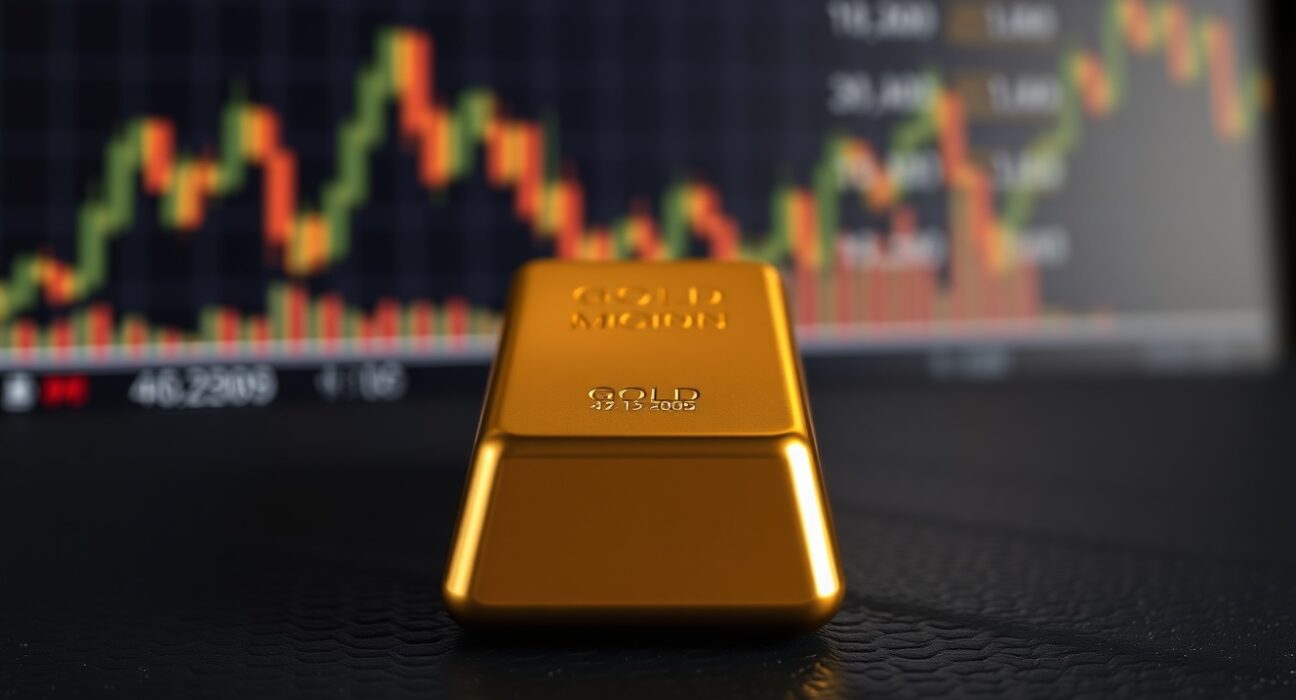
LONDON, April 2025 – The gold price is consolidating near three-week highs today, a direct consequence of a newly announced ceasefire between the United States and Iran. This significant geopolitical development has triggered a sharp sell-off in the US Dollar, consequently propelling the precious metal, a traditional safe-haven asset, to its strongest level in over twenty-one days. Market analysts are closely monitoring this inverse correlation, which underscores gold’s enduring role during periods of shifting global risk sentiment.
Gold Price Dynamics and the Weakening Dollar
The immediate catalyst for gold’s ascent is the formal ceasefire agreement. Consequently, this news has reduced immediate geopolitical risk premiums priced into the US currency. Historically, the US Dollar and gold exhibit a strong inverse relationship. Therefore, when the Dollar weakens, dollar-denominated assets like gold become cheaper for holders of other currencies. This mechanism invariably boosts demand and pushes prices higher.
Furthermore, the ceasefire has altered short-term interest rate expectations. Markets now perceive a reduced likelihood of aggressive Federal Reserve action, which was previously anticipated to support the Dollar. This shift in monetary policy outlook applies additional downward pressure on the currency. As a result, investors are reallocating capital into non-yielding bullion as a store of value.
Historical Context of Geopolitical Events and Gold
This market reaction follows a well-established historical pattern. For instance, during periods of de-escalation following prolonged tensions, initial dollar weakness often benefits gold. However, the sustainability of this rally depends on subsequent economic data and central bank signals. A comparative analysis of past events provides crucial context.
| Event | Initial Gold Reaction | Subsequent 30-Day Trend |
|---|---|---|
| 2015 Iran Nuclear Deal | +3.2% | -1.8% (as focus shifted to Fed) |
| 2020 US-China Phase One Trade Deal | +1.8% | +5.1% (due to pandemic fears emerging) |
This data illustrates that gold’s trajectory is rarely linear. While the initial trigger is clear, other macroeconomic factors quickly reassert their influence on the market.
Expert Analysis on Market Sentiment
Dr. Anya Sharma, Chief Commodities Strategist at Global Markets Insight, provides expert commentary. “The ceasefire is a textbook catalyst for the move we are seeing,” she states. “However, traders are already looking beyond the headline. The key question is whether this marks a structural decline for the Dollar or a temporary adjustment. For now, the technical breakout for gold is valid, but it requires confirmation from sustained physical demand and ETF inflows.” This analysis highlights the multi-faceted evaluation professional investors undertake.
The Broader Impact on Precious Metals and Commodities
The rally is not isolated to gold alone. Other precious metals are also experiencing positive momentum, albeit to varying degrees. This sector-wide movement confirms the primary driver is macro-financial, not metal-specific.
- Silver: Often follows gold but with higher volatility, showing a 2.5% gain.
- Platinum: Reacting more to industrial demand outlooks, posting modest gains.
- Mining Stocks: The GDX ETF (Gold Miners) is outperforming the spot price, indicating leveraged bullish bets.
Simultaneously, the weaker Dollar is providing a broad lift to dollar-priced commodities. For example, crude oil and base metals are also firmer. This creates a complex environment where gold must compete for capital against other cyclical assets now benefiting from the same currency effect.
Technical Analysis and Key Price Levels
From a chart perspective, gold has convincingly broken above its 50-day moving average, a key technical indicator watched by algorithmic and discretionary traders alike. The next major resistance level sits near the early March high of $2,185 per ounce. Conversely, support has now been established at the previous congestion zone around $2,130. A close above the March high would signal a potential resumption of the longer-term bullish trend, potentially targeting all-time highs.
Market volume during this move has been above average, suggesting strong conviction behind the price action. This is a critical detail, as low-volume breakouts are often less reliable. The commitment of traders report will be scrutinized next week to see if managed money positions have shifted from net-short to net-long.
Central Bank Policy and the Long-Term Outlook
Looking ahead, the trajectory of gold will increasingly hinge on monetary policy. The ceasefire may allow the Federal Reserve to maintain a more patient stance on interest rates if global stability reduces inflationary risks from energy markets. Lower real interest rates are a fundamentally positive environment for gold, which bears no yield. Therefore, upcoming inflation data and Fed meeting minutes will be pivotal.
Additionally, central bank gold buying remains a structural support. Institutions in emerging markets have been consistent net buyers, diversifying reserves away from traditional currencies. This demand provides a solid floor for prices, irrespective of short-term speculative flows driven by forex movements.
Conclusion
The gold price is holding firm near three-week highs, directly fueled by the US-Iran ceasefire and the resultant weakness in the US Dollar. This movement reaffirms the metal’s core dynamics within the global financial system. While the immediate catalyst is geopolitical, the sustainability of the rally will depend on a confluence of factors including central bank policy, real yields, and physical market demand. Investors should monitor these developments closely, as the current breakout presents both opportunity and the need for careful risk assessment in the volatile commodities space.
FAQs
Q1: Why does a weaker US Dollar make gold prices rise?
Gold is priced in US Dollars globally. When the Dollar loses value, it takes fewer units of other currencies (like Euros or Yen) to buy one ounce of gold. This increased purchasing power for international buyers boosts demand and pushes the Dollar price higher.
Q2: Is the ceasefire the only reason gold is rising?
While the primary short-term catalyst, other factors support gold. These include expectations of slower Federal Reserve rate hikes, persistent central bank buying, and ongoing macroeconomic uncertainty, which collectively enhance its safe-haven appeal.
Q3: How do interest rates affect gold?
Gold offers no yield (interest). When interest rates rise, yield-bearing assets like bonds become more attractive relative to gold, often pressuring its price. Conversely, when rate hike expectations diminish or rates fall, gold’s opportunity cost decreases, making it more attractive.
Q4: Will other precious metals like silver follow gold higher?
Silver often correlates with gold due to its dual role as a precious and industrial metal. It typically exhibits higher volatility. A rising gold price often pulls silver higher, but silver’s performance is also tied to the economic outlook for industrial demand.
Q5: What should investors watch next to gauge gold’s direction?
Key indicators include: the US Dollar Index (DXY) for forex momentum, real Treasury yields, weekly Commitments of Traders reports for speculative positioning, and physical gold holdings in major ETFs like the SPDR Gold Shares (GLD).
Disclaimer: The information provided is not trading advice, Bitcoinworld.co.in holds no liability for any investments made based on the information provided on this page. We strongly recommend independent research and/or consultation with a qualified professional before making any investment decisions.