

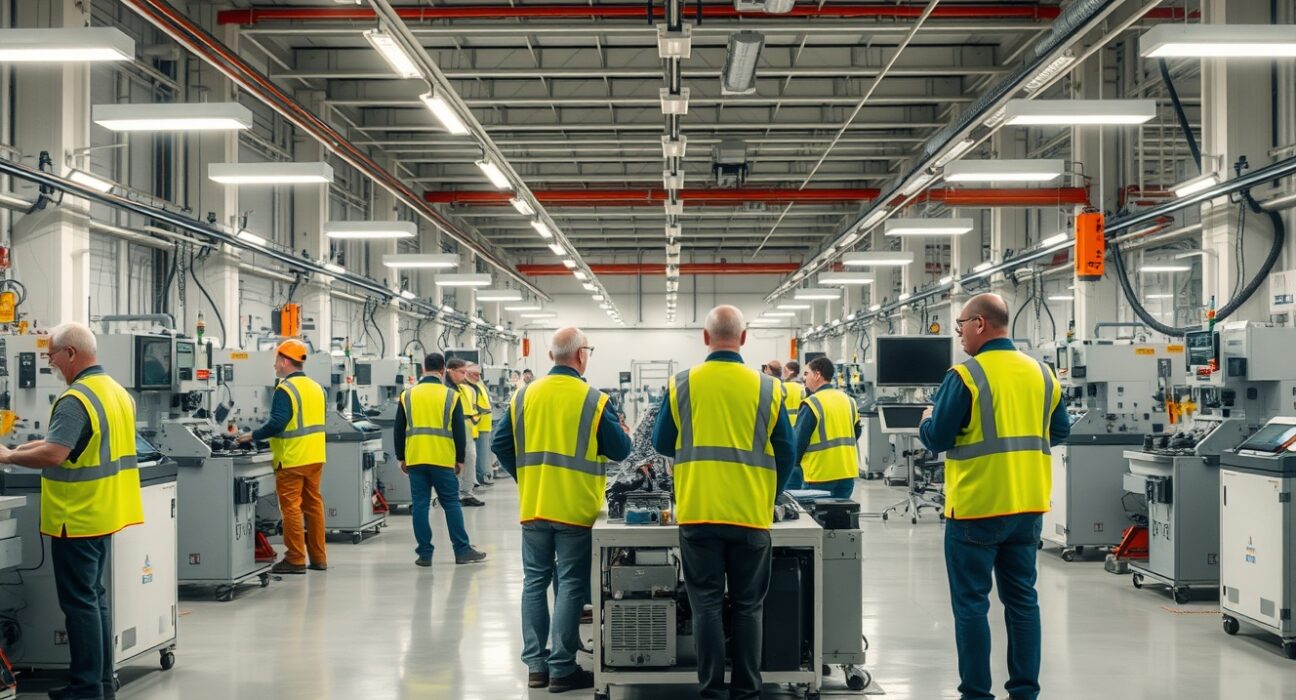
Greece’s industrial production rose 3.9% year-on-year in May, accelerating from a revised 2.1% increase in April, according to data released by the Hellenic Statistical Authority (ELSTAT). The figure marks the strongest annual growth since January 2025 and signals continued momentum in the country’s manufacturing and energy sectors.
Sector Breakdown and Drivers
The May increase was broad-based, with manufacturing output rising 4.2% year-on-year, while electricity production posted a 3.1% gain. Mining and quarrying output grew 2.8% over the same period. On a month-on-month basis, industrial production was up 0.6% in May, following a 0.3% decline in April.
The acceleration reflects improving export demand from key European trading partners and stabilization in energy costs, which have supported industrial activity. The manufacturing PMI for Greece remained in expansion territory in May at 52.4, indicating sustained growth in new orders and production volumes.
Economic Context and Implications
Industrial production is a closely watched indicator for the Greek economy, which has been recovering steadily since the pandemic. The sector accounts for approximately 12% of Greece’s GDP and employs roughly 400,000 workers. The May data suggests that the industrial recovery remains on track, despite headwinds from elevated interest rates and slower growth in the broader Eurozone.
The Bank of Greece recently revised its 2025 GDP growth forecast to 2.1%, supported by industrial output and tourism. The industrial production data aligns with this outlook, though analysts caution that external demand risks persist.
Comparison with Regional Trends
Greece’s industrial production growth outpaced the Eurozone average, which stood at 1.5% year-on-year in May. Among Southern European economies, Spain reported 2.8% growth, while Italy posted a 1.2% decline. The outperformance highlights Greece’s relative resilience, partly due to its lower exposure to energy-intensive heavy industries compared to northern European peers.
Conclusion
The 3.9% year-on-year increase in Greece’s industrial production for May provides a positive signal for the country’s economic trajectory. While the data supports the broader recovery narrative, continued monitoring of external demand and energy costs will be essential to assess whether the momentum can be sustained in the second half of 2025.
FAQs
Q1: What does the 3.9% year-on-year increase in industrial production mean for the Greek economy?
The increase indicates that the industrial sector is expanding, contributing positively to GDP growth and employment. It suggests that manufacturing and energy production are recovering steadily, supporting the broader economic outlook.
Q2: Which sectors drove the industrial production growth in May?
Manufacturing output rose 4.2%, electricity production increased 3.1%, and mining and quarrying grew 2.8%. The gains were broad-based, with manufacturing being the primary driver.
Q3: How does Greece’s industrial performance compare to other Eurozone countries?
Greece’s 3.9% growth exceeded the Eurozone average of 1.5% in May. It also outperformed Spain (2.8%) and Italy (-1.2%), reflecting relative strength in the sector.
Disclaimer: The information provided is not trading advice, Bitcoinworld.co.in holds no liability for any investments made based on the information provided on this page. We strongly recommend independent research and/or consultation with a qualified professional before making any investment decisions.
