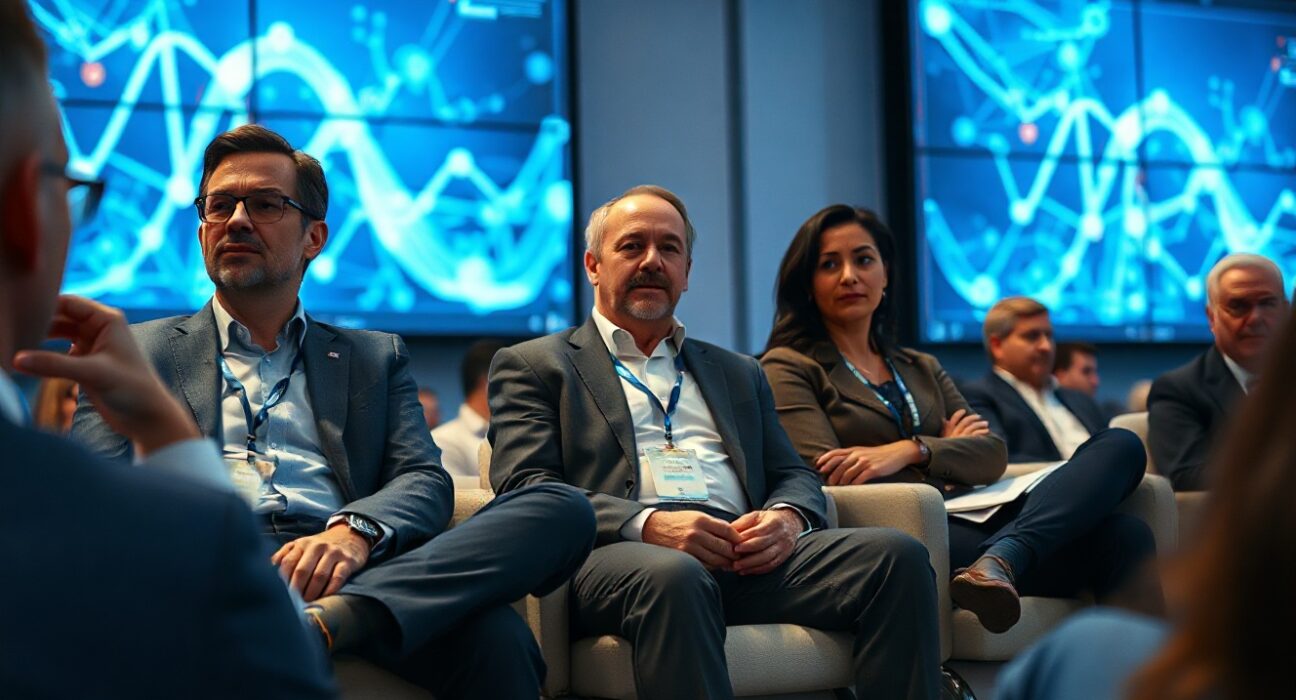
At the Ai4 conference in Las Vegas last week, three of AI’s most prominent figures—Nobel laureate Geoffrey Hinton, World Labs CEO Fei-Fei Li, and Coursera co-founder Andrew Ng—offered a unified defense of openness in AI development, even as they disagreed on the specifics of how to manage risks. Their remarks come at a time when major labs are increasingly locking down their models, citing safety concerns and competitive pressures.
Why Openness Matters in AI
The core concern for all three speakers was the concentration of power in a few large companies. Andrew Ng warned against a future where gatekeepers control access to AI, stifling innovation and limiting who benefits from the technology. He argued for a competitive landscape with multiple providers, saying, “If I were to try to give one prescription, it would be to promote openness, because AI is amazing technology and I want it to be in everyone’s hands.”
Ng also highlighted a geopolitical dimension: if China’s open-weight models gain widespread adoption in developing regions, they could shape how billions of people encounter ideas about democracy and human rights. He urged American competitiveness in open-source AI to counter this influence.
Open Weights vs. Open Source: A Critical Distinction
Geoffrey Hinton drew a sharp line between open-source software and open-weight models. Open source allows inspection of code, which he praised for enabling community bug-fixing. Open weights, however, release a trained model’s parameters, making it easier for malicious actors to fine-tune them for harmful purposes like cyberattacks. “I was against open [weights] because it makes it so easy for people to take these big foundation models, which are very expensive to train, and for much less money train them to do bad things,” Hinton said.
Yet Hinton conceded that the battle over open weights is already lost: “I think that battle’s been lost. We now have open-weight models, so the barrier to lots of people getting these big models, which was the cost of training foundation models, that barrier has disappeared.” He accepted the reality while still calling for regulation to steer AI toward beneficial outcomes.
A Nuanced Middle Ground
Fei-Fei Li pushed back against framing the debate as a binary choice between full openness and complete closure. She drew an analogy to nuclear physics, where scientific papers are published openly, uranium is regulated, and laboratory work falls in between. Li emphasized that different layers of the AI ecosystem can operate at different levels of openness, citing the Human Genome Project as an example where open knowledge served as a platform for both scientific progress and commercial innovation.
“We need some levels of openness, both in scientific discovery, in education, in global partnership, as well as lucrative business models for entrepreneurs. But we also will accept closed-source systems,” Li said. “This debate, especially at the sweeping level of ‘we can only tolerate one,’ is a false debate.”
Regulation and the Path Forward
Despite their differences, all three agreed that some regulation is necessary. Hinton stressed that decisions about AI’s direction should not be left to a few tech billionaires. “What we want to do is develop AI in a direction that helps people, and regulation will help us do that,” he said. “You can’t leave it to people like Elon Musk and Mark Zuckerberg to decide how AI should be done.”
For policymakers, the takeaway is that openness and safety are not mutually exclusive. A layered approach—balancing open research with targeted safeguards—could preserve innovation while mitigating risks.
Conclusion
The Ai4 panel underscored a growing consensus among leading researchers: AI’s future should not be controlled by a handful of corporations. While they differ on how to manage risks, Hinton, Li, and Ng collectively argue for a more open, competitive, and regulated ecosystem—one that maximizes benefits while addressing legitimate concerns. As AI continues to permeate every sector, this debate will shape not only technology but also global power dynamics.
FAQs
Q1: What is the difference between open-source AI and open-weight models?
Open-source AI releases the underlying code for public inspection and modification, while open-weight models release the trained parameters (weights) of a model, allowing others to fine-tune it without the original training data or code. Open weights are easier to misuse, as they can be adapted for harmful purposes with relatively little compute.
Q2: Why do some experts oppose open-weight models?
Critics like Geoffrey Hinton worry that open-weight models lower the barrier for malicious actors to create dangerous AI applications, such as cyberattacks, by building on expensive foundation models at a fraction of the cost. This makes it harder to control how the technology is used.
Q3: How can AI be both open and safe?
Fei-Fei Li suggests a nuanced approach where different layers of the AI ecosystem—research, applications, and infrastructure—operate at varying levels of openness, similar to how nuclear physics balances open science with regulation. This allows for innovation while maintaining safeguards where needed.
Disclaimer: The information provided is not trading advice, Bitcoinworld.co.in holds no liability for any investments made based on the information provided on this page. We strongly recommend independent research and/or consultation with a qualified professional before making any investment decisions.