

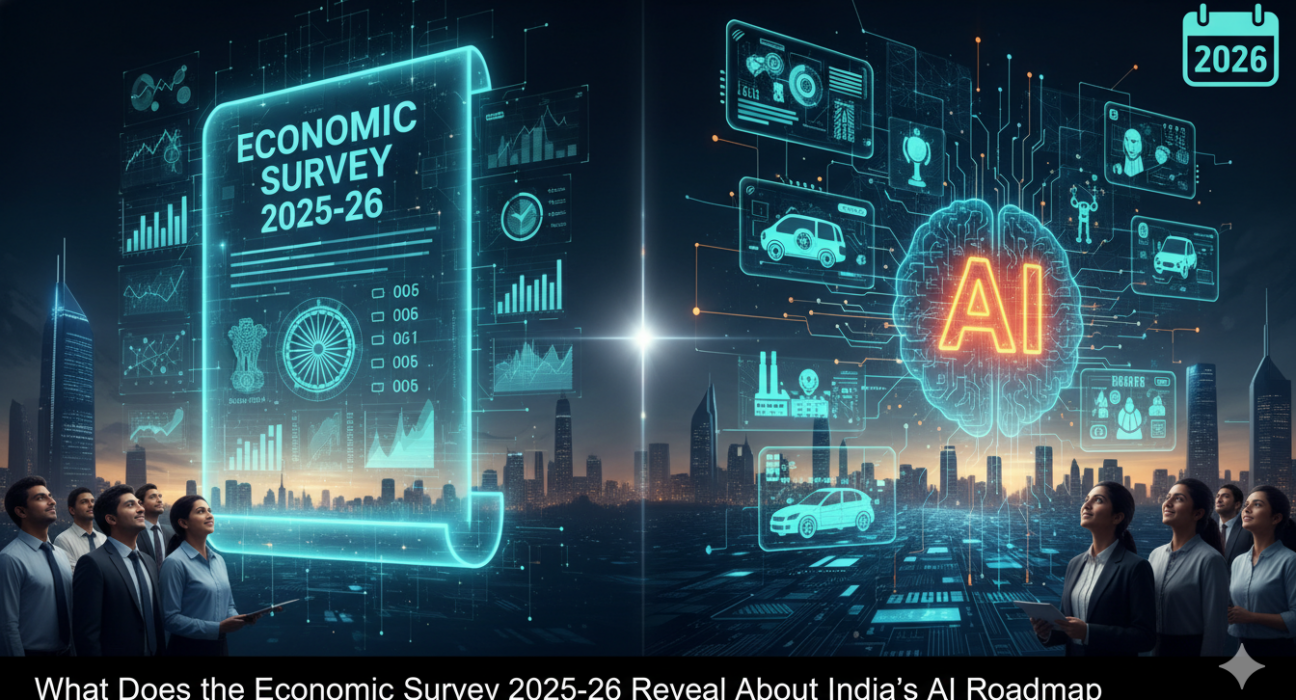
The Economic Survey 2025-26, tabled in Parliament on January 29, 2026, presents a decisive shift in the nation’s technological roadmap, viewing Artificial Intelligence (AI) not merely as a global arms race but as a strategic economic lever. Instead of competing directly with Western “frontier” models, the Survey advocates for a “bottom-up, application-focused” approach tailored to India’s unique socio-economic needs. This strategy prioritizes frugal innovation, sovereign compute infrastructure, and a workforce transition toward augmented intelligence to ensure inclusive growth.
How Will India Implement a “Bottom-Up” AI Innovation Strategy?
The Survey explicitly advises against mimicking capital-intensive foreign models. Instead, it outlines a pragmatic framework designed to solve local problems using indigenous solutions.
- Sector-Specific Solutions: The focus is on developing smaller, highly efficient AI systems targeted at critical sectors like agriculture (precision farming), healthcare (diagnostics in remote areas), education (personalized learning), and urban management.
- Frugal AI: A core tenet of the strategy is “Frugal AI”—emphasizing systems that run on local, low-cost hardware and in low-resource settings. This reduces dependency on expensive foreign technology and ensures accessibility for the masses.
- Indigenous Ecosystem: Under the IndiaAI Mission, the government aims to create a state-hosted, community-curated code repository and facilitate pooled access to public datasets, fostering a sovereign digital infrastructure.
Will AI Replace Jobs in India According to the Survey?
Addressing widespread fears of job displacement, the Economic Survey 2025-26 shifts the narrative from “replacement” to “Augmented Intelligence” (man + machine). The goal is to enhance human productivity rather than substitute it.
- AI-Resilient Jobs: The Survey identifies roles reliant on empathy, manual dexterity, and complex social dynamics—such as nursing, mental health counselling, plumbing, and culinary arts—as the safest from automation disruption.
- Education Reform: There is a strong call to pivot education away from narrow technical specialisation toward foundational human skills like reasoning, communication, and adaptability.
- ‘Earn and Learn’ Initiative: To bridge the skills gap, the document recommends co-designed pathways between the private sector and academia, allowing students to integrate AI tools into their workflows while studying.
What New Institutions and Risks Does the Survey Identify?
To manage the rapid deployment of these technologies, the Survey proposes new governance structures while flagging critical infrastructure risks.
- New Institutional Bodies:
- AI Economic Council: Proposed to align technology deployment with India’s skilling infrastructure and developmental priorities.
- AI Safety Institute: Tasked with assessing emerging risks, plugging regulatory gaps, and institutionalizing safety testing protocols like “red-teaming” for new models.
- Key Risks:
- Compute Bottleneck: The shortage of GPUs and critical chips is identified as the single biggest long-term hurdle for expanding India’s AI capacity.
- Resource Intensity: The Survey warns that large-scale AI data centres are highly water- and energy-intensive, posing a strain on national resources.
- Financial Bubble: It flags the risk of highly-leveraged global investments in AI infrastructure, warning that a market correction could tighten global financial conditions.
Frequently Asked Questions
1.What is the “Frugal AI” approach mentioned in the Economic Survey 2026?
Frugal AI refers to the development of artificial intelligence systems that are resource-efficient and capable of running on local, low-cost hardware. The Economic Survey 2025-26 champions this approach to reduce India’s dependency on expensive foreign technology and to ensure that AI solutions are accessible and viable in low-resource environments like rural agriculture or remote healthcare.
2.Which jobs are considered “AI-Resilient” in the new Economic Survey?
The Survey identifies jobs that require deep empathy, manual dexterity, and complex social dynamics as the most “AI-Resilient.” Specific examples cited include nursing, mental health counselling, plumbing, and culinary arts, as these roles involve human nuances that current AI models cannot easily replicate.
3.What is the purpose of the proposed AI Safety Institute?
The AI Safety Institute is a new body proposed to institutionalize the safety and regulation of AI models in India. Its primary mandate is to assess emerging risks, identify and plug regulatory gaps, and conduct rigorous safety testing—such as “red-teaming”—to ensure that AI deployment aligns with national safety standards and ethical guidelines.
Conclusion
The Economic Survey 2025-26 charts a unique course for India, rejecting the “one-size-fits-all” model of Western tech giants in favor of a “bottom-up” strategy. By prioritizing Frugal AI, establishing bodies like the AI Economic Council, and focusing on Augmented Intelligence, India aims to harness the economic potential of AI while mitigating its social and environmental risks. For policymakers and investors, this document serves as a blueprint for a digital future that is not just technologically advanced, but socially inclusive and economically resilient.
Disclaimer: The information provided is not trading advice, Bitcoinworld.co.in holds no liability for any investments made based on the information provided on this page. We strongly recommend independent research and/or consultation with a qualified professional before making any investment decisions.
