

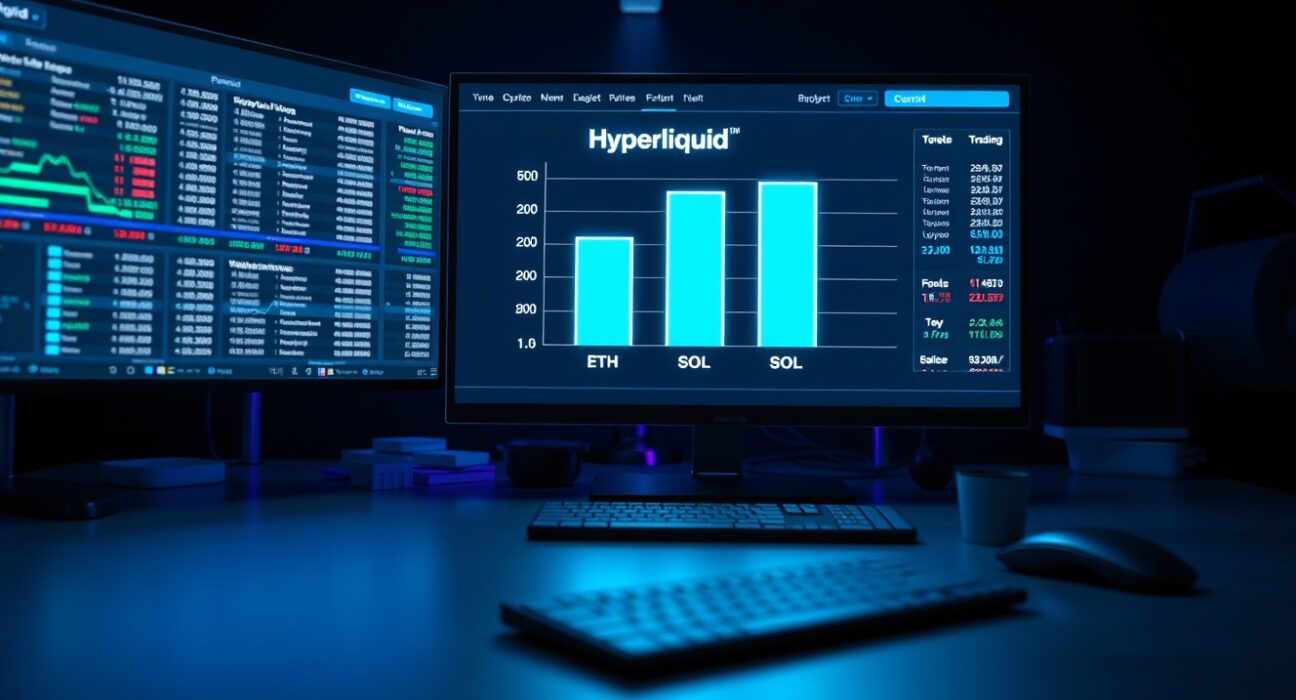
Hyperliquid, a decentralized exchange specializing in perpetual futures trading, has generated approximately $11 million in weekly fees, capturing 43% of the total market share among major blockchain networks, according to data from DeFiLlama as reported by Unfolded. This marks a significant shift in the fee landscape, outpacing established networks like Ethereum and Solana.
Fee Market Share Comparison
Over the same period, Ethereum generated roughly $3 million in fees, representing about 13% of the market, while Solana accounted for approximately $2 million, or 10%. The data highlights Hyperliquid’s rapid ascent in the decentralized finance (DeFi) sector, driven primarily by high-margin perpetual futures trading, which appeals to traders seeking leveraged exposure without traditional intermediaries.
What Is Driving Hyperliquid’s Growth?
Hyperliquid’s fee generation is closely tied to its niche focus on perpetual futures—a type of derivative contract that allows traders to speculate on asset prices with leverage, without an expiry date. The platform’s efficient order matching and low latency have attracted a growing user base, particularly during periods of high market volatility. Industry observers note that the platform’s fee structure, which is higher per trade compared to spot trading on other networks, contributes to its outsized fee revenue relative to transaction volume.
Implications for the Broader DeFi Ecosystem
The fee data underscores a broader trend where specialized DeFi applications can generate significant economic activity, rivaling general-purpose smart contract platforms. For Ethereum and Solana, which have historically dominated fee generation, Hyperliquid’s rise signals increasing competition in the fee market. However, analysts caution that fee comparisons can be misleading, as they reflect different types of on-chain activity. Ethereum’s fees are spread across a vast ecosystem of DeFi protocols, NFTs, and decentralized applications, while Hyperliquid’s are concentrated in a single product category.
Conclusion
Hyperliquid’s 43% weekly fee share represents a notable milestone, but its long-term sustainability depends on maintaining user demand for perpetual futures and navigating regulatory scrutiny. For now, the data provides a clear snapshot of shifting value capture within the crypto economy, where specialized platforms can outperform generalist networks in specific metrics.
FAQs
Q1: What is Hyperliquid?
Hyperliquid is a decentralized exchange (DEX) focused on perpetual futures trading, allowing users to trade with leverage. It operates on its own Layer 1 blockchain and has gained traction for its high-speed order execution.
Q2: Why are Hyperliquid’s fees so high compared to Ethereum and Solana?
Hyperliquid’s fees are driven by high-margin perpetual futures trades, which typically incur higher costs per transaction than spot trading. The platform’s fee structure and concentrated user activity in a volatile market contribute to its elevated fee generation.
Q3: Does this mean Hyperliquid is more valuable than Ethereum or Solana?
Not necessarily. Fee generation is just one metric. Ethereum and Solana support a much wider range of applications and have larger user bases, total value locked (TVL), and network effects. Hyperliquid’s fee dominance reflects its niche focus rather than overall network superiority.
Disclaimer: The information provided is not trading advice, Bitcoinworld.co.in holds no liability for any investments made based on the information provided on this page. We strongly recommend independent research and/or consultation with a qualified professional before making any investment decisions.
