
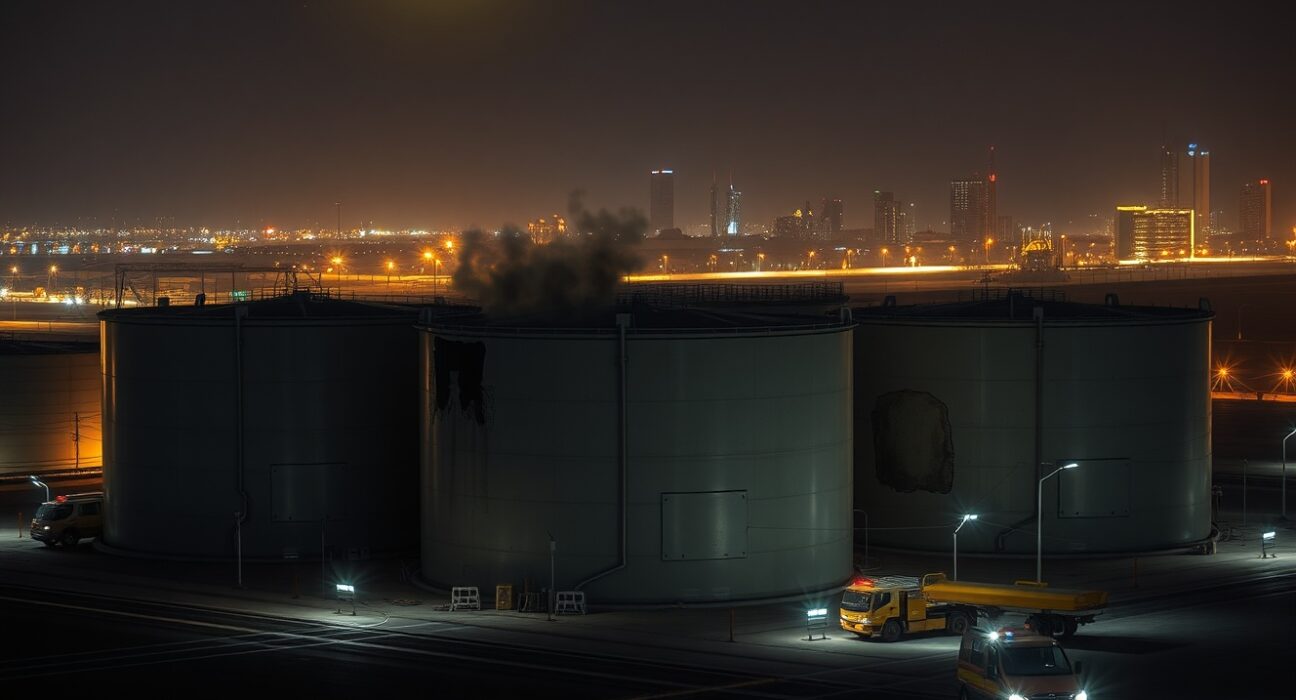
An explosive Iranian attack targeted critical fuel storage tanks at a major facility in Bahrain’s Muharraq district on March 15, 2025, marking a significant escalation in regional tensions and threatening energy security across the Gulf Cooperation Council states. The precision strike represents one of the most direct Iranian military actions against Bahraini infrastructure in recent years, raising immediate concerns about regional stability and international energy markets.
Iranian Attack on Bahrain’s Muharraq Facility: Immediate Impact
The attack specifically targeted fuel storage tanks at the Sitra Petroleum Complex in Muharraq, according to Bahrain’s Ministry of Interior. Emergency services responded immediately to contain fires and prevent environmental damage. Consequently, Bahrain’s National Oil and Gas Authority activated contingency plans to maintain fuel supplies. The facility stores approximately 250,000 barrels of refined petroleum products, primarily serving domestic consumption and regional distribution.
Security analysts confirm the attack utilized precision-guided munitions, likely launched from Iranian-controlled positions. Furthermore, regional defense monitoring groups detected unusual aerial activity in the hours preceding the strike. Bahrain’s Civil Defense reported containing the blaze within four hours, preventing catastrophic secondary explosions. Meanwhile, international observers documented significant damage to at least three primary storage tanks.
Geopolitical Context of Gulf Security Crisis
The Muharraq attack occurs against a backdrop of escalating tensions between Iran and Gulf Arab states. Bahrain maintains particularly sensitive relations with Iran due to historical claims and sectarian dynamics. The kingdom hosts the U.S. Navy’s Fifth Fleet headquarters, adding strategic significance to any security incident. Regional experts note this represents a calculated escalation in Iranian military posture.
Historical Precedents and Regional Patterns
This incident follows a pattern of Iranian proxy attacks throughout the region. Previously, Houthi forces in Yemen targeted Saudi Arabian oil facilities using Iranian-supplied drones. Similarly, Iranian-backed groups in Iraq have launched attacks against energy infrastructure. However, the direct targeting of Bahraini sovereign territory represents a notable escalation in tactics and brazenness.
The table below illustrates recent significant attacks on Gulf energy infrastructure:
| Date | Location | Target | Attributed Actor |
|---|---|---|---|
| September 2019 | Abqaiq, Saudi Arabia | Oil processing facility | Houthi forces |
| November 2022 | Jeddah, Saudi Arabia | Fuel distribution station | Houthi forces |
| January 2024 | UAE coastal facilities | Fuel storage tanks | Iranian-backed militias |
| March 2025 | Muharraq, Bahrain | Fuel storage complex | Iranian military |
Energy Security Implications for Middle East Infrastructure
The attack raises immediate concerns about the vulnerability of critical energy infrastructure throughout the Gulf region. Bahrain, while not a major oil exporter, plays a crucial role in regional energy logistics. The Muharraq facility serves as a key distribution hub for refined products. Consequently, any disruption affects supply chains across multiple GCC nations.
Energy analysts identify several critical implications:
- Supply chain vulnerability: The attack demonstrates precision targeting capabilities against hardened infrastructure
- Insurance premium increases: Maritime and energy insurers will likely raise premiums for Gulf operations
- Investment climate impact: Foreign energy companies may reconsider regional investment security
- Strategic reserve policies: GCC nations may accelerate strategic petroleum reserve expansion
International energy markets reacted cautiously to the news. Brent crude futures initially rose 2.3% before stabilizing. Meanwhile, shipping companies began rerouting some vessels as a precautionary measure. The Strait of Hormuz, through which approximately 20% of global oil passes daily, remains under heightened surveillance.
Military and Defense Response Analysis
Bahrain’s defense forces immediately elevated alert levels following the attack. The kingdom participates in the Combined Maritime Forces coalition, which includes 34 nations. Additionally, U.S. Central Command confirmed enhanced patrols in Bahraini territorial waters. Regional defense cooperation mechanisms activated contingency protocols within hours.
Military experts highlight several response considerations:
- Air defense capabilities: The attack succeeded despite Bahrain’s advanced air defense network
- Intelligence sharing: Regional intelligence cooperation failed to prevent the strike
- Deterrence posture: Current deterrence strategies appear insufficient against direct Iranian action
- Asymmetric warfare: The attack demonstrates Iran’s evolving asymmetric capabilities
Defense analysts note the attack employed sophisticated evasion techniques against radar systems. This suggests either technological advancement or intelligence penetration of defense networks. Consequently, regional militaries will likely accelerate air defense modernization programs.
Economic Consequences and Market Reactions
The immediate economic impact extends beyond energy markets. Bahrain’s tourism and financial sectors face potential disruption from perceived instability. The kingdom has worked diligently to position itself as a regional financial hub. However, security incidents undermine investor confidence and economic diversification efforts.
Key economic indicators show:
- Bahrain stock exchange declined 1.8% in early trading
- Credit default swap spreads widened by 15 basis points
- Currency markets showed minimal impact on Bahraini dinar peg
- Construction and real estate sectors expressed concern about project timelines
>
Regional economic integration efforts may face setbacks due to heightened security concerns. The GCC has pursued economic coordination through various initiatives. Nevertheless, security incidents complicate cross-border investment and trade facilitation. International financial institutions will monitor sovereign credit ratings closely.
Diplomatic Fallout and International Response
The United Nations Security Council scheduled emergency consultations following the attack. Permanent members expressed varying degrees of concern about regional escalation. The United States condemned the attack unequivocally, reaffirming security commitments to Bahrain. European Union foreign policy chiefs called for restraint and dialogue.
Regional diplomatic channels activated immediately. The GCC issued a strong condemnation statement within hours. Arab League emergency sessions produced calls for united action. Meanwhile, Iranian officials offered no immediate comment on the incident. This silence contrasts with previous denials following similar regional incidents.
International legal experts note potential violations of:
- United Nations Charter Article 2(4) prohibiting force against territorial integrity
- International humanitarian law principles regarding civilian infrastructure
- Customary international law norms of state responsibility
Environmental and Safety Considerations
Environmental agencies mobilized response teams to assess potential contamination. The Muharraq facility’s proximity to residential areas raised public health concerns. Bahrain’s Environment Authority confirmed monitoring air quality throughout the incident. Preliminary readings showed elevated particulate levels but no toxic chemical releases.
Safety protocols prevented catastrophic environmental damage through:
- Automatic fire suppression system activation
- Secondary containment berm integrity
- Rapid emergency response coordination
- Effective evacuation of non-essential personnel
Environmental impact assessments will continue for several weeks. Meanwhile, marine biologists expressed concern about potential coastal contamination. The facility’s location near sensitive marine ecosystems necessitates careful monitoring. International environmental organizations offered technical assistance.
Conclusion
The Iranian attack on Bahrain’s Muharraq fuel facility represents a dangerous escalation in Gulf security dynamics. This incident demonstrates evolving capabilities to target critical energy infrastructure with precision. Consequently, regional stability faces renewed pressure from asymmetric warfare tactics. The international community must address these security challenges through coordinated diplomatic and defense measures. Ultimately, the Muharraq attack underscores the fragile nature of energy security in strategically vital regions.
FAQs
Q1: What specifically was targeted in the Muharraq attack?
The attack precision-targeted fuel storage tanks at the Sitra Petroleum Complex in Bahrain’s Muharraq district. These tanks store approximately 250,000 barrels of refined petroleum products for domestic and regional distribution.
Q2: How has Bahrain responded to the security incident?
Bahrain activated emergency response protocols, contained the fires within hours, elevated military alert levels, and initiated diplomatic outreach through GCC and international channels while maintaining fuel supply through contingency plans.
Q3: What are the immediate implications for regional energy markets?
The attack caused temporary Brent crude price increases, prompted vessel rerouting precautions, raised insurance premium concerns, and highlighted vulnerability of critical infrastructure throughout the Gulf region.
Q4: How does this attack fit into broader regional security patterns?
This incident represents an escalation from previous proxy attacks to direct state action, demonstrating evolving Iranian capabilities to target hardened infrastructure with precision-guided munitions across sovereign borders.
Q5: What international legal implications does this attack carry?
The attack potentially violates UN Charter prohibitions on use of force, international humanitarian law protections for civilian infrastructure, and customary international law norms regarding state responsibility for cross-border military actions.
Disclaimer: The information provided is not trading advice, Bitcoinworld.co.in holds no liability for any investments made based on the information provided on this page. We strongly recommend independent research and/or consultation with a qualified professional before making any investment decisions.