

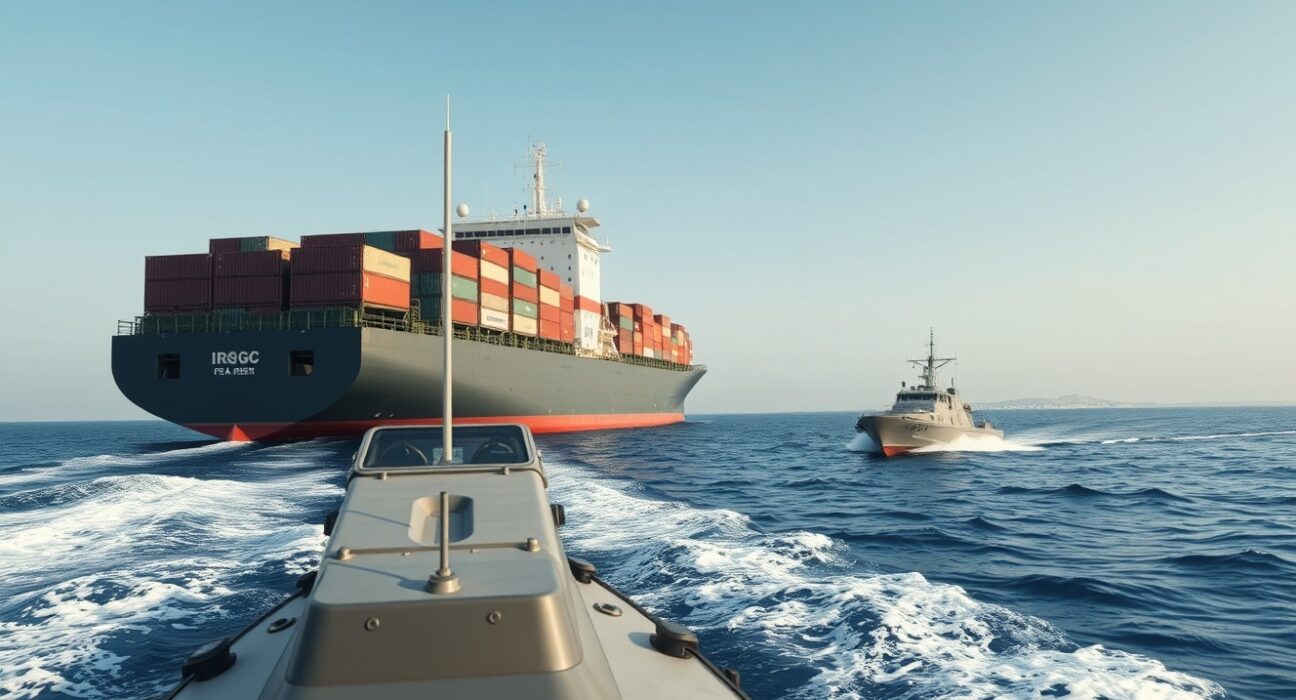
A recent IRGC gunboat attack on a commercial container ship near Oman has escalated regional maritime tensions and raised urgent questions about the security of vital global shipping lanes. This incident, occurring on March 15, 2025, in international waters approximately 50 nautical miles off the coast of Muscat, represents a significant escalation in a pattern of naval harassment. Consequently, shipping companies and international observers are now reassessing risk profiles for one of the world’s most critical economic arteries.
IRGC Gunboat Attack Details and Immediate Aftermath
The attacked vessel was the MV Global Trader, a Liberian-flagged container ship operated by a Singapore-based company. According to maritime security firm Dryad Global, the incident began at approximately 08:30 local time. Subsequently, two Islamic Revolutionary Guard Corps Navy (IRGCN) fast-attack craft approached the merchant vessel at high speed. The gunboats then conducted aggressive maneuvering, crossing the container ship’s bow at dangerously close distances. Furthermore, the IRGC personnel issued radio challenges, ordering the MV Global Trader to alter course. The ship’s master complied with standard protocols, maintaining a steady heading while alerting the United Kingdom Maritime Trade Operations (UKMTO) office in Dubai. Fortunately, no weapons were fired, and the vessel sustained no physical damage. However, the crew reported significant psychological distress following the 45-minute encounter.
Historical Context of Maritime Incidents
This event is not an isolated occurrence. Instead, it fits within a documented pattern of Iranian naval activity in the Strait of Hormuz and the Gulf of Oman. For instance, the U.S. Naval Institute’s database records over 20 similar incidents of harassment against commercial shipping since 2019. Moreover, the International Maritime Bureau (IMB) consistently lists these waters as a region of concern in its annual piracy reports. The table below illustrates the escalation in incidents over recent years.
| Year | Reported Harassment Incidents | Confirmed Attacks | Primary Actor |
|---|---|---|---|
| 2022 | 7 | 2 | IRGCN |
| 2023 | 11 | 3 | IRGCN / Houthi |
| 2024 | 15 | 5 | IRGCN |
| 2025 (YTD) | 4 | 1 | IRGCN |
Geopolitical Implications and Regional Tensions
The strategic location of the attack amplifies its significance. The Gulf of Oman serves as a crucial funnel for global energy supplies. Specifically, nearly 20% of the world’s oil consumption passes through the adjacent Strait of Hormuz. Therefore, any instability directly threatens global energy security and market prices. Regional powers have responded swiftly. The Omani Foreign Ministry issued a statement expressing “deep concern” and called for restraint. Conversely, Iranian state media framed the incident as a routine inspection of a “suspicious vessel.” This discrepancy in narratives highlights the ongoing information warfare in the region. Additionally, the U.S. Fifth Fleet, based in Bahrain, increased its patrol presence following the event. Similarly, the Combined Maritime Forces (CMF), a 34-nation naval partnership, has reportedly enhanced its surveillance in the area.
Expert Analysis on Motivations
Dr. Anya Petrova, a senior fellow at the Center for Maritime Security Studies, explains the likely calculus behind such actions. “These gunboat attacks serve multiple purposes for Tehran,” she notes. “Primarily, they demonstrate Iran’s capacity to disrupt shipping at a time of heightened nuclear negotiations. They also act as a pressure tool, reminding global powers of the regional costs of isolation.” Furthermore, these incidents test the response protocols of Western navies and commercial shippers. Petrova adds, “Each unchallenged encounter emboldens further escalation, potentially leading to a miscalculation with severe consequences.”
Impact on Global Shipping and Insurance Markets
The immediate commercial impact has been tangible. Following the attack, the Baltic Exchange’s assessments showed a 15% increase in war risk insurance premiums for vessels transiting the Gulf of Oman. Major shipping lines, including Maersk and MSC, have issued advisories to their fleets. These advisories recommend enhanced vigilance and, in some cases, suggest considering longer alternative routes. However, rerouting around the Cape of Good Hope adds approximately 10-14 days to Asia-Europe transit times. Consequently, this increases fuel costs by an estimated $500,000 per voyage. The cumulative effect on global supply chains, still recovering from pandemic-era disruptions, could be significant. Key impacts include:
- Increased Operational Costs: Higher insurance, potential security escort fees, and longer voyage times.
- Supply Chain Delays: Just-in-time manufacturing and retail inventory could face new bottlenecks.
- Market Volatility: Energy and freight futures markets often react sharply to security incidents in the region.
Legal and Diplomatic Frameworks
International law provides clear guidelines for such incidents. The United Nations Convention on the Law of the Sea (UNCLOS) guarantees freedom of navigation in exclusive economic zones (EEZs) and international waters. Article 110 permits warships to board foreign merchant vessels only under specific conditions, such as reasonable suspicion of piracy or slavery. The IRGC’s stated reason of a “routine inspection” does not clearly meet this legal threshold. Therefore, the attack may constitute a violation of international maritime law. Diplomatically, the incident will likely be raised at the International Maritime Organization (IMO) and through bilateral channels. The United Kingdom, as the penholder on maritime security at the UN Security Council, has already called for a briefing on the event.
Comparison to Other Global Chokepoints
Understanding this incident requires a global perspective. Other critical maritime chokepoints, like the South China Sea and the Bab el-Mandeb Strait, also experience tensions. However, the combination of state-sponsored harassment, high traffic volume, and concentrated energy exports makes the Strait of Hormuz uniquely volatile. Unlike piracy in the Gulf of Guinea, which is primarily criminally motivated, actions in the Gulf of Oman are often geopolitically driven. This state-actor dimension makes resolution more complex and dangerous.
Conclusion
The IRGC gunboat attack on a container ship near Oman underscores the fragile state of maritime security in a region vital to the global economy. This event highlights the persistent threat of state-sponsored harassment to commercial freedom of navigation. Moving forward, the international community must balance robust diplomatic engagement with credible naval deterrence to prevent escalation. Ensuring the safe passage of goods through these waters remains a fundamental interest for all trading nations. The response to this incident will set a critical precedent for the security of global shipping lanes in 2025 and beyond.
FAQs
Q1: What exactly happened in the IRGC gunboat attack?
The Islamic Revolutionary Guard Corps Navy deployed fast-attack craft to aggressively approach and harass the MV Global Trader, a container ship, in international waters off Oman. The gunboats conducted dangerous maneuvers and issued radio challenges for approximately 45 minutes before disengaging.
Q2: Why is the location of this attack so significant?
The attack occurred in the Gulf of Oman, near the entrance to the Strait of Hormuz. This chokepoint is arguably the world’s most important oil transit lane, handling about 20% of global oil consumption. Instability here directly impacts global energy prices and security.
Q3: Has Iran commented on the incident?
Yes. Iranian state media has described the event as a routine inspection of a suspicious vessel, a claim contested by the shipping company and international maritime security organizations which classify it as harassment.
Q4: What are the immediate impacts on global shipping?
The primary impacts are increased war risk insurance premiums for vessels transiting the region, potential rerouting adding significant time and cost to voyages, and heightened alert levels for shipping companies operating in Middle Eastern waters.
Q5: What legal protections do commercial ships have in international waters?
The United Nations Convention on the Law of the Sea (UNCLOS) guarantees freedom of navigation. Warships cannot board or detain foreign merchant vessels without reasonable suspicion of specific serious crimes like piracy. Unprovoked harassment likely violates these international legal norms.
Disclaimer: The information provided is not trading advice, Bitcoinworld.co.in holds no liability for any investments made based on the information provided on this page. We strongly recommend independent research and/or consultation with a qualified professional before making any investment decisions.
