

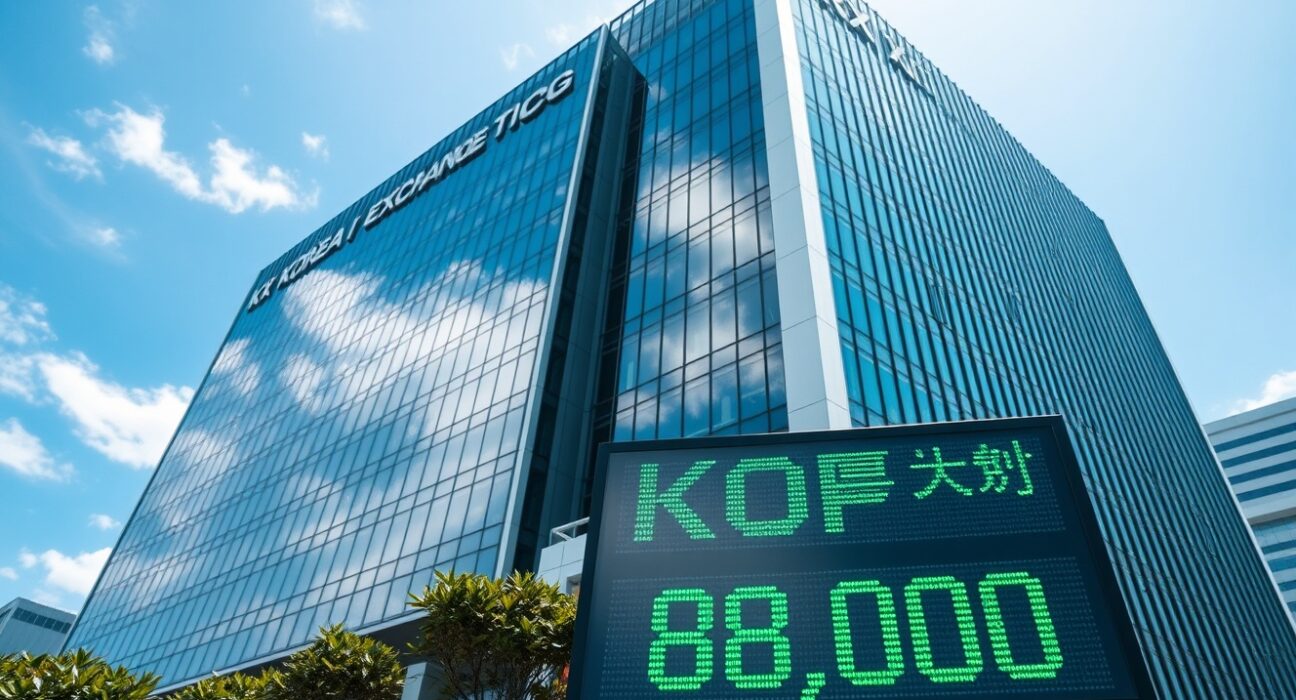
South Korea’s benchmark stock index, the KOSPI, reached an unprecedented milestone on Wednesday, surpassing the 8,700 mark during intraday trading for the first time in its history. The index touched 8,712.34 before paring some gains, driven by strong buying in technology and semiconductor shares.
Market Momentum and Key Drivers
The rally was fueled by a surge in heavyweight stocks, particularly Samsung Electronics and SK Hynix, which benefited from rising global demand for memory chips and artificial intelligence components. Foreign investors were net buyers, adding approximately 1.2 trillion won ($900 million) to local equities by midday.
The KOSPI has gained over 18% year-to-date, supported by robust export data, a recovering Chinese economy, and expectations that the Bank of Korea will maintain accommodative monetary policy. The index closed at 8,689.45, up 1.4% from the previous session.
Historical Context and Milestones
The KOSPI was launched in 1983 with a base value of 100. It first broke the 2,000 mark in 2007, crossed 3,000 in early 2021, and has accelerated sharply over the past 18 months. The rapid ascent from 7,000 to 8,700 took just over 10 months, reflecting the structural shift in South Korea’s economy toward high-value technology exports.
Market analysts note that the current rally is broader than previous ones, with mid-cap and small-cap stocks also participating. The KOSPI’s price-to-earnings ratio stands at approximately 12.5, which is below the five-year average of 14.2, suggesting the market may not be overvalued despite the record levels.
Implications for Retail and Institutional Investors
For domestic retail investors, who have increased their equity exposure significantly since the pandemic, the milestone reinforces confidence in the long-term growth story of Korean companies. However, financial advisors caution against chasing momentum and recommend maintaining diversified portfolios.
Institutional investors are closely watching the Bank of Korea’s next policy decision, scheduled for next week. Any hawkish signals on interest rates could temper the rally, though most economists expect rates to remain unchanged until the fourth quarter.
Conclusion
The KOSPI’s breach of 8,700 marks a historic moment for South Korea’s capital markets, reflecting the country’s growing influence in the global semiconductor and technology supply chain. While short-term volatility is possible, the underlying fundamentals — strong exports, corporate earnings growth, and structural reforms — provide a solid foundation for sustained market performance. Investors should monitor global trade dynamics and monetary policy developments as key factors influencing the index’s next direction.
FAQs
Q1: What does the KOSPI reaching 8,700 mean for the South Korean economy?
A1: It signals strong investor confidence in South Korea’s export-driven economy, particularly in technology and semiconductor sectors. The milestone reflects robust corporate earnings and positive macroeconomic conditions.
Q2: Should I invest in KOSPI stocks now?
A2: Market timing is difficult. While the long-term outlook remains positive, investors should assess their risk tolerance, diversify holdings, and consult a financial advisor before making investment decisions.
Q3: How does the KOSPI compare to other global indices?
A3: The KOSPI has outperformed many major indices in 2026, including the S&P 500 and Nikkei 225, driven by strong demand for AI-related semiconductors and memory chips. Its valuation remains reasonable compared to historical averages.
Disclaimer: The information provided is not trading advice, Bitcoinworld.co.in holds no liability for any investments made based on the information provided on this page. We strongly recommend independent research and/or consultation with a qualified professional before making any investment decisions.
