
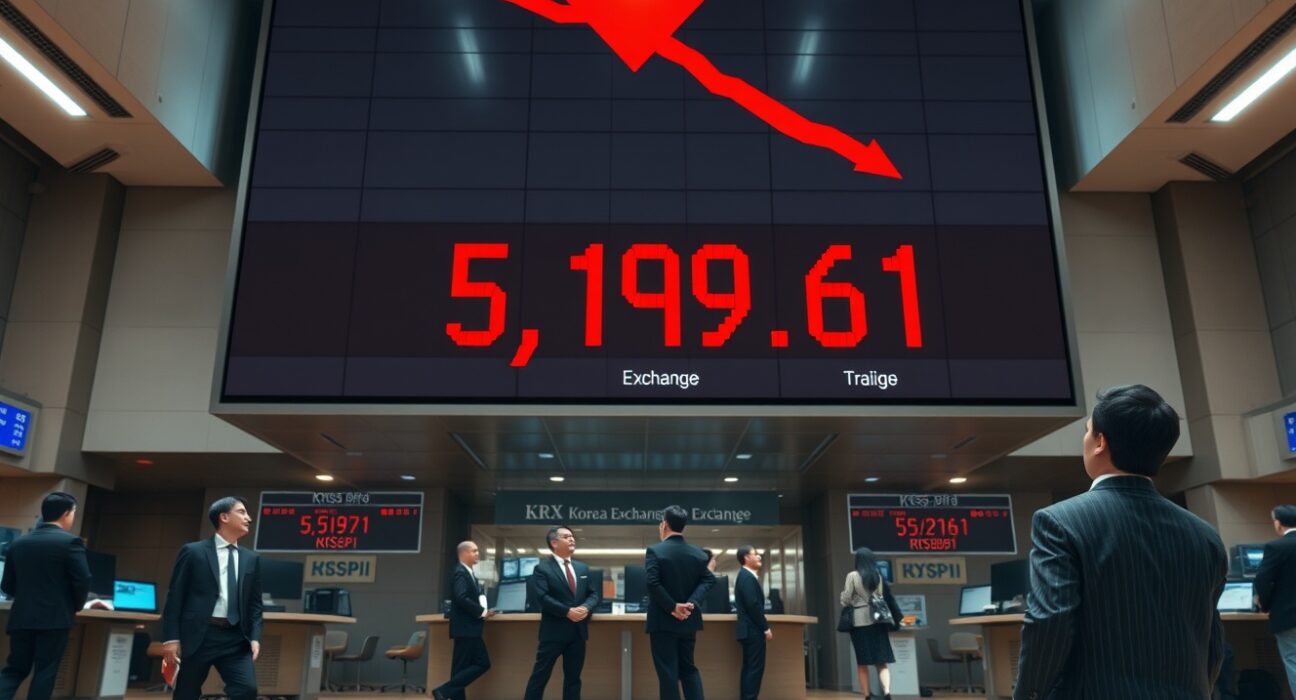
SEOUL, South Korea – The Korea Exchange (KRX) activated a critical sell-side sidecar circuit breaker today after the benchmark KOSPI index plunged more than 5% in a sharp, sudden market downturn. This decisive action marks the first such activation in eight days, following a previous intervention on March 23, and immediately halted a cascade of automated sell orders. Consequently, the KOSPI is currently trading at 5,195.61, representing a steep 5.17% decline from the previous session’s close. This event underscores the volatile conditions currently gripping Asian financial markets.
KOSPI Plunge Triggers Market Safeguard Mechanism
The sell-side sidecar is a specific, automated trading curb deployed by the Korea Exchange. It activates automatically when the KOSPI 200 futures contract falls by more than 5% from the previous day’s closing price within a five-minute window. Upon activation, the mechanism imposes a five-minute cooling-off period for all sell-side program trades linked to the futures market. This pause is designed specifically to prevent a flash crash driven by algorithmic trading systems. Meanwhile, buy orders and non-program trades continue normally, allowing liquidity to potentially re-enter the market. The system’s primary goal is to provide a brief respite for human traders and risk managers to assess the situation. Therefore, it acts as a first line of defense before more severe market-wide circuit breakers come into play.
Anatomy of the Korea Exchange Circuit Breaker System
The Korea Exchange employs a multi-tiered system to manage extreme volatility. The sell-side sidecar represents just one component of this sophisticated framework. For context, the full system includes:
- Sidecar (Trading Curb): A 5-minute halt on program sell orders triggered by a 5% futures drop.
- Market-Wide Circuit Breaker (Level 1): An 8% drop in the KOSPI index triggers a 20-minute trading halt for all securities.
- Market-Wide Circuit Breaker (Level 2): A 15% drop triggers a full trading suspension for the remainder of the session.
Today’s event stopped at the sidecar level, preventing a deeper collapse. By comparison, major global exchanges use similar mechanisms. For instance, the U.S. has Market-Wide Circuit Breakers (MWCBs), and Japan employs price limits on futures. The KRX system is notably proactive in targeting algorithmic sell pressure directly.
Expert Analysis on the Market Catalyst
Financial analysts point to a confluence of factors driving the sudden KOSPI sell-off. Primarily, stronger-than-expected inflation data from a major trading partner has renewed fears of prolonged restrictive monetary policy globally. Simultaneously, a sharp appreciation of the US Dollar has pressured emerging market currencies, including the Korean Won, prompting foreign investor outflow. Additionally, sector-specific weaknesses in key Korean export industries, such as semiconductors and batteries, have amplified the downward momentum. Market sentiment was already fragile following the previous sidecar activation on March 23, indicating underlying instability. Consequently, the rapid decline met the precise technical threshold for the sidecar, demonstrating the system’s designed responsiveness.
Historical Context and Frequency of Sidecar Activations
The activation of a sell-side sidecar remains a relatively rare event, signaling periods of acute stress. Prior to today, the last activation occurred on March 23, 2025. Historically, these events cluster during periods of global financial uncertainty. For example, multiple activations were recorded during the 2020 pandemic-induced volatility and the 2022 market corrections. The table below shows recent notable activations:
| Date | KOSPI Close | Trigger (Futures Drop) | Outcome |
|---|---|---|---|
| March 31, 2025 | 5,195.61 | >5% | 5-min halt; market stabilized post-halt |
| March 23, 2025 | ~5,480.00 | >5% | 5-min halt; session ended lower |
| October 2022 | ~2,200.00 | >5% | Multiple activations during bear market |
This pattern shows the mechanism’s role as a stabilizing tool during rapid declines. Furthermore, its use provides a clear, data-driven signal to the international investment community about real-time market conditions in Seoul.
Immediate Impact and Market Reaction
Following the five-minute sell-side sidecar halt, trading resumed with continued volatility. The immediate impact was a visible reduction in the velocity of the decline. Market depth, as measured by order book liquidity, showed signs of tentative improvement as the automated sell pressure subsided. Key blue-chip stocks like Samsung Electronics and Hyundai Motor experienced heavy selling volume but found temporary support levels after the halt. The Korean Won also depreciated further against the dollar during the session, reflecting broader risk-off sentiment. Overseas investors were net sellers for the session, continuing a recent trend of capital outflow from emerging Asian markets. Domestic institutional investors, however, provided some counter-balancing buy-side activity, according to preliminary exchange data.
The Role of Algorithmic Trading in Modern Volatility
The very existence of the sell-side sidecar highlights the dominant role of algorithmic and high-frequency trading (HFT) in modern markets. These systems can execute thousands of orders per second based on pre-set conditions. While they provide liquidity in normal times, they can also create self-reinforcing feedback loops during a downturn. A decline triggers algorithm-driven selling, which causes further declines, prompting more selling. The sidecar mechanism directly interrupts this specific feedback loop for a critical five minutes. This design acknowledges that human intervention and reassessment are necessary to break automated panic. Regulators globally continue to debate the optimal design of such circuit breakers as trading technology evolves.
Conclusion
The activation of the sell-side sidecar following a greater than 5% KOSPI plunge serves as a critical reminder of the automated safeguards embedded in modern financial systems. This event, the second in just over a week, reflects ongoing global macroeconomic uncertainties impacting South Korea’s export-oriented economy. The Korea Exchange’s circuit breaker system performed its intended function by temporarily halting automated sell pressure, providing a circuit break in the electronic panic. While the mechanism stabilizes trading technically, the underlying causes of the sell-off—inflation concerns, currency pressures, and sectoral weaknesses—require broader economic attention. Consequently, market participants will closely monitor whether this intervention provides a lasting floor or merely a pause in a broader corrective trend.
FAQs
Q1: What is a sell-side sidecar?
A sell-side sidecar is a trading curb on the Korea Exchange that triggers a five-minute halt on all program-driven sell orders for stock index futures when they fall more than 5% in five minutes. It aims to cool automated selling pressure.
Q2: How often does the Korea Exchange activate the sidecar?
Activations are rare and signal high stress. Before today’s (March 31, 2025) event, the last was eight days prior on March 23. Clusters occur during periods of global market turmoil.
Q3: What is the difference between a sidecar and a full market circuit breaker?
A sidecar only pauses program sell orders for futures. A full market circuit breaker (triggered by an 8% or 15% KOSPI drop) halts all trading in all stocks for a set time or the rest of the session.
Q4: Did trading stop completely when the sidecar activated?
No. Only program-driven sell orders for KOSPI 200 futures were paused for five minutes. Buy orders, individual stock trades, and non-program trading continued normally.
Q5: What usually happens after the sidecar’s five-minute halt ends?
Trading resumes. The halt often reduces the momentum of the decline, allowing human traders to reassess. However, the market can continue to fall or recover based on underlying news and sentiment.
Disclaimer: The information provided is not trading advice, Bitcoinworld.co.in holds no liability for any investments made based on the information provided on this page. We strongly recommend independent research and/or consultation with a qualified professional before making any investment decisions.