
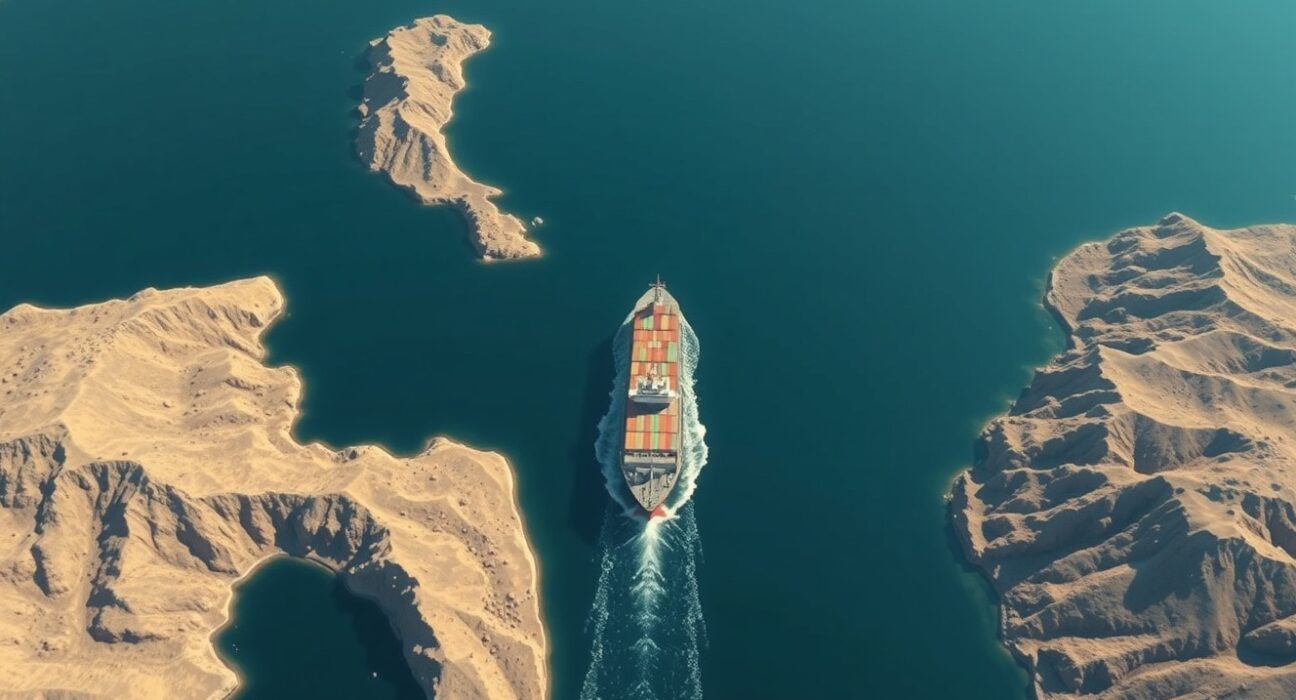
PARIS, France – In a significant geopolitical intervention, French President Emmanuel Macron has delivered a stark assessment of the escalating tensions surrounding the Strait of Hormuz, declaring that a military solution to secure the vital waterway is fundamentally unrealistic. Consequently, Macron emphasized that reopening and safeguarding this maritime artery can only occur through sustained diplomatic negotiations with Iran.
The Strait of Hormuz Standoff and Macron’s Diplomatic Stance
President Macron’s statement directly addresses a prolonged period of instability threatening one of the world’s most critical energy corridors. The Strait of Hormuz, a narrow passage between the Persian Gulf and the Gulf of Oman, serves as a transit route for approximately 21 million barrels of oil daily. This volume represents nearly a quarter of global seaborne-traded oil. Furthermore, a significant portion of liquefied natural gas (LNG) shipments also traverse this chokepoint. Therefore, any disruption triggers immediate volatility in global energy markets and poses severe risks to the world economy.
Macron’s position underscores a growing European divergence from more hawkish postures sometimes advocated by other global powers. His assertion that force is not a viable option is rooted in the complex military and geopolitical realities of the region. For instance, Iran’s coastline dominates the northern side of the strait, and its military has developed asymmetric capabilities specifically designed to threaten shipping in these confined waters. These capabilities include swarms of fast-attack craft, sophisticated anti-ship missile batteries, and naval mines.
Historical Context of Tensions
The current crisis did not emerge in a vacuum. It follows years of escalating incidents, including tanker seizures, suspected limpet mine attacks, and drone strikes. These events are often linked to the broader standoff over Iran’s nuclear program and international sanctions. The 2019 tanker crisis, where multiple vessels were attacked, and the 2021 seizure of the MV Stena Impero by Iranian forces are pivotal examples. Each incident has raised the specter of a broader conflict. Consequently, global naval patrols, like the International Maritime Security Construct (IMSC), have increased their presence, creating a tense environment of military posturing.
Why a Military Solution is Deemed Unrealistic
President Macron’s characterization of a military solution as unrealistic is supported by several strategic analysts and former naval commanders. First, permanently securing a 21-mile-wide channel against a determined regional state with home-field advantage is a monumental, if not impossible, task. A military campaign would likely involve attempting to neutralize Iran’s coastal defenses, an action that could rapidly escalate into a full-scale regional war.
Second, the economic consequences would be catastrophic. Even a limited conflict could lead to the complete closure of the strait, triggering an unprecedented global energy shock. Insurance premiums for shipping would skyrocket, and supply chains would face severe disruption. Third, there is no clear political endgame. A military operation might temporarily clear the waterway but would almost certainly harden Iranian resolve and eliminate prospects for diplomacy for a generation.
Key Realities of the Strait:
- Geography: At its narrowest, the navigable channel is only 2 miles wide, creating a natural chokepoint.
- Traffic Density: Over 100 large vessels transit daily, making them vulnerable to harassment.
- Iranian Advantage: Iran’s territory and islands provide ideal positions for monitoring and interdicting traffic.
- Global Dependence: Major economies in Asia and Europe are critically reliant on hydrocarbons transiting the strait.
The Path of Negotiation: Challenges and Frameworks
By advocating for negotiations, Macron aligns with a school of thought that views the Strait of Hormuz as a symptom of a larger political dispute. The core issues revolve around the Joint Comprehensive Plan of Action (JCPOA), regional security architecture, and the lifting of economic sanctions. Successful negotiations would require addressing these interconnected problems. For example, a potential agreement could involve reciprocal commitments: guarantees of safe navigation in exchange for sanctions relief and steps to de-escalate regional proxy conflicts.
However, the path to negotiation is fraught with obstacles. Trust between Iran and Western powers remains extremely low. Domestic political pressures in Iran, the United States, and European capitals often constrain diplomatic flexibility. Moreover, other regional actors, particularly Gulf Arab states and Israel, have their own significant security concerns regarding Iran’s activities. Any viable diplomatic framework would need to be inclusive enough to address these multilateral fears while being focused enough to produce tangible results on maritime security.
Europe’s Role as a Potential Mediator
France, along with the European Union, has historically positioned itself as a potential mediator in the Iran nuclear dossier. Macron’s statement reinforces this role. European powers have a strong interest in regional stability to ensure energy security but lack the historical baggage that sometimes complicates US-Iran relations. This position could allow France to facilitate back-channel communications or propose confidence-building measures, such as establishing direct military-to-military communication lines to prevent accidental clashes at sea.
Global and Economic Impacts of Continued Instability
The persistent threat to the Strait of Hormuz has already forced a long-term recalibration of global energy logistics and security planning. Major importers are actively diversifying their supply routes and investing in strategic petroleum reserves. For instance, pipeline networks bypassing the strait, like the Abu Dhabi Crude Oil Pipeline to the Fujairah terminal on the Gulf of Oman, have gained strategic importance. Similarly, Saudi Arabia and the UAE have expanded export terminals on their Red Sea coasts.
The table below outlines alternative oil export routes that gain prominence during strait tensions:
| Route/Infrastructure | Country | Approximate Capacity | Strategic Benefit |
|---|---|---|---|
| East-West Pipeline (Petroline) | Saudi Arabia | 5 million bpd | Redirects oil from the Gulf to the Red Sea |
| Abu Dhabi Crude Oil Pipeline | UAE | 1.5 million bpd | Exports from Fujairah, outside the Strait |
| Ceyhan Terminal via Pipeline | Iraq/Turkey | 1.5 million bpd | Provides a Mediterranean export route |
This diversification, however, is costly and cannot fully replace the strait’s capacity in the short term. Consequently, the risk premium on oil—often ranging from $5 to $15 per barrel during crises—becomes a semi-permanent tax on the global economy, fueling inflation and slowing growth.
Conclusion
President Emmanuel Macron’s declaration that a military solution for the Strait of Hormuz is unrealistic serves as a sobering reality check for international policymakers. It highlights the severe limitations of force in resolving a geographically and politically complex standoff. The statement reinforces that lasting security for this indispensable waterway is inextricably linked to the broader, thorny diplomatic puzzle of Iran’s relationship with the international community. Ultimately, Macron’s call for negotiations underscores the urgent need for creative, sustained diplomacy to prevent a miscalculation that could destabilize global energy markets and trigger a wider conflict.
FAQs
Q1: Why is the Strait of Hormuz so important?
The Strait of Hormuz is the world’s most important oil transit chokepoint. Approximately 21 million barrels of oil per day, about 21% of global petroleum liquids consumption, pass through it. Closure would cause a massive supply shock.
Q2: What specific military capabilities does Iran have in the strait?
Iran possesses extensive asymmetric naval capabilities, including hundreds of small, fast attack craft, land-based anti-ship missiles (like the Ghadir and Khalij Fars), naval mines, and submarine assets. These are designed to swarm and harass commercial shipping and naval vessels in the confined waters.
Q3: Has the strait ever been closed before?
It has never been completely closed, but traffic was severely threatened during the 1980-1988 Iran-Iraq “Tanker War,” where both sides attacked oil tankers. The current period is marked by periodic seizures and attacks, creating a persistent risk of closure.
Q4: What is the European Union’s official position on this issue?
The EU officially advocates for de-escalation and diplomatic solutions to ensure freedom of navigation. It supports the JCPOA (Iran nuclear deal) framework as a foundation for broader regional stability and has participated in maritime awareness missions in the region.
Q5: Are there any existing diplomatic channels for strait security?
Direct channels are limited. However, the International Maritime Organization (IMO) provides a forum for discussion. Some communication occurs through intermediaries like Oman or via military de-confliction lines established by naval forces operating in the region, though these are often crisis-focused rather than strategic.
Disclaimer: The information provided is not trading advice, Bitcoinworld.co.in holds no liability for any investments made based on the information provided on this page. We strongly recommend independent research and/or consultation with a qualified professional before making any investment decisions.