Table of Contents
- / Key Takeaways
- / Crypto Market Performance
- Decentralized Finance (DeFi)
- Stablecoins
- Tokenized Real-World Assets (RWAs)
- / Charts of the Month
- Quantum Resistance: The Sector Gaining Ground
- Crypto Flows Are Starting to Look Like Bonds, Not Tech
- From Treasuries to Reinsurance: Inside the 2026 RWA Boom
- Crypto Card Volume Surge Follows Flows, Not Float
- / Upcoming Events and Token Unlocks
- / References
- / New Binance Research Reports
- About Binance Research
- Resources
1. / Key Takeaways
- May’s crypto pullback was driven by a range of macro factors. BTC tested the 200-day moving average and short-term holder realized price but failed to hold – a level the market continues to watch. ETF outflows reflected short-term pressure as inflation drives the Fed hawkish, while on-chain supply tightening remains intact. Looking ahead, markets are watching Warsh’s dot plot as new Fed Chair, CLARITY Act outcomes, and AI sentiment repricing as near-term catalysts.
- This month, capital rotated into narratives. Quantum resistance is shifting from tail risk to portfolio imperative, with the sector delivering ~59.3% MoM outperformance vs BTC. Zcash leads on execution, with quantum-recoverable wallets shipping within the month, as Vitalik’s 2030 odds and NIST’s 2035 deadline add urgency to the thesis.
- Both BTC and ETH ETF fund flows have structurally decoupled from the equities they once tracked — correlations to semiconductors and small-caps have inverted or collapsed, while flow behavior increasingly mirrors corporate and government debt, with HYG and TLT now the only assets showing convergent signals across both flow correlation and price trend. This represents a broader shift in crypto’s market role: from a frontier-tech risk asset toward a macro-liquidity-sensitive instrument.
- Active tokenised real-world assets grew roughly 589% from early 2025 to June 2026. Bonds and money market funds led in dollar terms (+US$6.5B, +83%) as BlackRock, Fidelity, Circle and Ondo continued to make inroads. But the fastest growth came from public equities (+422%) — while a non-correlated “exotic” RWA frontier – spanning reinsurance to GPU tokenization, expanded 72% – signalling diversification beyond treasuries.
- Monthly crypto card volumes surpassed US$747M in May, growing 48.6% year-to-date (YTD), significantly higher than the 3.2% growth in stablecoin supply over the same period. Spending is increasingly concentrated in execution-focused chains such as BNB Chain and Solana, while Ethereum, despite holding 53% of stablecoin supply, accounted for just 12% of card volume. This suggests the crypto card settlement layer is developing its own market structure, independent of stablecoin float.
2. / Crypto Market Performance
In May, the total cryptocurrency market capitalization edged down 3.3% to US$2.55T. The Strait of Hormuz disruption graduated from a transitory supply shock to a structural inflation problem, and digital assets were impacted as a result of the rise in real interest rates.
BTC’s short squeeze from ~US$77K was rejected at the 200-day moving average (~US$82K), coinciding with the short-term holder’s realized price — a key level the market continues to watch. Meanwhile, the S&P logged its eighth consecutive green week, though gains remain concentrated in AI-linked sectors with the top 10 stocks accounting for roughly 41% of the index. The energy shock has passed through into broader inflation pressures, shifting the Fed’s conversation from cuts to potential hikes, with markets now pricing in roughly one rate hike by early 2027. The US 10Y moved from ~4.0% in February to ~4.55%, with the 30Y above 5.0%. Warsh was confirmed as Fed Chair, with his first dot plot due June 16–17.
BTC ETF flows flipped to a net US$1.1B monthly outflow, with over US$2B leaving in the final two weeks as institutions crystallised gains into the squeeze. ETH ETFs shed US$300M, with ETH/BTC at a 10-month low as BTC dominance climbed to ~58.8%. While these flows impact the interim picture, on-chain exchange balances have fallen to 15.0% from a COVID peak of 17.6%, with ~500K BTC structurally leaving exchanges and sell-side supply at a 6-year low. Looking ahead, policy is a key watch, with Warsh’s June dot plot, the CLARITY Act floor vote, and Q2 earnings being the near-term catalysts. The broader structure remains intact, though any geopolitical disruptions, inflation risks or deviations from AI concentrated earnings can continue to impact overall market sentiment.
Figure 1: Monthly crypto market capitalization edged down 3.3% in May
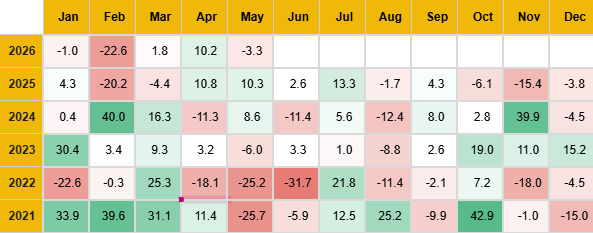
Figure 2: Monthly price performance of the top 10 coins by market capitalization
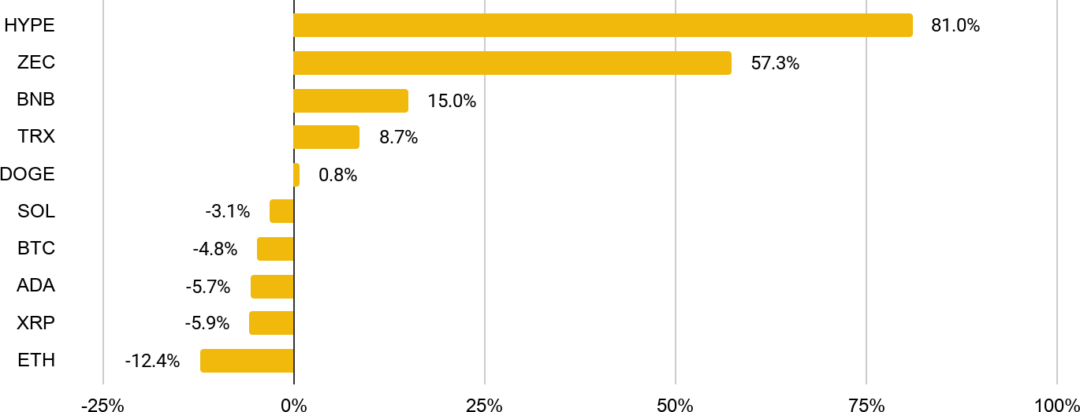
In descending order of performance:
- HYPE rose ~81%, surpassing US$70 to new all-time highs as both the 21Shares and Bitwise HYPE ETFs went live this month, bringing in US$100M+ in flows.
- ZEC was another standout outperformer, surging ~57.3% MoM, alongside Multicoin Capital disclosing a sizable accumulation and driving the privacy store-of-value narrative.
- BNB gained ~15%, driven by VanEck’s announcement of the first U.S.-listed spot BNB ETF (“VBNB”), physically backed by BNB held in cold storage.
- TRX gained ~8.7%, supported by Tron reaching US$90B in stablecoin market cap and surpassing Solana with 4M daily active users for low-cost stablecoin transfers.
- DOGE edged up ~0.8% in May. SOL and ADA fell ~3.1% and ~5.7% respectively, with SOL holding above monthly support established in February while ADA saw capital rotate toward assets with active ETF flows or imminent upgrades.
- BTC fell ~4.8% as speculation around Strategy’s BTC exchange deposit intensified, with Polymarket odds reaching +80% of selling BTC this year.
- XRP declined ~5.9% despite a landmark cross-border settlement pilot between JPMorgan, Ripple, Mastercard and Ondo Finance, integrating the XRP Ledger with traditional banking rails for the first time.
- ETH was the weakest performer, down ~12.4% as sentiment hit lows after several high-profile Ethereum Foundation exits. Bankless cofounder David Hoffman disclosed ETH sales, arguing network growth no longer directly benefits holders.
2.1 Decentralized Finance (DeFi)
Figure 3: TVL share of top blockchains
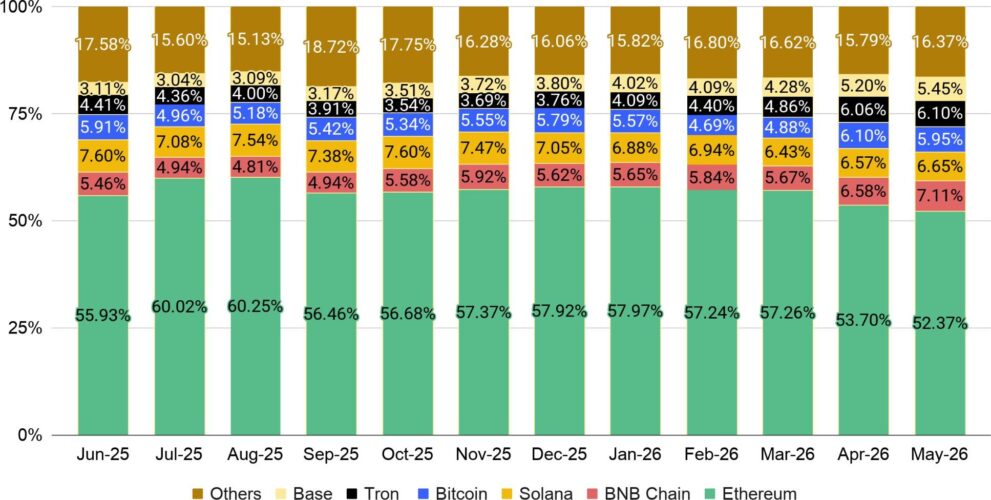
In May 2026, DeFi Total Value Locked (TVL) declined to US$79.5B, marking a 4.11% month-over-month (MoM) drop, as the sector operated in recovery mode following April’s US$634.9M exploits – the largest monthly hack total since the Bybit breach (~US$1.4B) in February 2025. Base, BNB Chain, and Tron posted strong YTD gains, collectively growing from ~15% to ~18.5%, compressing Ethereum’s DeFi dominance to 52.49%.
Kelp DAO and Aave restored rsETH operations after the April 18 exploit (~US$293M), with DeFi United raising US$300M in relief and a court ruling unblocking ~US$72M in frozen ETH. Stablecoin borrow rates, which spiked to ~13% in April, normalized to ~3.8% with no broader market spillover.
Per our latest projection, the base-case sizing for tokenized assets reaches ~US$1.6T by 2030 — assuming regulatory frameworks improve while custody, liquidity, distribution and secondary markets remain limited, with adoption concentrated in tokenized treasuries, gold and select institutional credit products, see our recent commentary on the topic here.
2.2 Stablecoins
Figure 4: Monthly net issuance for stablecoins
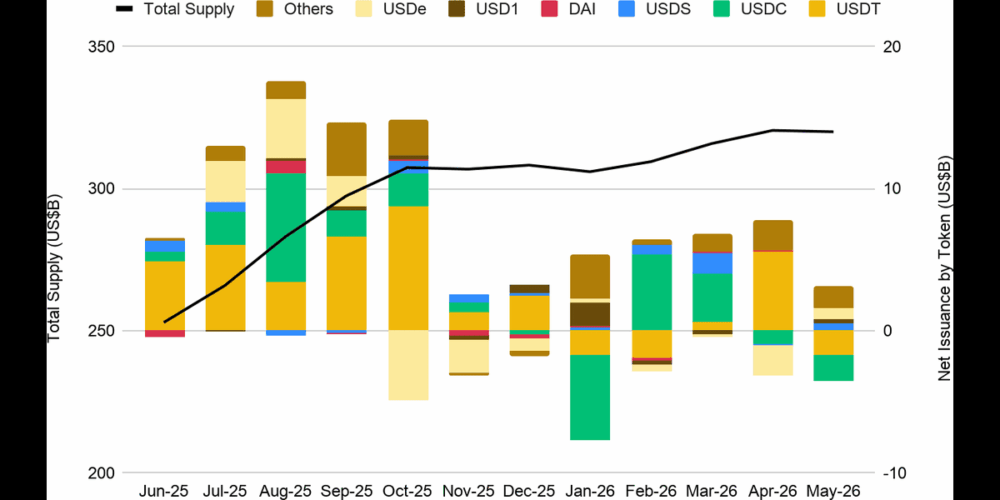
Stablecoin supply reached ~US$319.9B in May 2026, down 0.15% MoM, while institutional adoption and payments utility continued to drive steady market expansion. On a YTD basis, BNB Chain and Tron led large-cap growth at +9.9% and +7.6% respectively, while Ethereum maintained its commanding lead at US$173B despite a modest +1.3% YTD expansion.
Emerging chains posted notable gains. The XRP Ledger (XRPL) surpassed US$1B in stablecoin supply with RLUSD also crossing US$1.7B in market cap; Ripple’s recent 30M token burn on Ethereum points to active enterprise redemptions and growing multi-firm adoption. HyperEVM’s +314% YTD growth further highlights growth beyond the majors.
Tether’s USAT (its stablecoin designed for the U.S. market) expanded sixfold since late April, reaching ~US$157M market cap, reflecting accelerating institutional interest in GENIUS Act-compliant offerings as regulatory clarity becomes a key differentiator for capital flows.
2.3 Tokenized Real-World Assets (RWAs)
Figure 5: RWA net monthly growth by category
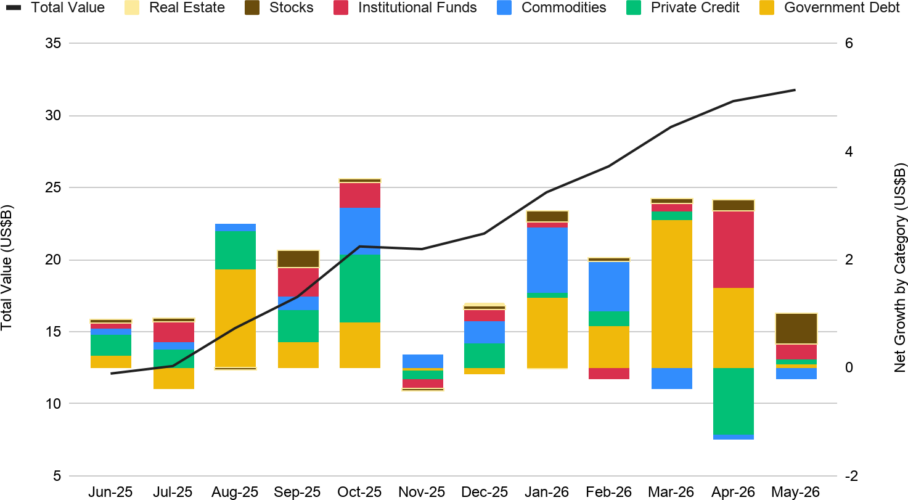
Total RWA asset value reached approximately US$31.8B, continuing to break successive all-time highs. The stocks sector led growth, driven by Strategy PP Variable xStock (“STRCX”) surging ~148% MoM from US$54M to US$134M.
DTCC is accelerating its tokenization push on two fronts. Its Collateral AppChain will integrate Chainlink’s Runtime Environment for 24/7, near real-time collateral management launching Q4 2026, while a separate plan targets connecting tokenized stocks, ETFs, and treasuries to the Stellar network by H1 2027 — advancing DTCC’s multi-chain strategy.
Per our latest report, long-term opportunities remain largely untapped as tokenized penetration sits at ~0.01% of the total addressable market today, when even sub-1% penetration by 2030 points to a potentially trillion-dollar market. For a deeper dive on tokenized RWA markets and their path toward the trillion-dollar scale, see our recent commentary on this topic here.
3. / Charts of the Month
Quantum Resistance: The Sector Gaining Ground
Figure 6: Relative performance of crypto sectors vs BTC
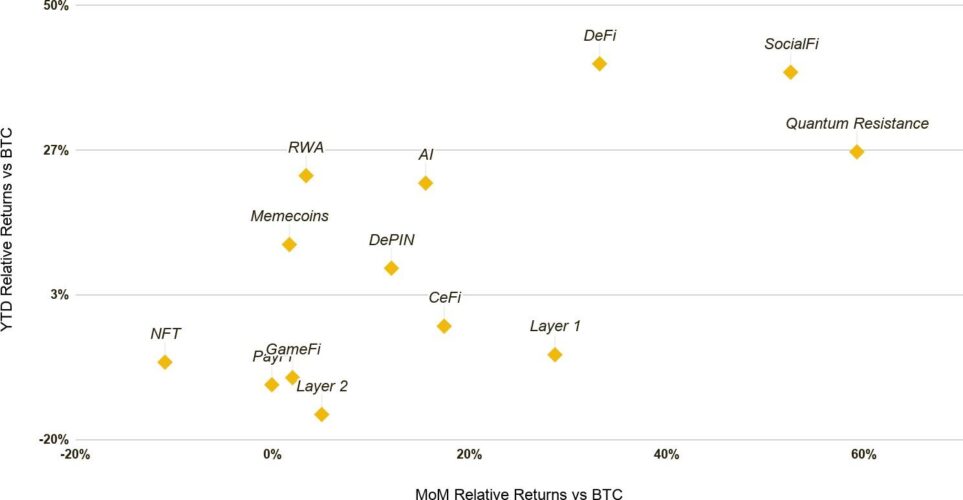
Signs of capital rotating into momentum-driven narratives are emerging this month. Quantum Resistance delivered ~26.3% YTD and ~59.3% MoM outperformance vs BTC — led by Zcash, which reached US$690 in mid-May and overtook ADA as the 9th largest crypto by market cap, alongside its announcement of quantum-recoverable wallets shipping within a month. Algorand and Starknet reinforced the theme — Algorand rallied earlier this year after Google cited its post-quantum architecture as a reference implementation, and Starknet adopted the same approach at the base layer.
With Vitalik putting 20% odds on cryptography breaking by 2030 and NIST’s hard 2035 deadline approaching, what once seemed distant is fast becoming a factor institutional allocators are watching closely. SocialFi and DeFi also showed relative strength across major players. TON rallied ~35% MoM after Pavel Durov announced Telegram taking direct control of the network. HYPE gained ~81% MoM as 21Shares and Bitwise also launched HYPE ETFs. ONDO rose ~40% MoM in what appears to be a lagging rally, reflecting its continued fundamental expansion in tokenized RWA adoption.
Crypto Flows Are Starting to Look Like Bonds, Not Tech
Figure 7: BTC+ETH ETF flow correlation is migrating from Equity-like to Bond-like
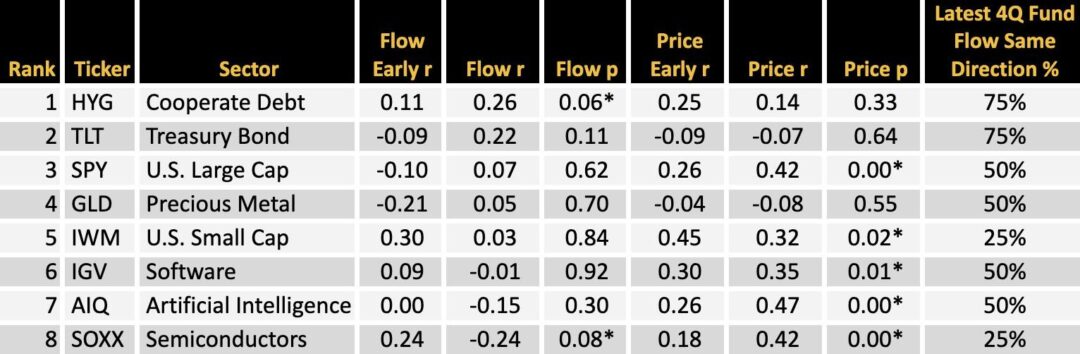
Crypto ETF flows used to behave like the tech sector, but they don’t anymore. Using 117 weeks of BTC and ETH spot ETF aggregate flows, we measured both flow correlation and price correlation against eight traditional ETF categories. The table above presents the core results ranked by the recent 52-week flow correlation, where three structural ffindings emerged:
First, credit risk appetite is the only convergent signal. HYG (high-yield corporate debt) is the sole asset with positive signals across all three frameworks: flow correlation (r=+0.26, p=0.06), price correlation (r=+0.14, though not significant), and quarterly same-direction (75%, 3 out of 4 quarters). No other asset clears this bar. The economic mechanism is intuitive: when credit markets price risk constructively, institutional capital flows into both high-yield bonds and crypto ETFs. HYG is the bridge asset between traditional fixed-income allocation and crypto exposure.
Second, allocation logic and trading behavior have structurally decoupled. The right side of the table captures this tension: AIQ (r=+0.47), SOXX (r=+0.42), and SPY (r=+0.42) show strong price co-movement with BTC, yet their flow correlations are weak or outright negative. The most extreme case is SOXX: price r=+0.42 (highly significant) but flow r=-0.24 (borderline significant in the opposite direction). Markets trade BTC as though it were an AI/semiconductor proxy, but institutional allocators treat crypto and semiconductor ETFs as competing destinations for the same marginal dollar. The quarterly same-direction data confirms this: SOXX and IWM score just 25% – while in three of the last four quarters, their flows moved opposite to crypto.
Third, the regime is shifting. TLT flow correlation moved from -0.09 (early 52 weeks) to +0.22 (recent 52 weeks) – the largest positive transition in the table – while SOXX flipped from +0.24 to -0.24, a complete reversal. The investor base migrating into crypto ETFs is increasingly macro-driven and decreasingly tech-thematic.
From Treasuries to Reinsurance: Inside the 2026 RWA Boom
Figure 8: Change in RWA Active Market Capitalisation by Category, 2026 (YTD)
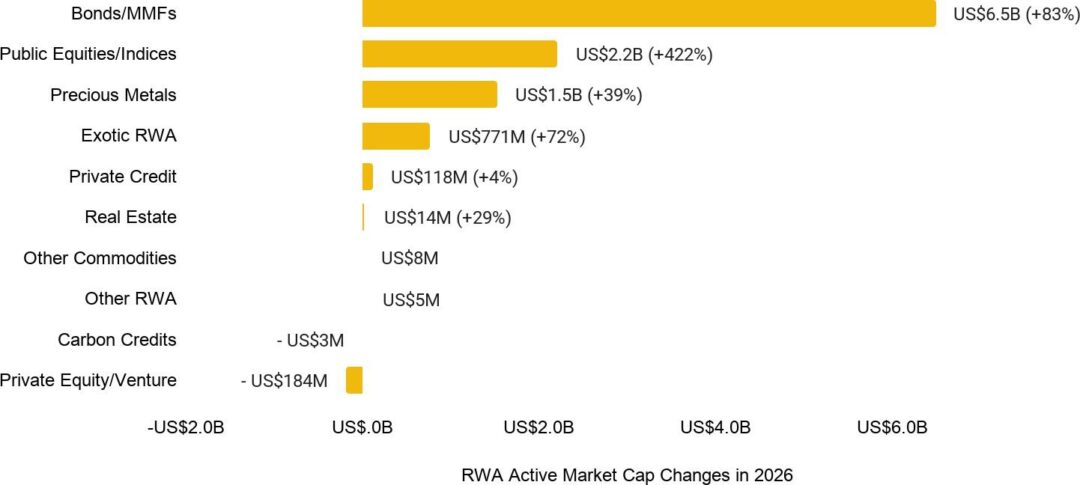
The tokenized RWA sector extended its breakout in 2026. The broader active market capitalization has expanded roughly 589% from early 2025 to June 2026, with growth driven almost entirely by institutional demand for on-chain yield rather than speculation. The distribution of those gains across asset classes reveals where that demand is concentrating.
On an absolute basis, bonds and money market funds (MMFs) led decisively, adding US$6.5B (+83%). The category has become traditional finance’s entry point: BlackRock, Franklin Templeton and Fidelity have all moved into tokenized cash management, with BlackRock filing with the SEC for two additional tokenized fund structures on 9 May 2026. More telling is the role of crypto-native issuers — Circle and Ondo drove much of the MMF expansion, underscoring that on-chain capital is increasingly oriented toward yield rather than idle balances.
Public equities and indices ranked second by absolute growth (+US$2.2B) and set the fastest pace — up roughly 422%; Ondo Global Markets alone crossed US$1B in total value locked within eight months of launch. Precious metals added US$1.5B (+39%), with most of the gain front-loaded into January and February as a clear flight to safety amid geopolitical uncertainty lifted tokenised gold past US$6B, before momentum cooled and the underlying price retraced.
The most notable development sits in what we group internally as Exotic RWA — a US$771M (+72%) category spanning reinsurance, preferred-stock collateralisation, GPU and physical-asset tokenisation, FX carry-trade strategies and direct mortgage lending. Ranking fourth-fastest overall, just behind precious metals, the segment matters disproportionately: it introduces yield streams largely uncorrelated to crypto, renders previously opaque strategies transparent and liquid for token holders, and liberalises returns once confined to sophisticated investors.
In conclusion, 2026 marks RWA tokenisation’s maturation from a treasury-dominated narrative into a diversified yield ecosystem.
Crypto Card Volume Surge Follows Flows, Not Float
Figure 9: Crypto card volumes surpassed US$747M in May, growing 48.6% YTD vs 3.2% for supply, with spend skewed away from the chains holding large stablecoin float
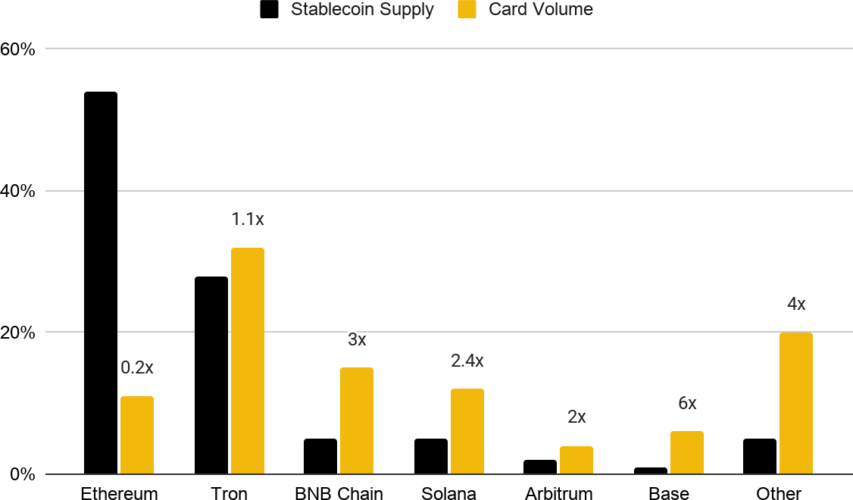
Crypto card volumes surpassed US$747M in May, taking cumulative volume near US$8B. Stablecoin supply over the same period grew from ~US$311B to ~US$321B, a 3.2% increase against 48.6% YTD growth in monthly card volumes. Card-linked spend is now growing at roughly twice the rate of the underlying float, indicating stablecoins are increasingly functioning as a payment instrument rather than purely as collateral or store of value. Crypto card products, rather than direct on-chain transfers, are emerging as a key growth channel for retail stablecoin spend.
Ethereum accounts for 53% of stablecoin supply but only 12% of card settlement. Tron is the only major chain where supply and settlement shares broadly align, at 28% and 32% respectively. Every other chain skews materially the other way. BNB Chain settles ~14% of card volume against 5% of supply, a 2.8x velocity multiple and the highest among major L1s. Solana sits at 12% against 5%. Supply concentrates on Ethereum on the back of institutional collateral and DeFi composability; card spend concentrates on execution chains where the largest issuers have built distribution and where users already hold stablecoins on lower-cost rails.
Visa processes ~97% of crypto card volume, with Mastercard at 3% despite the BVNK acquisition earlier this year. Visa’s early integration with full-stack crypto-native issuers including Rain and Reap enabled it to scale more efficiently. On the issuer side, RedotPay accounts for ~59% of monthly volume, exceeding the next ten issuers combined. Its distribution is concentrated in emerging markets where crypto cards have seen the largest initial adoption. In terms of product mix, most card volume today runs through either debit or prepaid products, with credit only a marginal category. Closing this gap is where the next leg of expansion may sit, since credit is where traditional card economics concentrate.
Looking ahead, stablecoin velocity through card rails is expected to keep rising, with incremental spend also flowing to chains outside the ones holding most of the float. The crypto card settlement layer is developing its own market structure, independent of stablecoin float.
4. / Upcoming Events and Token Unlocks
Figure 10: Notable Events in June 2026
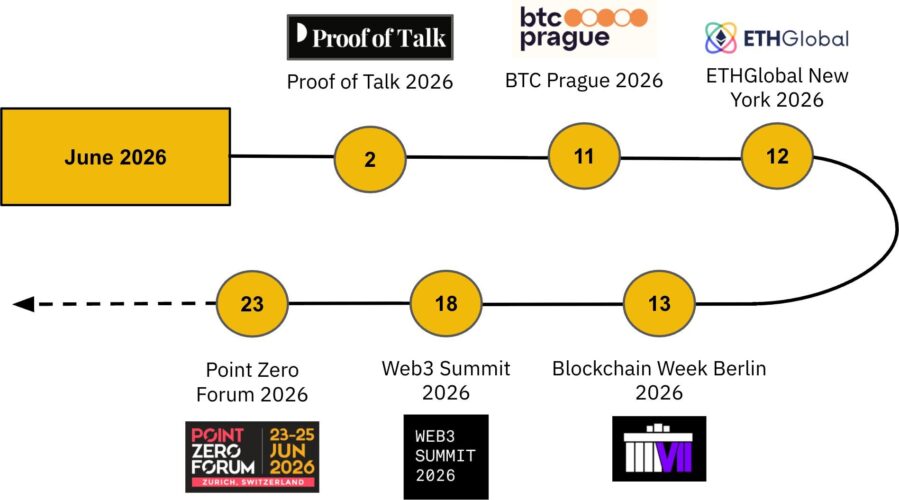
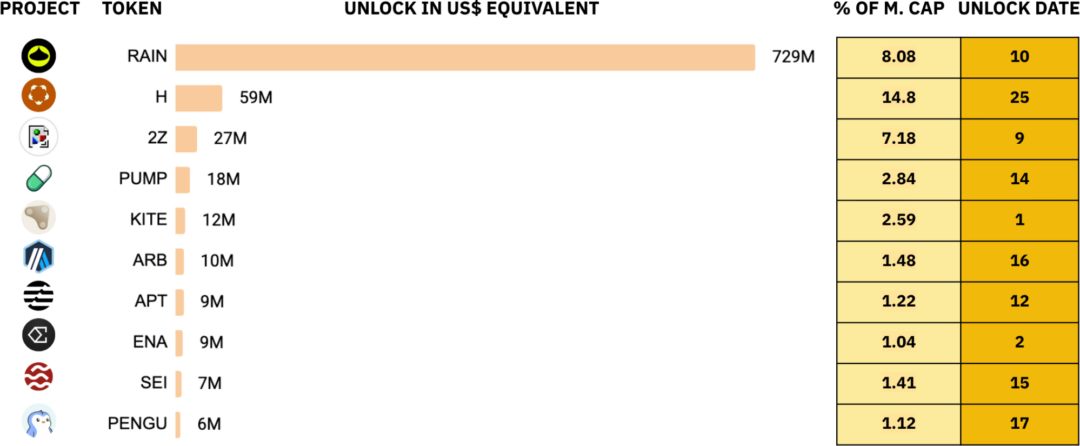
Figure 11: Largest token unlocks in US$ terms
5. / References
6. / New Binance Research Reports
Bitcoin: From Pizza to Portfolio Link
How Bitcoin has matured from a currency for pizza into a trillion-dollar portfolio asset.
Tokenization’s Trillion-Dollar Runway Link
How tokenized RWAs could grow from 0.01% penetration today to a trillion-dollar market by 2030.
About Binance Research
Binance Research is the research arm of Binance, the world’s leading cryptocurrency exchange. The team is committed to delivering objective, independent, and comprehensive analysis and aims to be the thought leader in the crypto space. Our analysts publish insightful thought pieces regularly on topics related but not limited to, the crypto ecosystem, blockchain technologies, and the latest market themes.

Moulik Nagesh
Macro Researcher
Moulik is a Macro Researcher at Binance and has been involved in the cryptocurrency space since 2017. Prior to joining Binance, he held cross-functional roles at Web3 and Silicon Valley-based tech companies. With a background in co-founding startups and a BSc in Economics from the London School of Economics and Political Science (LSE), Moulik brings a well-rounded perspective to the industry.

Michael JJ
Macro Researcher
Michael is a macro researcher at Binance. Prior to this, he worked as an economist at a U.S. private wealth management firm, focusing on cross-asset allocation. He also served as editor-in-chief at a media company, overseeing cryptocurrency reporting and educational content. Earlier in his career, he was a consultant at Ernst & Young and a crude oil trader at an energy firm.

Lim Kim Thye
Macro Researcher
Kim is a Macro Researcher at Binance. Researching the crypto markets full-time since 2021, he previously served as a Senior Investment Research Analyst at a crypto asset management firm, where he specialised in crypto investment strategy and rigorous asset valuation. Before dedicating his career entirely to the crypto space, he was a financial consultant and a trader at an investment bank.

Stefan Chen
Macro Research Intern
Stefan is a Macro Research Intern at Binance. Prior to this, he worked as a software operations intern at a global accounting firm. He holds a Bachelor of Arts in Public Finance from National Chengchi University and has been involved in the cryptocurrency space since 2022, with a focus on macro narratives and data analysis.
Resources
Binance Research Link

Share your feedback here
GENERAL DISCLOSURE: This material is prepared by Binance Research and is not intended to be relied upon as a forecast or investment advice, and is not a recommendation, offer or solicitation to buy or sell any securities, cryptocurrencies or to adopt any investment strategy. The use of terminology and the views expressed are intended to promote understanding and the responsible development of the sector and should not be interpreted as definitive legal views or those of Binance. The opinions expressed are as of the date shown above and are the opinions of the writer, they may change as subsequent conditions vary. The information and opinions contained in this material are derived from proprietary and non-proprietary sources deemed by Binance Research to be reliable, are not necessarily all-inclusive and are not guaranteed as to accuracy. As such, no warranty of accuracy or reliability is given and no responsibility arising in any other way for errors and omissions (including responsibility to any person by reason of negligence) is accepted by Binance. This material may contain ’forward looking’ information that is not purely historical in nature. Such information may include, among other things, projections and forecasts. There is no guarantee that any forecasts made will come to pass. Reliance upon information in this material is at the sole discretion of the reader. This material is intended for information purposes only and does not constitute investment advice or an offer or solicitation to purchase or sell in any securities, cryptocurrencies or any investment strategy nor shall any securities or cryptocurrency be offered or sold to any person in any jurisdiction in which an offer, solicitation, purchase or sale would be unlawful under the laws of such jurisdiction. Investment involves risks. For more information, see our Terms of Use and Risk Warning.
Disclaimer: The information provided is not trading advice, Bitcoinworld.co.in holds no liability for any investments made based on the information provided on this page. We strongly recommend independent research and/or consultation with a qualified professional before making any investment decisions.