

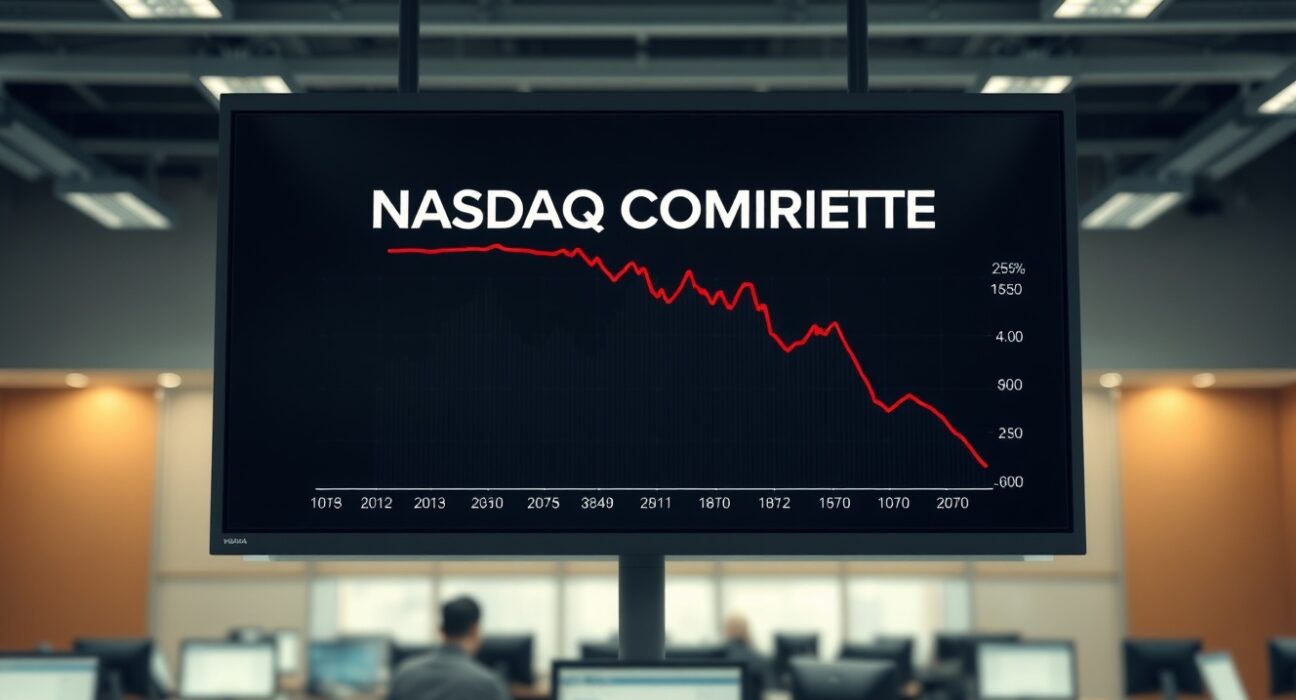
NEW YORK, March 21, 2025 – The Nasdaq Composite index extended a sharp intraday sell-off today, with losses deepening to over 2%, signaling significant pressure on the technology sector and broader market sentiment. Consequently, the S&P 500 fell 1.46%, while the Dow Jones Industrial Average dropped 0.85%, reflecting a widespread retreat from recent gains. This move represents one of the most substantial single-day pullbacks this quarter, prompting analysis from traders and strategists.
Nasdaq Composite Leads a Broad Market Decline
The Nasdaq Composite’s 2.06% drop highlights its heightened sensitivity to shifts in investor risk appetite. Primarily composed of technology and growth-oriented companies, the index often experiences amplified volatility. Meanwhile, the S&P 500’s 1.46% decline indicates a broader market reassessment. Similarly, the Dow Jones Industrial Average’s more modest 0.85% fall suggests relative strength in its more traditional, industrial components. This tiered performance pattern is common during growth-stock led corrections.
Market analysts immediately pointed to several concurrent factors. Firstly, rising Treasury yields have pressured equity valuations, particularly for long-duration tech stocks. Secondly, renewed concerns about corporate earnings growth for the upcoming quarter have emerged. Thirdly, geopolitical tensions have contributed to a risk-off mood among institutional investors. Historical data shows that intraday declines exceeding 2% for the Nasdaq often precede periods of elevated volatility.
Context and Drivers Behind the Sharp Sell-Off
Today’s market action did not occur in a vacuum. It follows a period of sustained gains, leaving indices technically overbought by some metrics. The sell-off accelerated during the late morning trading session. Notably, major mega-cap technology stocks, which carry significant weight in the Nasdaq, led the downward move. Furthermore, the CBOE Volatility Index (VIX), often called the market’s “fear gauge,” spiked over 20%, confirming a surge in expected near-term turbulence.
Economic data releases this week have also played a role. Stronger-than-expected inflation readings have altered expectations for the timing of potential interest rate cuts by the Federal Reserve. Higher-for-longer rate scenarios directly challenge the discounted cash flow models that support high valuations in the tech sector. Therefore, today’s price action reflects a rapid repricing of risk based on this macroeconomic shift.
Expert Analysis on Sector Performance and Impact
Financial strategists emphasize the importance of sector rotation during such declines. “While the Nasdaq bears the brunt, we are observing capital moving toward more defensive sectors like utilities and consumer staples,” noted a lead market strategist at a major investment bank, referencing real-time flow data. This rotation is a classic hallmark of a risk-averse trading environment. The performance divergence between growth and value stocks has widened considerably today.
The impact extends beyond equities. Cryptocurrency markets, which often correlate with tech stock sentiment, also traded lower. Additionally, initial public offering (IPO) activity may face delays if volatility persists, as investor appetite for new risk diminishes. For retail investors, the decline serves as a reminder of the importance of portfolio diversification across asset classes and market capitalizations.
Historical Comparisons and Market Structure
Intraday declines of this magnitude, while notable, are not unprecedented. Market history shows that similar sharp pullbacks have frequently served as healthy consolidations within longer-term bull markets. However, the key differentiator is the underlying cause. Declines driven by fundamental earnings concerns tend to have longer-lasting effects than those driven by technical corrections or fleeting geopolitical headlines.
The current market structure, dominated by passive investment funds and algorithmic trading, can exacerbate intraday moves. These systems often trigger automatic sell orders at specific technical levels, creating cascading effects. Understanding this modern market microstructure is crucial for interpreting the speed and scale of today’s decline. Liquidity remains robust, but it can become segmented during stress events.
Looking Ahead: Key Levels and Investor Sentiment
Traders are now closely watching key technical support levels for the Nasdaq Composite. A sustained break below certain moving averages could signal a deeper correction phase. Conversely, a swift recovery above today’s opening price would indicate strong dip-buying demand. Investor sentiment surveys, such as the AAII Bull-Bear Spread, will be scrutinized in the coming days for signs of excessive pessimism, which can itself be a contrarian bullish signal.
The options market provides another window into expectations. The pricing of put options (bets on decline) versus call options (bets on gains) has skewed dramatically today. This skew, measured by metrics like the put-call ratio, shows a sharp increase in demand for downside protection. Market makers hedging these positions can create additional selling pressure, creating a short-term feedback loop.
Conclusion
The Nasdaq Composite’s extension of intraday losses beyond 2% marks a significant shift in near-term market dynamics, dragging the broader S&P 500 and Dow Jones indices lower with it. This move underscores the ongoing sensitivity of equity markets to interest rate expectations and growth projections. While unsettling for participants, such volatility is an inherent feature of financial markets and underscores the necessity for a disciplined, long-term investment strategy grounded in fundamental analysis rather than reactive trading.
FAQs
Q1: What caused the Nasdaq Composite to drop over 2% today?
The decline was driven by a combination of factors including rising bond yields, reassessed expectations for Federal Reserve interest rate policy, sector rotation out of high-growth technology stocks, and a broader risk-off sentiment among investors.
Q2: How does the Nasdaq’s performance compare to the S&P 500 and Dow Jones?
The Nasdaq Composite, down 2.06%, fell the most due to its heavy weighting in technology stocks. The S&P 500, with a broader mix, fell 1.46%. The Dow Jones, comprised of 30 large industrial and financial firms, saw the smallest decline at 0.85%.
Q3: Is a 2% intraday drop considered a market crash?
No, a 2% intraday decline is considered a significant correction or pullback, not a crash. Market crashes are typically defined by much larger, rapid declines (often 10% or more in a single day) and are accompanied by systemic financial stress.
Q4: What should investors do during a sharp market sell-off?
Financial advisors generally recommend against making panic-driven decisions. Investors should review their long-term financial plans, ensure their portfolios are properly diversified, and consider whether any rebalancing is needed to align with their risk tolerance and investment goals.
Q5: Could this decline lead to a bear market?
A single day’s decline does not define a bear market, which is typically a prolonged drop of 20% or more from recent highs. While today’s action increases volatility, whether it develops into a bear market depends on subsequent economic data, corporate earnings, and central bank policy.
Disclaimer: The information provided is not trading advice, Bitcoinworld.co.in holds no liability for any investments made based on the information provided on this page. We strongly recommend independent research and/or consultation with a qualified professional before making any investment decisions.
