
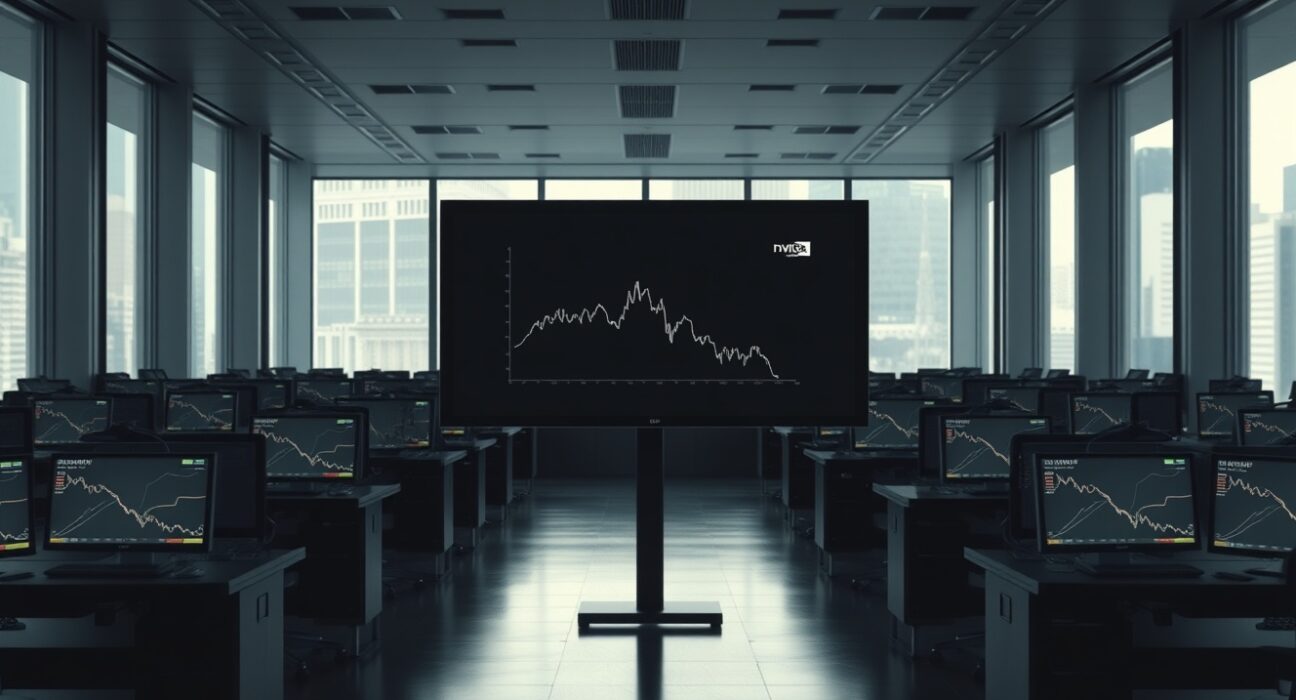
When Nvidia CEO Jensen Huang concluded his ambitious 2.5-hour GTC keynote in San Jose on March 17, 2025, the company’s stock began an immediate decline, revealing a profound disconnect between Silicon Valley’s AI enthusiasm and Wall Street’s cautious calculus.
Nvidia’s GTC Conference Fails to Impress Investors
Nvidia’s annual GPU Technology Conference typically serves as a showcase for the chipmaker’s latest innovations. This year, Huang presented what appeared to be a compelling vision. He unveiled new graphics technology, updated networking infrastructure, autonomous vehicle partnerships, and the Blackwell and Vera Rubin chip architectures. Furthermore, Huang projected staggering market opportunities: a $35 trillion AI agent ecosystem and a $50 trillion physical AI and robotics industry. He also forecasted $1 trillion in purchase orders for just two chip platforms by 2027’s end. Despite these announcements, Nvidia’s stock dropped approximately 3.5% during the presentation. This reaction highlights how financial markets now weigh speculative future projections against present realities and risks.
The Growing Chasm Between Silicon Valley and Wall Street
A distinct atmosphere of uncertainty permeated Wall Street trading desks, contrasting sharply with the confident buzz in Silicon Valley boardrooms. This divergence stems from fundamentally different risk assessments. While tech executives focus on transformational potential, institutional investors must evaluate timing, profitability, and competitive threats. The nervousness reflects broader concerns about AI’s economic impact and valuation metrics. Many portfolio managers now question whether current stock prices adequately discount the substantial execution risks and capital expenditure required to realize Huang’s vision. Consequently, they reacted to the keynote not as a blueprint for guaranteed growth, but as confirmation of already lofty expectations that leave little room for positive surprise.
Expert Analysis on Market Psychology
Daniel Newman, CEO of Futurum Research, provided crucial context to Bitcoin World. “AI is so transformational and moving so rapidly that we don’t fully understand its societal implications,” Newman explained. “Financial markets inherently dislike this type of uncertainty. The speed of innovation has created a novel form of market anxiety that most analysts never anticipated.” Newman specifically addressed reports of slow enterprise AI adoption, suggesting they might be misleading. “Enterprise AI adoption will likely reach an inflection point rapidly,” he argued. “When people claim it’s not happening, they’re often referencing ROI metrics that remain undefined or survey data that’s already six months old. Data aggregation simply takes time.”
Examining the AI Bubble Debate
The GTC reaction inevitably fuels discussions about a potential AI investment bubble. Historical parallels with the dot-com era emerge, where visionary rhetoric sometimes outpaced sustainable business models. However, critical differences exist. Nvidia demonstrates tangible, extraordinary financial performance that many 1990s internet companies lacked. Last quarter, Nvidia’s revenue surged 73% year-over-year, consistently exceeding lofty expectations. Concrete demand signals also appear. For instance, Reuters reported Amazon’s plan to purchase 1 million GPUs for AWS by 2027. This evidence suggests that while certain AI segments might be overvalued, Nvidia’s core infrastructure business rests on measurable, current demand.
| Metric | Data Point | Market Interpretation |
|---|---|---|
| Q4 2024 Revenue Growth | +73% Year-over-Year | Strong fundamental performance |
| GTC Keynote Stock Reaction | ~3.5% Decline | “Sell the news” event |
| Amazon GPU Order (Reported) | 1 Million Units by 2027 | Validation of long-term demand |
| CEO Market Projections | $35T & $50T Sectors | Seen as speculative by some investors |
Nvidia’s Central Role in the Modern Economy
Kevin Cook, Senior Equity Strategist at Zacks Investment Research, offered a macroeconomic perspective to Bitcoin World. He noted, somewhat wryly, that investor dissatisfaction doesn’t alter a fundamental reality: the broader stock market currently relies on Nvidia’s technology. “The economy is orbiting around Nvidia,” Cook stated. “The company is building essential infrastructure. Numerous hardware, software, and physical AI companies—even industrial firms like Caterpillar—are developing platforms based on Nvidia’s technology.” This observation underscores Nvidia’s transition from a graphics chip supplier to a foundational platform company. Huang emphasized this shift during his keynote, stating, “Nvidia is a platform company. We have technology, platforms, and a rich ecosystem.”
The Infrastructure Investment Thesis
The investment case for Nvidia increasingly resembles historical bets on pivotal infrastructure providers—similar to railroads, telecommunications networks, or the early internet backbone. Investors aren’t merely betting on AI software applications; they’re investing in the picks and shovels required for the entire digital gold rush. This thesis explains the stock’s resilience despite periodic sell-offs. While application-layer companies might face existential risks from shifting AI trends, infrastructure providers typically benefit from broad-based adoption regardless of which specific applications ultimately dominate. This structural position may partially insulate Nvidia from the volatility affecting pure-play AI software firms.
Conclusion: Uncertainty as the New Normal
Nvidia’s GTC conference ultimately highlighted a new market paradigm where extraordinary growth and performance can still disappoint investors conditioned to expect perpetual positive surprises. The stock’s decline wasn’t a verdict on Nvidia’s execution or technology leadership, but a reflection of recalibrated risk assessments in an uncertain macroeconomic and technological landscape. While Silicon Valley focuses on AI’s transformative potential, Wall Street must price in execution risks, competitive responses, and the sheer scale of capital required. The disconnect between Huang’s visionary presentation and the stock’s reaction signifies that for now, markets are prioritizing measurable, near-term deliverables over even the most ambitious long-term projections. Nvidia’s journey forward will likely be characterized by this tension between revolutionary promise and financial market pragmatism.
FAQs
Q1: Why did Nvidia’s stock drop during the GTC keynote?
The decline reflected a “sell the news” reaction where the presented information, though positive, was already anticipated by the market. Investors found no new catalysts to drive the stock higher beyond already lofty expectations.
Q2: What is the main difference between Silicon Valley and Wall Street’s view of AI?
Silicon Valley tends to focus on long-term, transformational potential and technological capability. Wall Street prioritizes near-term financial metrics, profitability, risk assessment, and whether current valuations already reflect future growth.
Q3: Are the concerns about an AI bubble valid?
Certain segments of the AI market may exhibit bubble-like characteristics, with high valuations detached from current revenue. However, Nvidia’s business is supported by record-breaking financial results and tangible, large-scale purchase orders from major cloud providers, suggesting its core infrastructure role is on solid ground.
Q4: What did experts say about enterprise AI adoption?
Futurum CEO Daniel Newman suggested that reports of slow adoption might be misleading, based on lagging survey data. He believes enterprise adoption is progressing and will reach a significant inflection point, though measuring return on investment (ROI) remains challenging in the short term.
Q5: How is Nvidia’s role in the economy changing?
Analysts like Kevin Cook from Zacks describe the economy as “orbiting around Nvidia,” positioning it as a critical infrastructure provider. The company is evolving from a component supplier to a platform company upon which vast segments of the hardware, software, and industrial AI sectors are being built.
Disclaimer: The information provided is not trading advice, Bitcoinworld.co.in holds no liability for any investments made based on the information provided on this page. We strongly recommend independent research and/or consultation with a qualified professional before making any investment decisions.