
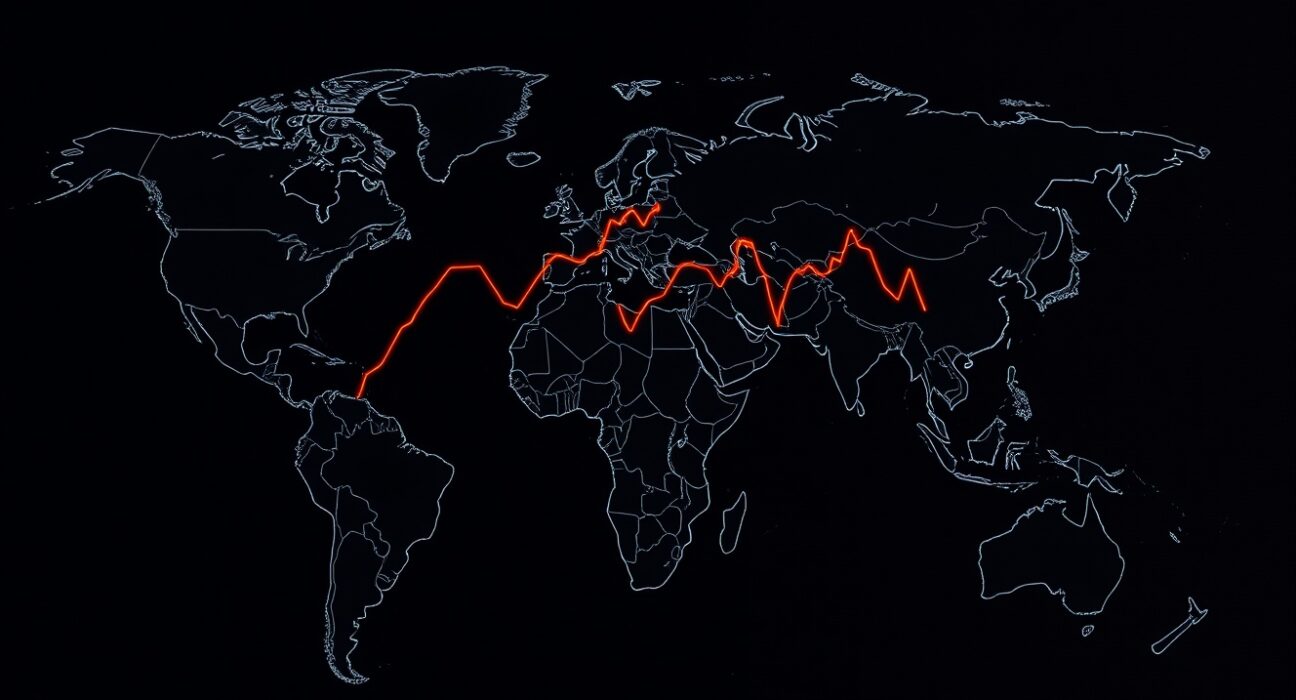
Global oil markets face a period of unprecedented volatility as geopolitical tensions redefine risk, according to a detailed technical analysis from TD Securities. The firm’s latest report, published in March 2025, utilizes proprietary charting models to illustrate how specific conflict scenarios could create a dramatically wide trading range for crude prices throughout the year. This analysis moves beyond simple supply-demand equations to quantify the direct market impact of political instability.
Oil Price Forecast: Decoding the Charts from TD Securities
TD Securities, a leading global investment bank, has released a comprehensive chart-based outlook for crude oil. The analysis identifies several key geopolitical flashpoints that serve as primary drivers for price direction. Consequently, the firm projects not a single price target but a potential range spanning from $65 to $115 per barrel for Brent crude. This wide band reflects the high degree of uncertainty embedded in the current geopolitical landscape. The methodology relies heavily on historical volatility patterns and scenario modeling.
Furthermore, the charts highlight critical technical levels that could act as support or resistance depending on news flow. For instance, a sustained breakout above $90 is directly linked in their model to an escalation scenario in the Strait of Hormuz. Conversely, a breakdown below $70 aligns with a resolution of several ongoing regional disputes. This approach provides traders and analysts with a framework, rather than a prediction, for navigating the market.
Geopolitical Risk: The Primary Engine of Oil Market Volatility
The current energy market narrative has decisively shifted from pure fundamentals to geopolitics. While inventory data and OPEC+ production decisions remain relevant, their influence is now often overshadowed by headline risk. TD Securities’ research underscores this shift by mapping price reactions to specific events over the past 24 months. The correlation between regional conflict news and intraday price spikes has strengthened significantly.
Several regions contribute disproportionately to this risk premium:
- The Middle East: Persistent tensions involving major producers and critical maritime chokepoints.
- Eastern Europe: Ongoing conflict continues to disrupt traditional energy trade flows and logistics.
- West Africa: Political instability in key producing nations like Nigeria adds a consistent undercurrent of supply risk.
Each region presents a different set of variables, but collectively, they inject a persistent layer of uncertainty that charts struggle to fully discount in advance.
Expert Analysis: Interpreting the Technical Signals
Senior commodity strategists at TD Securities emphasize that their charts are a tool for measuring market sentiment and positioning, not a crystal ball. The wide price range itself is a signal, indicating that the market is pricing in multiple, contradictory outcomes simultaneously. This often leads to violent price swings when one scenario gains perceived probability over another. For example, a single drone attack on infrastructure can trigger a rapid repricing from the lower to the middle or upper end of their projected range.
Moreover, the analysis examines open interest and trading volume patterns around key technical levels. These metrics often reveal where institutional money is placing its bets regarding geopolitical outcomes. Currently, the data suggests a buildup of options contracts that would profit from a sharp price increase, indicating that professional traders see significant tail risk to the upside.
The Impact on Global Energy Security and Inflation
This volatility has profound implications beyond trading desks. Sustained high prices directly impact global inflation, complicating central bank policies aimed at economic stabilization. Additionally, energy security has returned to the forefront of national strategy for importing nations. Countries are actively diversifying sources and accelerating investments in alternatives, but these are long-term solutions. In the immediate term, the market remains captive to the geopolitical winds charted by analysts.
The following table summarizes the potential price scenarios linked to specific geopolitical developments, as interpreted from the TD Securities framework:
| Scenario | Key Driver | Potential Brent Crude Range |
|---|---|---|
| De-escalation | Multiple ceasefire agreements, reopened trade routes | $65 – $78 |
| Status Quo | Current tensions persist without major new conflicts | $78 – $92 |
| Regional Escalation | Significant attack on major export infrastructure | $92 – $105 |
| Multi-Front Crisis | Concurrent conflicts in two or more key regions | $105 – $115+ |
Conclusion
The oil price forecast from TD Securities presents a clear, chart-driven argument: geopolitical conflict scenarios are the dominant force shaping the crude market’s volatile path. Their analysis of a wide potential price range underscores the extreme sensitivity of energy markets to political risk. For investors, policymakers, and consumers, understanding this dynamic is crucial. The charts ultimately tell a story of a market in search of equilibrium amidst profound instability, where traditional analysis must be augmented by a careful watch on global events.
FAQs
Q1: What is the main takeaway from TD Securities’ oil analysis?
The primary takeaway is that geopolitical conflicts, not just supply and demand, are creating an extremely wide and volatile potential price range for oil, estimated between $65 and $115 per barrel for Brent crude in 2025.
Q2: Which regions are most critical for oil price volatility according to the report?
The analysis highlights the Middle East (due to maritime chokepoints), Eastern Europe (disrupted trade flows), and West Africa (political instability) as the key regions contributing to geopolitical risk premiums.
Q3: How does TD Securities use charts to make this forecast?
They use proprietary technical models that map historical price volatility and trading patterns against specific geopolitical events, identifying key price levels that act as support or resistance under different conflict scenarios.
Q4: What does a wide price range indicate about the market?
A wide projected range indicates that the market is simultaneously pricing in several contradictory geopolitical outcomes, leading to high uncertainty and the potential for sharp, sudden price movements based on news headlines.
Q5: What are the broader economic impacts of this oil price volatility?
Prolonged volatility and high prices can fuel global inflation, affect central bank interest rate decisions, and force nations to urgently rethink their long-term energy security and diversification strategies.
Disclaimer: The information provided is not trading advice, Bitcoinworld.co.in holds no liability for any investments made based on the information provided on this page. We strongly recommend independent research and/or consultation with a qualified professional before making any investment decisions.