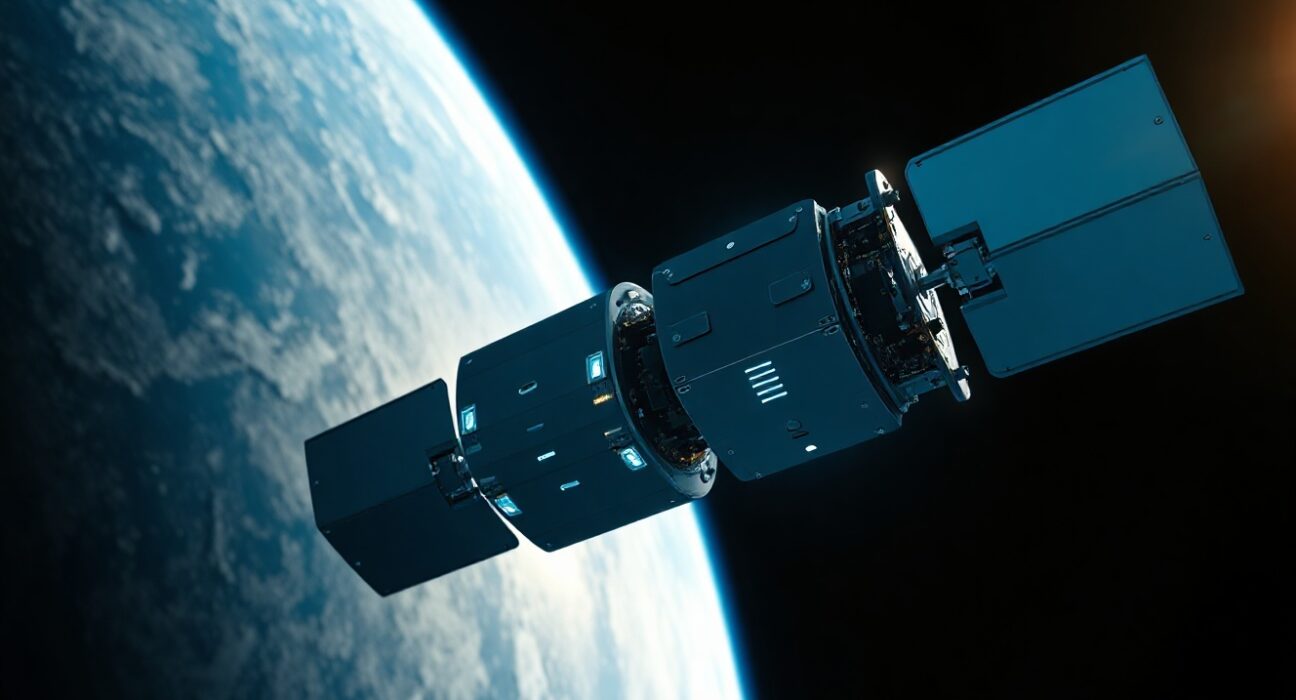
Euwyn Poon, the founder who built and sold e-scooter company Spin to Ford in 2018, has raised $5 million in seed funding for a far more ambitious venture: putting AI data centers in orbit. The startup, called Orbital, emerged from a16z’s Speedrun accelerator in May with backing from a16z and a roster of investors including Basis Set, Human Element, Wayfinder, Antler, Anti Fund, Ascent, and others. The company is betting that SpaceX’s Starship will eventually make the economics of space-based compute viable — a gamble shared by a growing number of startups in the nascent sector.
A familiar pitch, a new frontier
Orbital’s core premise is straightforward: demand for AI compute is exploding, and terrestrial data centers face constraints in power, cooling, and permitting. Space offers unlimited solar energy and minimal regulatory friction. The catch, as Poon readily acknowledges, is that launching hardware into orbit remains prohibitively expensive with current rockets. “We will get to full scale when Starship comes online,” Poon told Bitcoin World. “The price of the Falcon 9 makes this not economically feasible.”
For now, the company — a team of about a dozen engineers in Los Angeles with backgrounds at Amazon’s LEO satellite project, SpaceX, and Northrop Grumman — is focused on a demo flight. Orbital plans to fly an Nvidia Blackwell chip on a partner’s satellite to test its radiation shielding and thermal management technology. The company’s roadmap targets 2028 for the launch of its first dedicated data-processing spacecraft, equipped with Nvidia’s Space-1 Vera Rubin-class GPUs. At that point, Orbital expects to begin generating revenue through piece-wise inference work, with each satellite contributing to a distributed computing network.
Betting big on Starship — and patience
Orbital’s long-term goal is to deploy 10,000 satellites providing a distributed gigawatt of computing power, with each satellite rated at 100 kW. For context, Elon Musk has said SpaceX expects its own AI satellites to produce up to 150 kW, while rival Starcloud plans 200 kW-rated spacecraft. The capital requirements are staggering — Poon estimates the full buildout could take a decade and cost $5 billion or more.
But venture investors, once skittish about long-duration, capital-intensive space bets, have grown more comfortable. a16z partner Andrew Chen, who worked with Poon through Speedrun, noted that Poon’s experience scaling Spin — deploying 250,000 scooters across 100 cities — demonstrated the operational rigor needed for aerospace. “This kind of thing would have sounded crazy 10 years ago when we were all building mobile apps,” Chen said. “Starting it in 2026 just lets you tap into all the energy and excitement happening in the capital markets.”
Competitors and impatience
Orbital is not alone. Starcloud already has a GPU in orbit and plans to launch more before Starship arrives. Cowboy Space Company, another a16z-backed startup, grew impatient and decided to build its own rockets. Jeff Bezos’ Blue Origin has also announced plans to launch data centers using its New Glenn vehicle. Poon is unfazed by the competition. “There’s so many lanes for companies in our space to pursue,” he said, citing different AI workloads, satellite designs, and operational concepts as opportunities for multiple winners.
How a scooter founder ended up in space
Poon’s path to space data centers was unconventional. After leaving Ford, he bought an Nvidia A100 GPU on a whim, co-located it in a Santa Clara data center, and began serving open-weight AI models. That hands-on experiment convinced him that the real value in the AI boom lies in delivering compute — not just building models. Now he faces the challenge of putting thousands of GPUs into orbit, a task that will test both his engineering instincts and his ability to raise capital at scale.
Conclusion
Orbital represents a bet that the space industry’s cost curve will bend sharply downward, driven by Starship’s reusability. If that bet pays off, the company could be among the first to offer orbital AI processing as a commercial service. If Starship is delayed, Orbital — like its competitors — will have to survive on demo missions and investor patience. Either way, the fact that a former scooter entrepreneur can raise $5 million for a space data center startup says as much about the current venture climate as it does about the technology.
FAQs
Q1: What is Orbital’s business model?
Orbital plans to launch satellites equipped with Nvidia GPUs to perform AI inference in space. The company will sell compute capacity to customers who need low-latency processing for satellite imagery, remote sensing, or other orbital applications.
Q2: Why does AI compute need to go to space?
Space offers unlimited solar power, no land-use restrictions, and faster permitting compared to terrestrial data centers. For applications where data is already generated in orbit — such as Earth observation — processing in space reduces latency and bandwidth costs.
Q3: How is Orbital different from Starcloud or Cowboy Space Company?
Orbital is focused on deploying a large constellation of smaller, 100 kW-class satellites, while Starcloud targets larger 200 kW spacecraft. Cowboy Space Company has chosen to develop its own launch vehicle rather than wait for Starship. All three are pursuing the same fundamental opportunity but with different technical and go-to-market strategies.
Disclaimer: The information provided is not trading advice, Bitcoinworld.co.in holds no liability for any investments made based on the information provided on this page. We strongly recommend independent research and/or consultation with a qualified professional before making any investment decisions.