

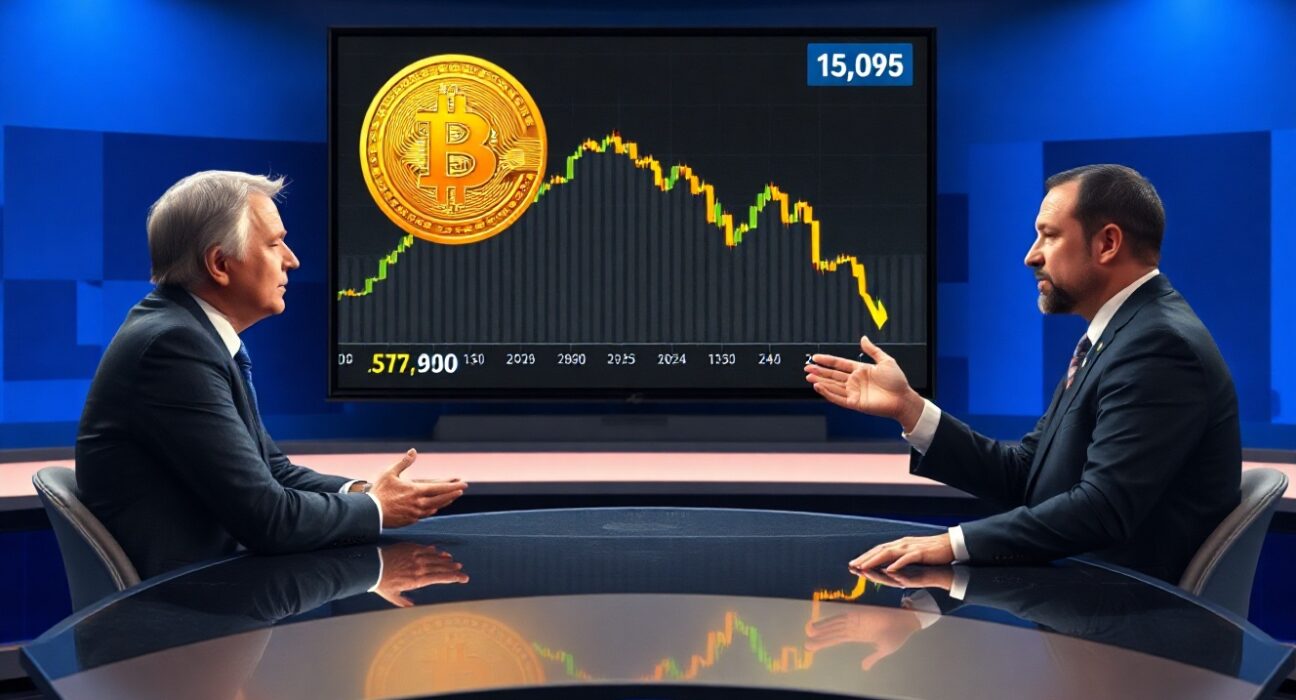
Bitcoin faced renewed criticism this week from longtime skeptic Peter Schiff, who declared on Fox Business that the cryptocurrency is a “worthless digital asset” whose speculative bubble has definitively burst. The comments, made during a heated segment with crypto advocate Anthony Pompliano, reignited a long-standing debate over Bitcoin’s intrinsic value and market trajectory.
Schiff’s Core Argument: Hype Over Substance
Schiff, CEO of Euro Pacific Capital and a well-known gold proponent, argued that Bitcoin’s price decline since its all-time high of approximately $126,000 in October 2024 signals a fundamental lack of real demand. He claimed that institutional buying pressure — driven by professional investment firms and spot Bitcoin ETFs — merely provides liquidity for early investors to exit their positions at a profit.
“Bitcoin buyers are acting on the expectation that someone else will purchase it at a higher price, with no genuine long-term outlook,” Schiff said during the broadcast. He further noted that the current price is “only slightly higher than it was five years ago,” which he characterized as evidence that the market is “losing vitality without real demand.”
Schiff’s critique aligns with his long-standing position that Bitcoin lacks the intrinsic value of gold, which he views as a stable store of wealth with millennia of historical precedent.
Pompliano’s Counterpoint: Volatility Is Not a Flaw
Anthony Pompliano, founder of crypto investment firm Pomp Investments, offered a sharply different perspective. He countered that Bitcoin’s compound annual growth rate over the past decade has been approximately 55% to 60%, significantly outpacing gold’s returns during the same period.
“Volatility is not unique to Bitcoin,” Pompliano argued. “It is a common feature of high-return assets. The idea that volatility is inherently bad is a misconception.” He emphasized that Bitcoin remains a nascent asset class and that price fluctuations should be expected as the market matures and adoption continues.
Pompliano’s defense underscores a broader argument among crypto proponents: that Bitcoin’s volatility is a trade-off for its asymmetric upside potential, particularly in an era of global monetary expansion.
What This Debate Means for Investors
The clash between Schiff and Pompliano reflects a fundamental divide in how traditional and digital asset investors evaluate value. For mainstream audiences, the debate highlights the ongoing uncertainty surrounding Bitcoin’s role in a diversified portfolio.
Key considerations for readers:
- Time horizon matters: Schiff’s five-year price comparison overlooks Bitcoin’s long-term compounding trend, which Pompliano emphasized.
- ETF impact: The approval of spot Bitcoin ETFs in early 2024 has brought institutional capital into the market, but critics argue it also creates exit liquidity for early adopters.
- Market maturity: Bitcoin’s price remains highly sensitive to macroeconomic factors, regulatory news, and sentiment shifts — a reality that neither side disputes.
Conclusion
The Schiff-Pompliano exchange offers a microcosm of the broader cryptocurrency debate: one side views Bitcoin as a speculative mania sustained by hype, while the other sees it as a transformative asset with a proven track record of growth. For investors, the takeaway is not a simple verdict but a reminder that asset evaluation depends heavily on time frame, risk tolerance, and belief in long-term technological adoption. As regulatory frameworks evolve and market structures mature, the conversation around Bitcoin’s value is likely to remain as volatile as the asset itself.
FAQs
Q1: Did Peter Schiff say Bitcoin is worthless?
Yes, during a Fox Business segment, Schiff described Bitcoin as a “worthless digital asset” whose bubble has burst, arguing that its price decline since its 2024 all-time high reflects a lack of genuine demand.
Q2: How did Anthony Pompliano respond?
Pompliano countered that Bitcoin’s compound annual growth rate over 10 years has been around 55% to 60%, far exceeding gold’s, and that volatility is a normal feature of high-return assets, not a flaw.
Q3: What was Bitcoin’s all-time high mentioned in the debate?
Schiff referenced an all-time high of approximately $126,000 in October 2024, though actual market data shows Bitcoin’s peak was around $73,000 in March 2024. The figure cited by Schiff may refer to a specific index or an error in the broadcast.
Disclaimer: The information provided is not trading advice, Bitcoinworld.co.in holds no liability for any investments made based on the information provided on this page. We strongly recommend independent research and/or consultation with a qualified professional before making any investment decisions.
