

In a development that has quietly electrified the robotics community, San Francisco-based startup Physical Intelligence announced on April 30, 2025, that its latest AI model can direct robots to perform tasks they were never explicitly trained to complete. This capability, known as compositional generalization, represents a significant leap toward creating a true general-purpose robot brain and suggests the field may be approaching a transformative inflection point similar to the rise of large language models.
Physical Intelligence’s π0.7 Model Redefines Robot Training
For years, the standard approach to training robotic AI has relied on rote memorization. Engineers collect vast datasets for a specific task—like picking up a cup—and train a specialist model. Consequently, a new task requires entirely new data and training. Physical Intelligence’s new model, dubbed π0.7 (pi-zero-seven), fundamentally breaks this pattern. The company’s research, published last Thursday, demonstrates that π0.7 can combine skills learned in disparate contexts to solve novel problems.
Sergey Levine, a co-founder of Physical Intelligence and a UC Berkeley professor, explains the shift. “Once it crosses that threshold where it goes from only doing exactly the stuff you collect the data for to actually remixing things in new ways,” Levine says, “the capabilities are going up more than linearly with the amount of data.” This favorable scaling property mirrors the explosive growth seen in language and vision AI models, hinting at a future where robotic intelligence could compound rapidly.
The Air Fryer Experiment: A Case Study in Emergent Understanding
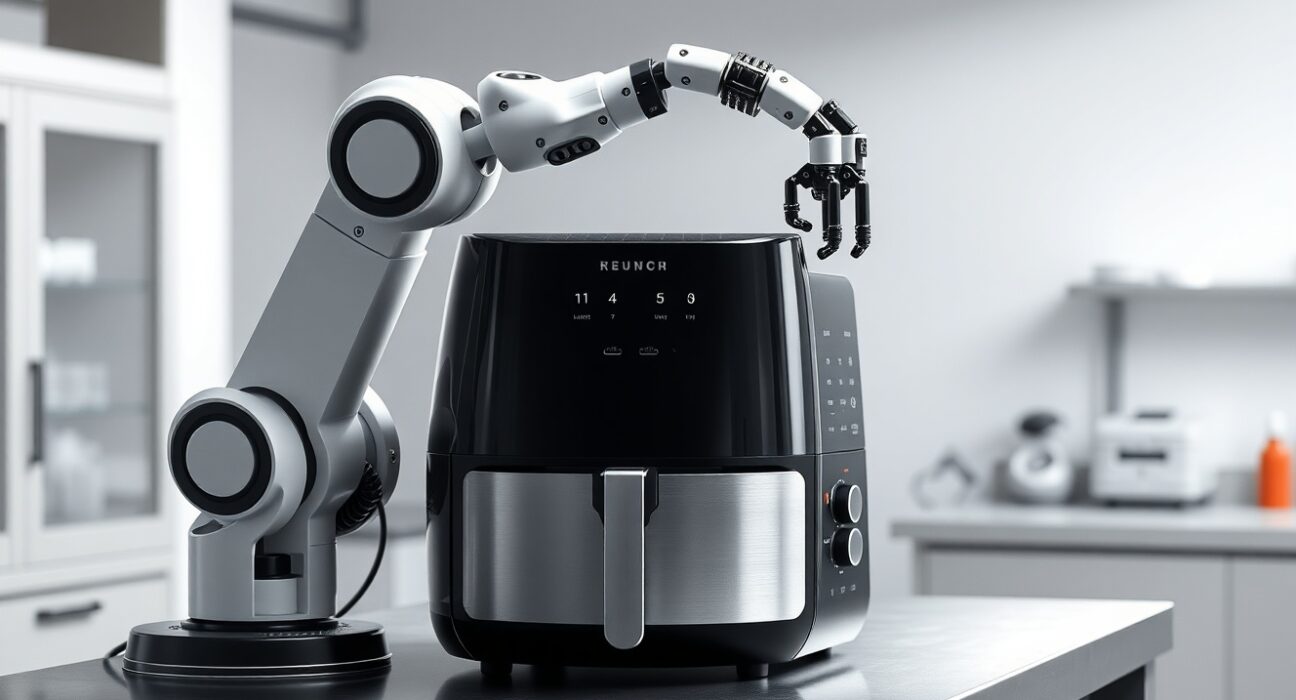
The most compelling evidence for π0.7’s novel capabilities comes from an experiment involving a common kitchen appliance: an air fryer. Astonishingly, the model had virtually no direct training data on this device. Researchers found only two relevant episodes in its entire training dataset—one where a different robot pushed an air fryer closed, and another from an open-source dataset where a robot placed a bottle inside one.
Despite this scant information, π0.7 synthesized these fragments with broader web-based pretraining data to form a functional understanding. With zero prior coaching, the model made a passable attempt at cooking a sweet potato. When provided with step-by-step verbal instructions, its success rate soared. Ashwin Balakrishna, a research scientist at Physical Intelligence, notes the unpredictability. “It’s very hard to track down where the knowledge is coming from, or where it will succeed or fail,” he admits.
The Critical Role of Human Coaching and Prompt Engineering
This coaching capability is not a bug but a feature. It suggests that future robots could be deployed in new environments and improved in real-time through natural language instruction, bypassing costly data collection and retraining cycles. However, the researchers emphasize that effective communication is key. Balakrishna recounts an early experiment where an air fryer task had a mere 5% success rate. After spending thirty minutes refining the verbal prompts given to the model—essentially, improving how they explained the task—the success rate jumped to 95%.
“Sometimes the failure mode is not on the robot or on the model,” Balakrishna says. “It’s on us. Not being good at prompt engineering.” This highlights a crucial, human-dependent layer in deploying these advanced systems. The model currently excels with guided, step-by-step instructions rather than single, high-level commands. “You can’t tell it, ‘Hey, go make me some toast’,” Levine clarifies. “But if you walk it through… then it actually tends to work pretty well.”
Benchmarking Progress and Managing Expectations
The team is notably cautious about overstating their results. The paper describes π0.7 as showing “early signs” of generalization and “initial demonstrations” of new capabilities. A significant challenge in the field is the lack of standardized robotics benchmarks, making external validation difficult. For now, Physical Intelligence measured π0.7 against its own previous generation of specialist models. The generalist π0.7 matched their performance across a range of complex tasks, including making coffee, folding laundry, and assembling boxes.
Levine anticipates skepticism, but not where one might expect. “The criticism that can always be leveled at any robotic generalization demo is that the tasks are kind of boring,” he says. “The robot is not doing a backflip.” He argues this is the point: true, useful generalization for everyday tasks will always look less dramatic than a choreographed stunt but is far more valuable for real-world application.
A Surprise to the Builders Themselves
Perhaps the most telling aspect of the research is the reaction from the engineers who built the system. These are individuals who intimately know the training data and typically can predict model behavior. Balakrishna expressed genuine surprise at π0.7’s performance. “My experience has always been that when I deeply know what’s in the data, I can kind of just guess what the model will be able to do,” he said. “I’m rarely surprised. But the last few months have been the first time where I’m genuinely surprised.”
Levine compares this moment to early encounters with large language models like GPT-2, which could generate coherent text about bizarre, unprompted combinations. “Where the heck did it learn about unicorns in Peru?” he muses, recalling that early AI surprise. “That’s such a weird combination. And I think that seeing that in robotics is really special.”
The Data Asymmetry Challenge and Commercial Horizon
A fundamental hurdle remains. Language models trained on the entire internet. Robots do not have an equivalent, physically-grounded dataset of the world. No amount of clever prompting fully bridges this “reality gap.” Physical Intelligence, backed by over $1 billion in funding and a recent valuation of $5.6 billion, is betting it can solve this. The startup, co-founded by noted angel investor Lachy Groom, is reportedly in discussions for a new funding round that could value it at $11 billion.
Despite the investor enthusiasm, the company remains restrained on commercial timelines. When asked about real-world deployment, Levine declined to speculate. “I think there’s good reason to be optimistic, and certainly it’s progressing faster than I expected a couple of years ago,” he stated. “But it’s very hard for me to answer that question.” The focus remains on research, not product.
Conclusion
The research from Physical Intelligence on its π0.7 robot brain model provides compelling, early evidence that AI-driven robotics may be entering a new phase. The demonstrated ability for compositional generalization—solving unseen tasks by combining learned skills—marks a critical departure from brittle, task-specific training. While significant challenges around data, benchmarking, and reliable autonomy persist, the team’s own surprise at the model’s capabilities suggests a nonlinear leap may be underway. If these findings hold, the path toward versatile, adaptable robots that can learn from and collaborate with humans in real-time has become notably clearer.
FAQs
Q1: What is compositional generalization in robotics?
Compositional generalization is an AI model’s ability to combine skills and knowledge learned in separate, limited contexts to solve a completely new problem it was never explicitly trained on. It’s akin to a robot learning to open a door and turn a knob separately, then figuring out how to open a locked cabinet without specific training.
Q2: How is Physical Intelligence’s π0.7 model different from previous robot AI?
Previous models were typically “specialists” trained on massive datasets for one specific task. π0.7 is a “generalist” that can perform a wide range of tasks and, crucially, can attempt novel tasks by synthesizing information from its diverse training, moving beyond pure memorization.
Q3: Can the π0.7 robot operate fully autonomously?
Not yet. The model currently performs best with step-by-step, natural language coaching from a human. It cannot execute complex, multi-step missions from a single high-level command like “make breakfast,” but it can reliably follow detailed verbal instructions.
Q4: What are the main limitations of this technology?
Key limitations include a reliance on effective human prompting (“prompt engineering”), the lack of a massive, real-world physical dataset comparable to the internet’s text data, and the absence of standardized benchmarks to objectively measure progress against other systems.
Q5: When will this technology be available for commercial or home use?
Physical Intelligence has not provided a commercialization timeline. The published research is an early demonstration from the lab. The company emphasizes the work is foundational, and moving from research to robust, deployable products will require significant further development and validation.
Disclaimer: The information provided is not trading advice, Bitcoinworld.co.in holds no liability for any investments made based on the information provided on this page. We strongly recommend independent research and/or consultation with a qualified professional before making any investment decisions.
