
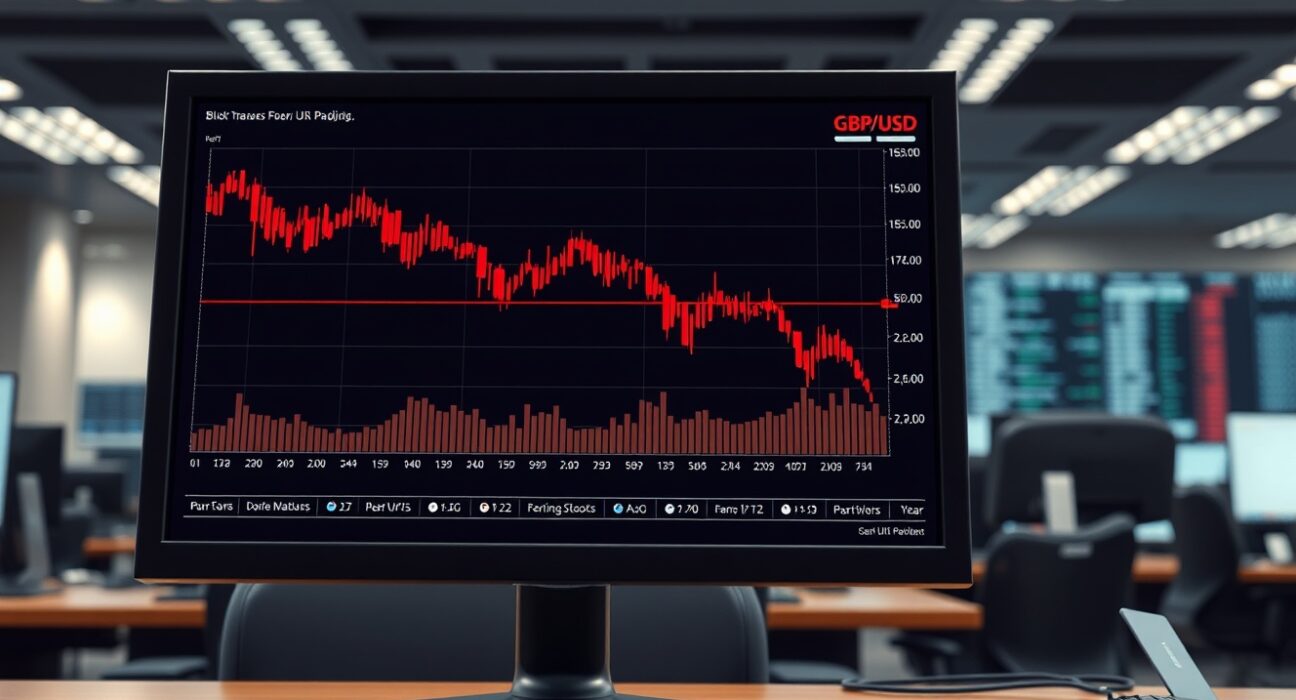
LONDON, April 2025 – The Pound Sterling continues to hover perilously close to its weekly low against the US Dollar, a direct consequence of rapidly escalating geopolitical tensions in the Middle East. Consequently, global investors are aggressively shifting capital into traditional safe-haven assets, thereby applying sustained downward pressure on the British currency. This movement underscores the fragile interplay between international conflict and foreign exchange market stability, a relationship currently dictating short-term currency valuations.
Pound Sterling Faces Sustained Pressure Against the Dollar
Market data from early April 2025 reveals the GBP/USD pair trading within a narrow band just above the 1.2500 support level, a threshold it has tested repeatedly throughout the week. This represents a decline of approximately 1.8% from the pair’s monthly high, recorded before the latest phase of regional hostilities began. The US Dollar Index (DXY), which measures the dollar against a basket of six major currencies, has conversely strengthened by 1.2% over the same period. Analysts at major financial institutions, including Standard Chartered and HSBC, attribute this dynamic to a classic ‘flight to safety’.
Historically, the US Dollar benefits from its status as the world’s primary reserve currency during periods of global uncertainty. Meanwhile, the Pound Sterling, while a major currency, is more exposed to regional economic data and investor risk appetite. The current divergence is stark. For instance, even relatively positive UK services PMI data released this week failed to provide meaningful support for the Pound, as the overarching geopolitical narrative dominated trader sentiment. This scenario highlights a critical market truth: in times of crisis, macroeconomic fundamentals can be temporarily overshadowed by risk aversion.
Expert Analysis on Forex Market Sentiment
Dr. Anya Sharma, Head of Currency Strategy at the Global Economics Institute, provides clear context. “The correlation between geopolitical risk indices and GBP/USD volatility has spiked to its highest level this year,” she states, referencing the Institute’s proprietary risk models. “Our data shows that for every 10-point increase in the Geopolitical Risk (GPR) Index, the Pound Sterling typically weakens by 0.3% against the Dollar, all else being equal. The current environment is a textbook example of this relationship in action.” This data-driven perspective reinforces the observed market behavior, moving beyond speculation to evidence-based reasoning.
How Middle East Tensions Directly Impact Currency Flows
The specific nature of the current Middle East crisis triggers several immediate financial market mechanisms. Firstly, rising tensions threaten global oil supply routes, prompting fears of an energy price shock. The UK, as a net energy importer, faces potential inflationary pressures that could complicate the Bank of England’s monetary policy path. Secondly, heightened uncertainty prompts institutional investors and sovereign wealth funds to rebalance portfolios, often reducing exposure to European assets perceived as riskier.
Key mechanisms driving the GBP/USD move include:
- Capital Flight: Investors exit Pound-denominated assets for the perceived safety of US Treasuries.
- Commodity Channel: Oil price volatility impacts the UK’s import bill and trade balance outlook.
- Policy Divergence: Markets anticipate the US Federal Reserve may maintain a ‘higher-for-longer’ stance if global instability fuels inflation.
- Liquidity Preference: In stressed markets, liquidity becomes paramount, favoring the deep, liquid USD market.
The following table illustrates recent comparative performance, showing the Pound’s weakness is particularly pronounced against traditional safe havens:
| Currency Pair | Weekly Change | Primary Driver |
|---|---|---|
| GBP/USD | -1.5% | Geopolitical Risk / Safe-Haven Demand |
| GBP/CHF (Swiss Franc) | -1.8% | Safe-Haven Demand |
| GBP/JPY (Japanese Yen) | -0.9% | Carry Trade Unwind & Safe-Haven Demand |
| GBP/EUR | +0.2% | Relative Regional Exposure |
Historical Context and Potential Trajectories
Examining past episodes provides crucial insight. During the initial phases of the Russia-Ukraine conflict in early 2022, the GBP/USD pair fell over 5% in three weeks as investors sought dollar safety. Similarly, periods of escalated Middle East tension have consistently led to short-term USD strength. However, the long-term trajectory for the Pound Sterling will inevitably refocus on domestic fundamentals. Key upcoming data points include UK inflation figures, GDP growth estimates, and the Bank of England’s Monetary Policy Committee meetings.
Market technicians are closely watching several support levels. A sustained break below 1.2500 could open the path toward 1.2350, a level not seen since late 2024. Conversely, a de-escalation in geopolitical news flow could trigger a swift retracement, as pent-up demand for undervalued Sterling assets re-emerges. The volatility index for GBP/USD options has risen significantly, indicating traders are pricing in larger price swings over the coming month. This environment demands caution and highlights the importance of robust risk management strategies for currency traders.
The Role of Central Bank Policy and Economic Data
Beyond immediate headlines, the fundamental divergence between the Bank of England (BoE) and the Federal Reserve remains a background driver. While both banks have paused active hiking cycles, market expectations for the timing and pace of future rate cuts differ. “The UK’s sticky core inflation problem gives the BoE less room to maneuver than the Fed if a global growth shock materializes from these tensions,” notes Michael Chen, a veteran City of London forex trader with over two decades of experience. “This policy uncertainty adds another layer of weakness to Sterling beyond pure risk-off flows.” His on-the-ground experience confirms that trading desks are factoring in both geopolitical and fundamental analysis.
Conclusion
In summary, the Pound Sterling’s position near a weekly low against the US Dollar is a direct and measurable reaction to intensifying Middle East tensions. The prevailing market dynamic is dominated by safe-haven demand, which powerfully benefits the US Dollar at the expense of risk-sensitive currencies like the Pound. While historical patterns suggest such geopolitically-driven moves can be sharp but temporary, the ultimate path for the GBP/USD pair will depend on a combination of conflict resolution and underlying UK economic performance. For now, traders and analysts alike are closely monitoring diplomatic developments, knowing they hold immediate sway over currency valuations in this fragile climate.
FAQs
Q1: Why does the US Dollar strengthen when there is geopolitical trouble?
The US Dollar is considered the world’s premier safe-haven currency. During crises, global investors seek the stability and deep liquidity of US Treasury bonds and dollar-denominated assets, increasing demand for USD.
Q2: How do oil prices affect the Pound Sterling?
The UK is a net importer of oil. Rising oil prices can worsen the UK’s trade deficit and increase import-cost inflation, which can be negative for the Pound’s value if it complicates economic management.
Q3: Is the Pound’s weakness solely due to Middle East tensions?
While the primary current driver is geopolitical risk, underlying factors like the UK’s economic growth outlook and the Bank of England’s future interest rate decisions also play a significant background role.
Q4: What are other traditional safe-haven currencies besides the US Dollar?
The Swiss Franc (CHF), Japanese Yen (JPY), and, to a lesser extent, gold are also considered major safe-haven assets during periods of market stress.
Q5: What key level are traders watching for the GBP/USD pair?
Technical analysts are closely monitoring the 1.2500 support level. A sustained break below this psychological and technical benchmark could signal further near-term weakness for the Pound Sterling.
Disclaimer: The information provided is not trading advice, Bitcoinworld.co.in holds no liability for any investments made based on the information provided on this page. We strongly recommend independent research and/or consultation with a qualified professional before making any investment decisions.