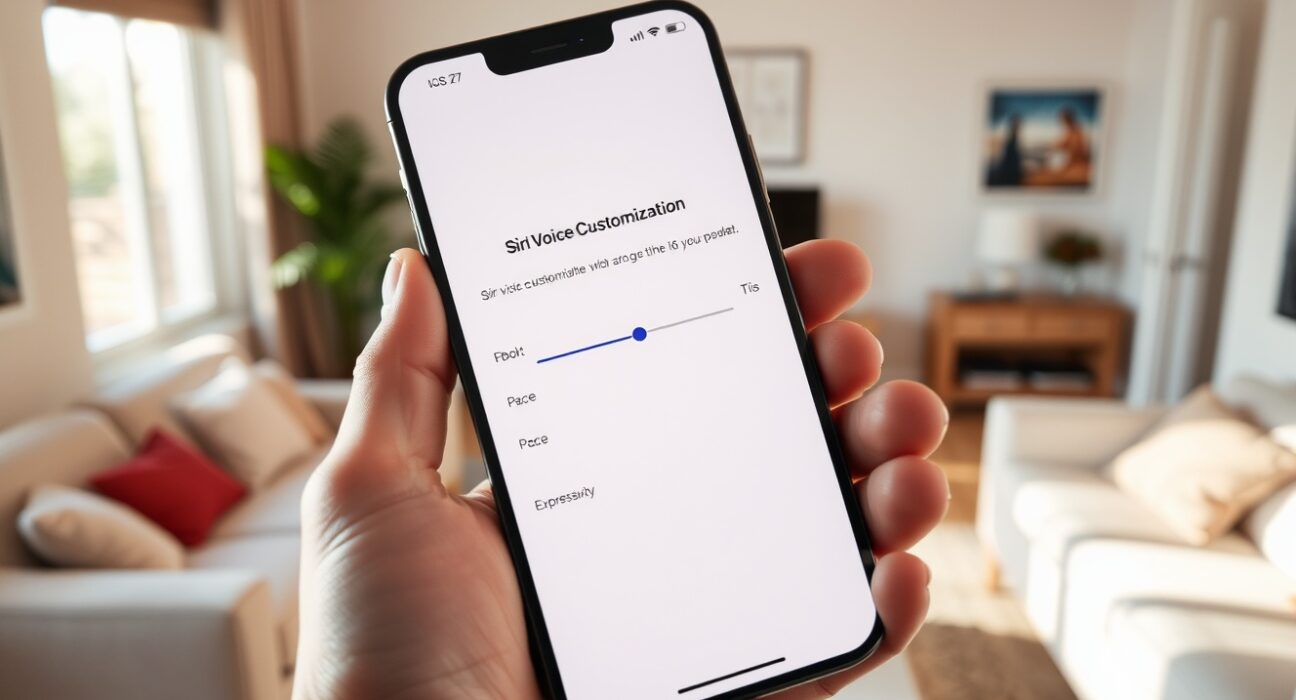
Apple has quietly enabled two long-awaited voice customization features for Siri in the latest developer beta of iOS 27. With beta 3, released today, testers can now adjust how quickly the AI assistant speaks and how much human-like emotion it conveys — controls that were previously labeled as “Coming soon” in earlier beta builds.
What the new Siri controls do
The update introduces two sliders in the Siri settings panel: one for “Pace” and another for “Expressivity.” Users can slow down or speed up Siri’s speech rate, and separately dial up or down the emotional inflection in its voice. As adjustments are made, Siri plays a sample phrase — such as “You have one new message” — so users can hear the effect in real time.
These controls build on the broader voice selection overhaul Apple first previewed at WWDC 26 in June. Beyond choosing between male and female voices, users can now pick from a range of regional accents and then fine-tune delivery with the new sliders. The goal, according to Apple, is to make Siri feel more natural and personal as the company rebuilds the assistant around generative AI.
How it compares to ChatGPT and other AI assistants
Apple’s move follows a trend among AI voice assistants toward greater personalization. OpenAI’s ChatGPT, for example, has offered adjustable warmth and enthusiasm settings since December 2025, along with tone presets like “friendly,” “professional,” or “quirky.” Those controls affect not only how ChatGPT speaks but also how it structures responses.
Apple’s approach is more focused on vocal delivery than conversational style. The company appears to be prioritizing naturalness over breadth of personality options — at least for now. The expressivity slider modulates tone and cadence rather than rewriting how Siri phrases its answers.
Deeper integration across iOS 27
The AI-powered version of Siri in iOS 27 is more deeply embedded into the operating system. Users can invoke it by speaking, swiping down from the Dynamic Island, tapping the side button, typing in a new text interface, or opening a standalone Siri app for the first time. These access points reflect Apple’s strategy of making Siri a persistent, ambient assistant rather than a feature users must consciously activate.
Other changes in beta 3
iOS 27 beta 3 also includes minor updates, such as a redesigned Reminders app icon. However, some testers on X have reported losing access to the new Siri after updating, or seeing their phones begin re-indexing data — a process that typically occurs when Siri AI optimizes its local search index. Apple has not yet commented on these reports.
Why this matters for iPhone users
Voice assistant personalization may seem like a small feature, but it reflects a broader shift in how companies approach human-AI interaction. Making an AI voice feel less robotic and more adaptable to individual preferences can improve user trust and comfort, especially as assistants take on more complex tasks. For Apple, which has lagged behind rivals in generative AI, these granular controls signal a more deliberate effort to catch up — not just in capability, but in user experience.
FAQs
Q1: Which devices support the new Siri pace and expressivity controls?
They are available in iOS 27 developer beta 3, which runs on iPhone models compatible with iOS 27. A public beta is expected later this summer.
Q2: Will these controls work with third-party apps or only Apple’s own services?
Currently, the pace and expressivity settings apply to Siri system-wide, including interactions with third-party apps that use SiriKit. However, developers may need to update their apps to fully support the new voice nuances.
Q3: Is the new Siri voice customization available in languages other than English?
Apple has not yet detailed language availability. Beta features often launch in English first, with additional languages rolling out in subsequent updates.
Disclaimer: The information provided is not trading advice, Bitcoinworld.co.in holds no liability for any investments made based on the information provided on this page. We strongly recommend independent research and/or consultation with a qualified professional before making any investment decisions.