

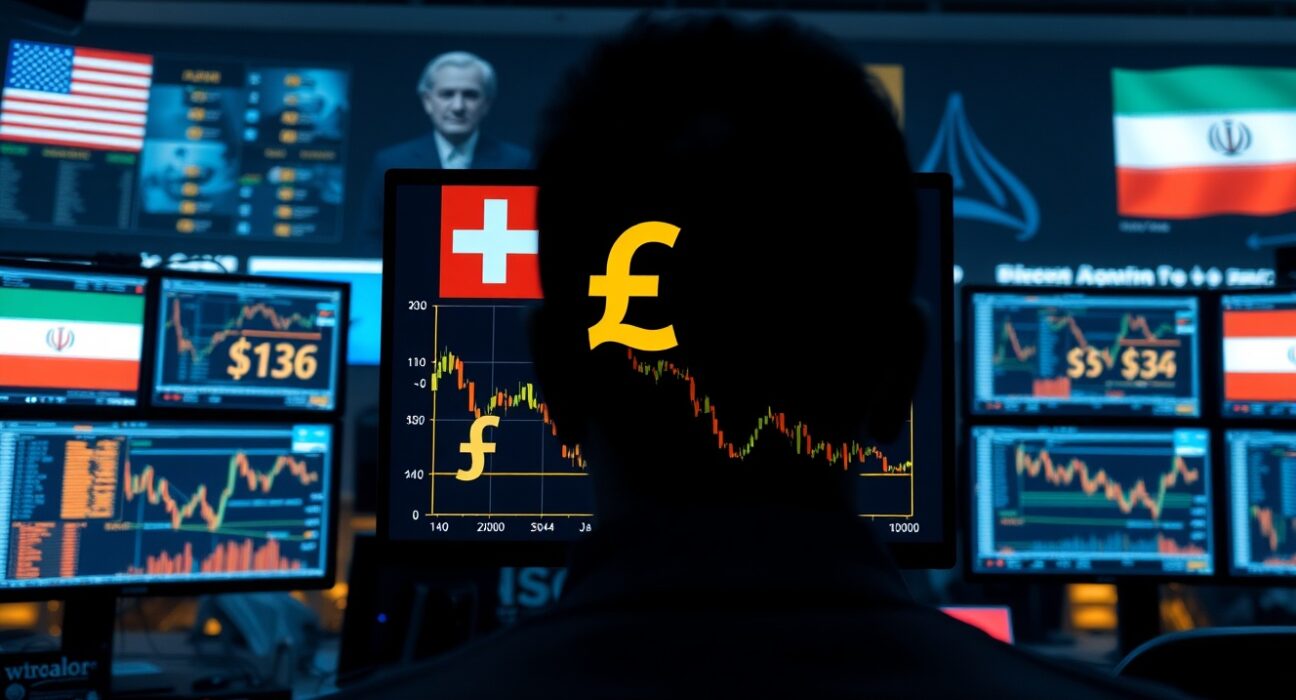
The Swiss Franc edged lower against major peers on Tuesday, as escalating geopolitical tensions between the United States and Iran triggered a shift in risk appetite, bolstering demand for the US dollar while the Swiss National Bank (SNB) reiterated its readiness to intervene in currency markets to curb excessive franc strength.
Renewed US-Iran Tensions Weigh on Risk Sentiment
Reports of heightened military posturing and diplomatic friction between Washington and Tehran have rekindled safe-haven flows. Historically, the Swiss Franc benefits from such uncertainty, but this time, the dollar has taken the lead as the primary beneficiary, partly due to rising US Treasury yields and expectations of a more hawkish Federal Reserve. The franc’s softening reflects a nuanced market where traditional safe-haven hierarchies are shifting.
SNB’s Intervention Stance Caps Franc Gains
The SNB has long viewed an excessively strong franc as a threat to Switzerland’s export-driven economy. In recent statements, central bank officials signaled a willingness to intervene more aggressively if the currency appreciates too rapidly. This stance has effectively capped the franc’s upside, even amid geopolitical jitters. Market participants are now pricing in a higher probability of SNB action, which has contributed to the franc’s relative underperformance compared to the dollar.
Market Implications and Trader Focus
For forex traders, the key dynamic is the interplay between safe-haven demand and central bank policy. The USD/CHF pair has found support near key technical levels, and a break above resistance could signal further franc weakness. The broader market is also watching for any diplomatic breakthroughs or further escalation, which could reverse the current trend. The SNB’s intervention history suggests it will act decisively if the franc threatens to disrupt economic stability.
Conclusion
The Swiss Franc’s recent softness is a product of competing forces: renewed geopolitical risk favoring the dollar and the SNB’s proactive intervention stance. While the franc remains a core safe-haven asset, its near-term trajectory will depend on the evolution of US-Iran relations and the SNB’s willingness to step in. Traders should monitor both geopolitical headlines and central bank communications for directional cues.
FAQs
Q1: Why is the Swiss Franc weakening despite rising geopolitical tensions?
The US dollar is currently the primary safe-haven beneficiary due to higher yields and Fed hawkishness. Additionally, the SNB’s explicit readiness to intervene caps franc gains.
Q2: How does the SNB intervene in currency markets?
The SNB typically sells francs and buys foreign currencies, such as the euro or dollar, to weaken the franc. It may also use forward contracts or verbal intervention.
Q3: What impact could further escalation in US-Iran tensions have on the franc?
If tensions spike sharply, the franc could strengthen as a traditional safe haven, but the SNB would likely respond with stronger intervention, creating a tug-of-war in the market.
Disclaimer: The information provided is not trading advice, Bitcoinworld.co.in holds no liability for any investments made based on the information provided on this page. We strongly recommend independent research and/or consultation with a qualified professional before making any investment decisions.
