
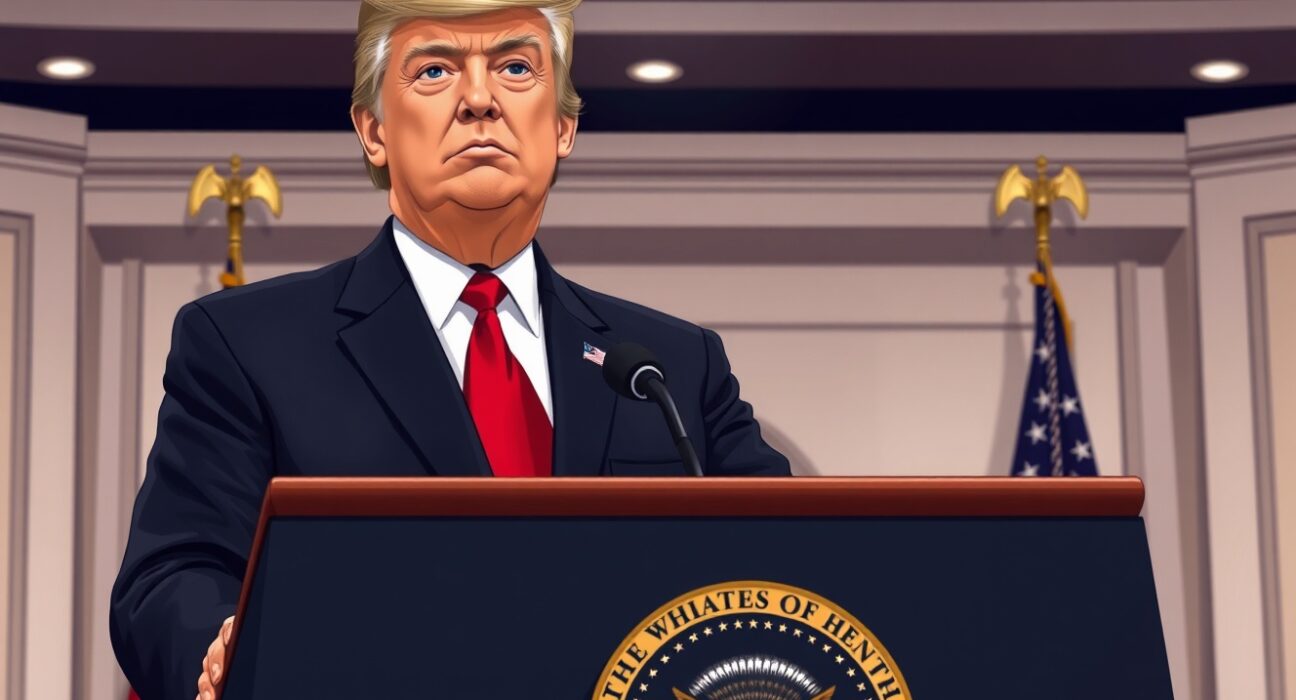
WASHINGTON, D.C. – In a pivotal national address, President Donald Trump delivered a critical update on U.S. strategy toward Iran, asserting that core strategic objectives have been largely achieved while addressing mounting concerns over volatile global oil prices. The President framed recent energy market turbulence as a temporary phenomenon directly linked to Iranian aggression against maritime shipping. This declaration arrives amid heightened tensions in the Strait of Hormuz, a vital chokepoint for global crude oil shipments. Consequently, analysts are scrutinizing the administration’s assessment for its implications on both Middle Eastern stability and worldwide economic security.
Trump’s Core Iran Objectives and Strategic Assessment
President Trump’s address centered on a definitive claim of strategic progress. He stated that the administration’s primary goals concerning Iran had been nearly fulfilled. This announcement follows years of maximum pressure campaigns involving severe economic sanctions and diplomatic isolation. The strategy explicitly aimed to curb Iran’s regional influence and dismantle its nuclear weapons program. Furthermore, the 2018 withdrawal from the Joint Comprehensive Plan of Action (JCPOA) represented a cornerstone of this approach. Experts note that the administration’s objectives have consistently included:
- Complete denuclearization of the Iranian regime.
- Restriction of ballistic missile development and testing.
- Counteraction of proxy influence in Yemen, Syria, and Lebanon.
However, regional observers immediately questioned the assertion of achieved objectives. They point to recent International Atomic Energy Agency (IAEA) reports indicating Iran has steadily increased its stockpile of enriched uranium. Simultaneously, proxy groups continue to operate across the region. Therefore, the President’s statement appears to signal a strategic recalibration rather than a conclusive endpoint. It potentially shifts the narrative toward managing outcomes instead of pursuing maximalist demands.
Analyzing the Temporary Oil Price Situation
The President directly linked recent oil price increases to specific Iranian actions, notably attacks on commercial oil tankers. He characterized the market reaction as a temporary disruption. Global benchmark Brent crude has experienced notable fluctuations following incidents in the Gulf of Oman. For instance, prices spiked by over 4% following a confirmed attack on two tankers in June. The Strait of Hormuz sees the transit of roughly 21 million barrels of oil daily. Consequently, any threat to this passage triggers immediate risk premiums in futures markets.
The following table illustrates recent price movements correlated with regional incidents:
| Date | Incident | Brent Crude Price Change | Duration of Spike |
|---|---|---|---|
| June 13 | Attack on two tankers | +4.3% | 3 trading days |
| July 19 | Seizure of a British tanker | +2.1% | 2 trading days |
| August-September | Period of relative calm | Price stabilization | Ongoing |
Market fundamentals support the temporary assessment. Global inventories remain ample, and U.S. shale production continues at record levels. Additionally, the Organization of the Petroleum Exporting Countries (OPEC) maintains significant spare capacity. Thus, supply shocks from the Middle East typically cause short-lived price spikes unless a prolonged conflict emerges. The President’s comments likely aimed to calm markets and preempt inflationary pressures on the U.S. economy.
Expert Perspective on Energy Market Resilience
Energy analysts largely concur with the temporary nature of the price pressure. Dr. Sarah Chen, a senior fellow at the Global Energy Institute, explains the market dynamics. “The geopolitical risk premium is real but finite,” Chen states. “Modern energy markets are diversified. U.S. output acts as a global swing producer, mitigating single-point failures. Unless we see a sustained military conflict that closes the Strait, prices will retract.” This analysis aligns with historical data. Previous Gulf conflicts caused sharp but brief price increases before markets corrected. The current situation mirrors those patterns, suggesting a contained risk profile.
The Nuclear Calculus and Comparative Risk
President Trump introduced a stark comparative risk framework during his remarks. He argued that a nuclear-armed Iran would inflict far greater suffering than the current rise in oil prices. This statement underscores the administration’s primary security concern. A nuclear Iran could destabilize the entire Middle East, potentially triggering a regional arms race. Moreover, it could embolden Iranian proxy networks, believing they operate under a nuclear umbrella. Historical precedent supports this concern. Nuclear deterrence theory suggests that asymmetric actors might engage in riskier conventional actions.
The administration’s policy has consistently prioritized non-proliferation above other economic considerations. This hierarchy explains the acceptance of temporary oil market volatility. The strategic calculation weighs short-term economic discomfort against a long-term, existential security threat. Consequently, the maximum pressure campaign seeks to force Iran back to negotiations under stricter terms. Whether this objective has been “almost achieved” remains a subject of intense debate among foreign policy circles in Washington and allied capitals.
Regional and Global Implications
The address carries significant implications beyond immediate oil prices. Regional allies, including Saudi Arabia and Israel, interpret U.S. statements as signals of commitment and red lines. A declaration of met objectives may suggest a de-escalatory phase. Alternatively, it could indicate a shift toward containment rather than rollback. European allies, meanwhile, remain committed to the JCPOA framework. They seek to preserve the agreement despite U.S. sanctions. This transatlantic divergence complicates unified diplomatic efforts.
Globally, energy-importing nations monitor U.S. assurances closely. Countries like India, China, and Japan depend on stable Middle Eastern supplies. Temporary price spikes strain their economies and trade balances. Therefore, the U.S. assessment provides crucial market guidance. It suggests that Washington does not anticipate a prolonged supply crisis. This confidence may prevent precautionary stockpiling that could exacerbate price pressures. Ultimately, the administration seeks to project control over a volatile situation, assuring global markets of its manageability.
Conclusion
President Trump’s national address presented a dual narrative of strategic success and transient economic challenge. The assertion that core Iran objectives are nearly met marks a potential inflection point in a prolonged geopolitical standoff. Simultaneously, the framing of oil price increases as temporary aims to stabilize nervous global energy markets. The underlying message emphasizes a calculated prioritization: preventing nuclear proliferation outweighs short-term market fluctuations. As the situation evolves, the accuracy of these assessments will be tested by Iran’s actions, market responses, and the durability of any diplomatic off-ramps. The global community now watches to see if this declared stability holds or if it precedes the next phase of uncertainty.
FAQs
Q1: What exactly did President Trump say about Iran’s objectives?
President Trump stated in a national address that the core strategic objectives of the United States regarding Iran have been “almost achieved.” He did not specify all objectives but historically they have included denuclearization, curbing ballistic missile development, and countering regional proxy influence.
Q2: Why does President Trump believe the oil price rise is temporary?
The President attributed the price increase directly to Iran’s attacks on oil tankers, which create a temporary risk premium. He and market analysts point to strong global supply fundamentals, including high U.S. shale production and OPEC spare capacity, which can absorb short-term disruptions.
Q3: How did Trump compare nuclear weapons to oil prices?
Trump argued that Iran obtaining nuclear weapons would cause “greater suffering” than the current increase in oil prices. This frames non-proliferation as the paramount strategic priority, justifying temporary economic side-effects from the pressure campaign.
Q4: What is the strategic importance of the Strait of Hormuz?
The Strait of Hormuz is a critical maritime chokepoint located between Oman and Iran. Approximately 21 million barrels of oil, representing about 21% of global petroleum liquid consumption, pass through it daily. Any threat to this transit directly impacts global oil prices.
Q5: How have oil markets historically reacted to Middle East tensions?
Historically, oil prices spike sharply following incidents that threaten supply but typically retract within days or weeks unless a sustained conflict erupts. The market applies a “geopolitical risk premium” that fades as the immediate threat appears contained, which aligns with the “temporary” assessment.
Disclaimer: The information provided is not trading advice, Bitcoinworld.co.in holds no liability for any investments made based on the information provided on this page. We strongly recommend independent research and/or consultation with a qualified professional before making any investment decisions.