

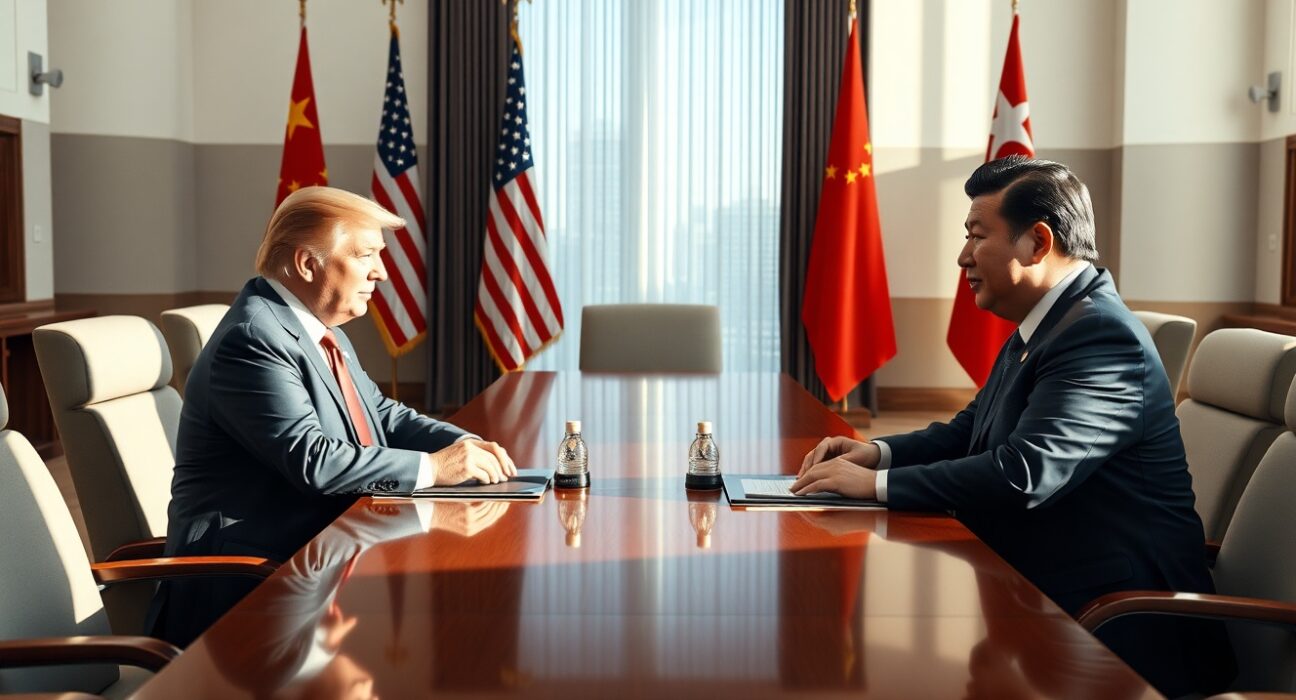
US President Donald Trump has stated that trade negotiations will be the primary focus of his upcoming summit with Chinese President Xi Jinping, explicitly downplaying speculation that Iran would be a central topic of discussion. The remarks, made to reporters traveling with the president, signal a clear prioritization of economic issues over geopolitical tensions in the bilateral dialogue.
Trade Tensions Remain Front and Center
The summit, expected to take place in the coming weeks, comes at a critical juncture for US-China economic relations. The Trump administration has maintained a强硬 stance on trade imbalances, intellectual property theft, and market access, while China has signaled willingness to negotiate on certain terms. By declaring trade the top agenda item, the president is reinforcing his administration’s longstanding position that economic reciprocity is a prerequisite for broader cooperation.
Analysts note that this approach aligns with Trump’s broader foreign policy strategy, which has often prioritized transactional outcomes over alliance-based diplomacy. The decision to sideline Iran as a primary talking point may also reflect a calculation that progress on trade is more achievable and domestically beneficial than resolving the complex and long-standing disputes over Tehran’s nuclear program and regional influence.
Implications for US-China Relations
The focus on trade could have significant implications for the trajectory of US-China relations. A successful trade agreement would not only boost economic confidence but could also create a foundation for addressing other contentious issues, including technology competition and regional security. However, critics argue that by not pressing China on Iran, the US may be missing an opportunity to leverage its economic influence to curb Beijing’s support for Tehran.
What This Means for Markets and Investors
For global markets, the emphasis on trade is a positive signal. Investors have long viewed the US-China trade war as a primary source of economic uncertainty. A de-escalation or resolution could reduce tariffs, stabilize supply chains, and improve corporate earnings outlooks. Conversely, if the summit fails to produce tangible progress, market volatility could increase. The absence of Iran on the agenda may also reassure oil markets, as a potential US-China agreement on Tehran could have led to tighter sanctions enforcement and supply disruptions.
Conclusion
President Trump’s declaration that trade will be the priority at his summit with Xi Jinping clarifies the administration’s immediate diplomatic objectives. While Iran remains a significant foreign policy challenge, the decision to focus on economic issues reflects a strategic choice to pursue progress where it is most tangible. The outcome of the summit will be closely watched for its impact on global trade, geopolitical alliances, and market stability.
FAQs
Q1: Why did President Trump say Iran would not be a priority at the summit?
A: President Trump indicated that trade negotiations are the primary goal of the meeting, suggesting that focusing on economic issues is more likely to yield concrete results than addressing the complex and long-standing disputes over Iran’s nuclear program.
Q2: How might this affect US-China relations?
A: Prioritizing trade could lead to a breakthrough on economic issues, potentially improving bilateral ties. However, it may also be seen as a missed opportunity to pressure China on its support for Iran, which remains a point of contention in US foreign policy.
Q3: What does this mean for global markets?
A: Markets generally view a focus on trade positively, as a potential de-escalation of the US-China trade war could reduce uncertainty, lower tariffs, and stabilize supply chains. The exclusion of Iran from the agenda may also calm oil markets by reducing the likelihood of immediate sanctions escalation.
Disclaimer: The information provided is not trading advice, Bitcoinworld.co.in holds no liability for any investments made based on the information provided on this page. We strongly recommend independent research and/or consultation with a qualified professional before making any investment decisions.
