

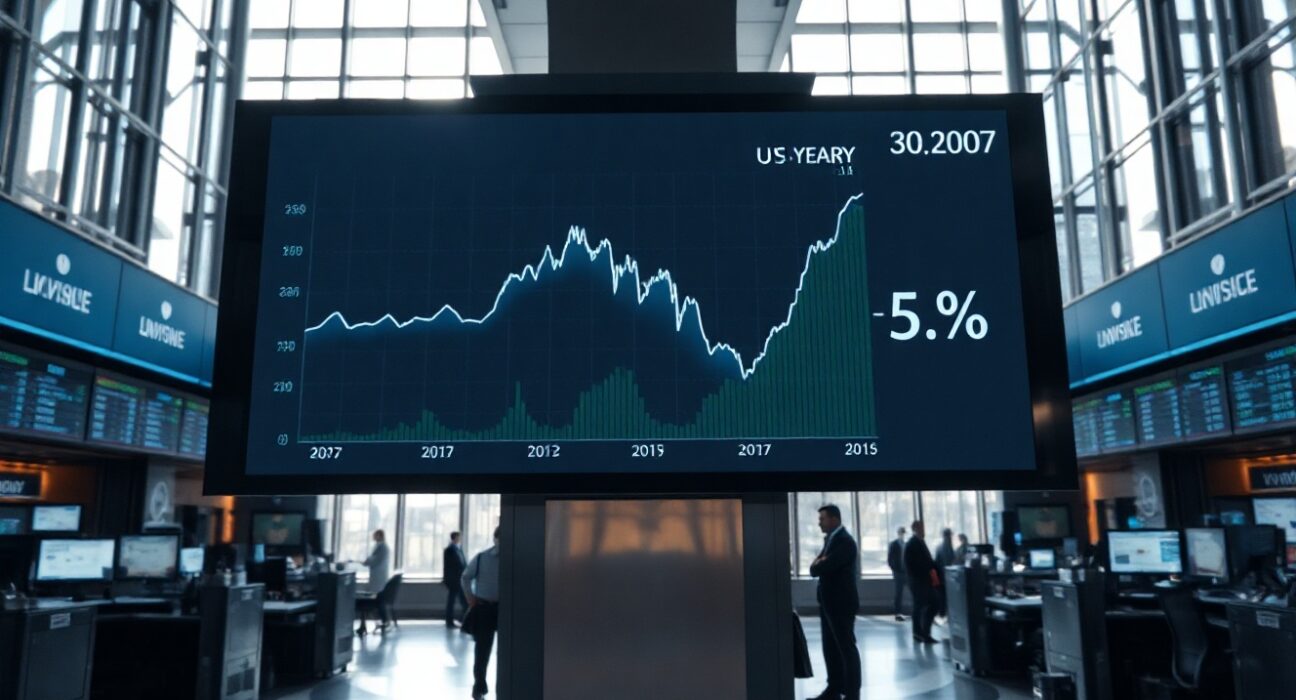
The US 30-year Treasury yield climbed to its highest level since 2007 on [current date], a move that underscores deepening concerns about persistent inflation, rising federal borrowing, and the Federal Reserve’s commitment to keeping interest rates elevated. The surge in long-term borrowing costs has rippled through global markets, pressuring equities and reigniting debates about the sustainability of US fiscal policy.
Why are long-term Treasury yields rising?
The 30-year Treasury yield, a benchmark for long-term borrowing costs, has been driven upward by a combination of factors. Investors are demanding higher compensation for the risk of holding longer-dated government debt, reflecting expectations that inflation will remain above the Fed’s 2% target for an extended period. Additionally, the Treasury’s increased issuance of long-dated securities to fund growing fiscal deficits has added supply pressure, pushing prices down and yields up.
Recent economic data, including stronger-than-expected job growth and resilient consumer spending, has also led traders to scale back bets on near-term rate cuts. According to CME Group’s FedWatch tool, the probability of a rate cut at the next Federal Reserve meeting has fallen to [percentage]% as of [current date], down from [percentage]% a month ago.
Market impact and investor sentiment
The rise in the 30-year yield has had a pronounced effect on financial markets. Equities, particularly rate-sensitive sectors like technology and real estate, have come under pressure as higher discount rates reduce the present value of future earnings. The S&P 500 and Nasdaq Composite both posted losses on [current date], with the Dow Jones Industrial Average falling [points] points.
In the housing market, the surge in long-term yields has pushed mortgage rates higher, further straining affordability for prospective homebuyers. The average 30-year fixed-rate mortgage climbed to [percentage]% this week, according to Freddie Mac, the highest level in over two decades. This has dampened homebuilding activity and existing-home sales, adding another headwind to the broader economy.
What this means for investors
For investors, the current environment demands a careful reassessment of portfolio positioning. Higher yields on government bonds make them more attractive relative to riskier assets, potentially drawing capital away from stocks. However, the underlying reasons for the yield surge—persistent inflation and heavy government borrowing—also pose risks to corporate earnings and economic growth.
Fixed-income investors may find opportunities in shorter-duration bonds, which are less sensitive to interest rate fluctuations, while equity investors might consider sectors with pricing power and strong balance sheets. Diversification across asset classes remains a prudent strategy amid heightened uncertainty.
Conclusion
The 30-year Treasury yield reaching a 2007 high marks a pivotal moment for financial markets, reflecting deep-seated concerns about inflation and fiscal sustainability. As the Federal Reserve navigates its dual mandate of price stability and maximum employment, the path of long-term rates will remain a critical variable for investors, businesses, and policymakers alike. Monitoring upcoming economic data and Fed communications will be essential for understanding the trajectory of this trend.
FAQs
Q1: What does the 30-year Treasury yield hitting a 2007 high mean for the average consumer?
For consumers, this typically translates into higher borrowing costs on long-term loans, such as mortgages and auto loans. It can also affect the interest rates on savings accounts and CDs, which may become more attractive as yields rise.
Q2: How does the 30-year Treasury yield affect the stock market?
Higher Treasury yields can make bonds more appealing relative to stocks, potentially leading to a sell-off in equities. They also increase the discount rate used in valuing future cash flows, which can lower stock valuations, particularly for growth and technology companies.
Q3: Will the Federal Reserve respond to the rise in long-term yields?
The Fed monitors long-term yields as part of its broader financial conditions assessment. While it primarily sets short-term rates, significant moves in long-term yields can influence its policy decisions. The Fed may adjust its communication or balance sheet policies if it deems the yield surge disruptive to its economic objectives.
Disclaimer: The information provided is not trading advice, Bitcoinworld.co.in holds no liability for any investments made based on the information provided on this page. We strongly recommend independent research and/or consultation with a qualified professional before making any investment decisions.
