
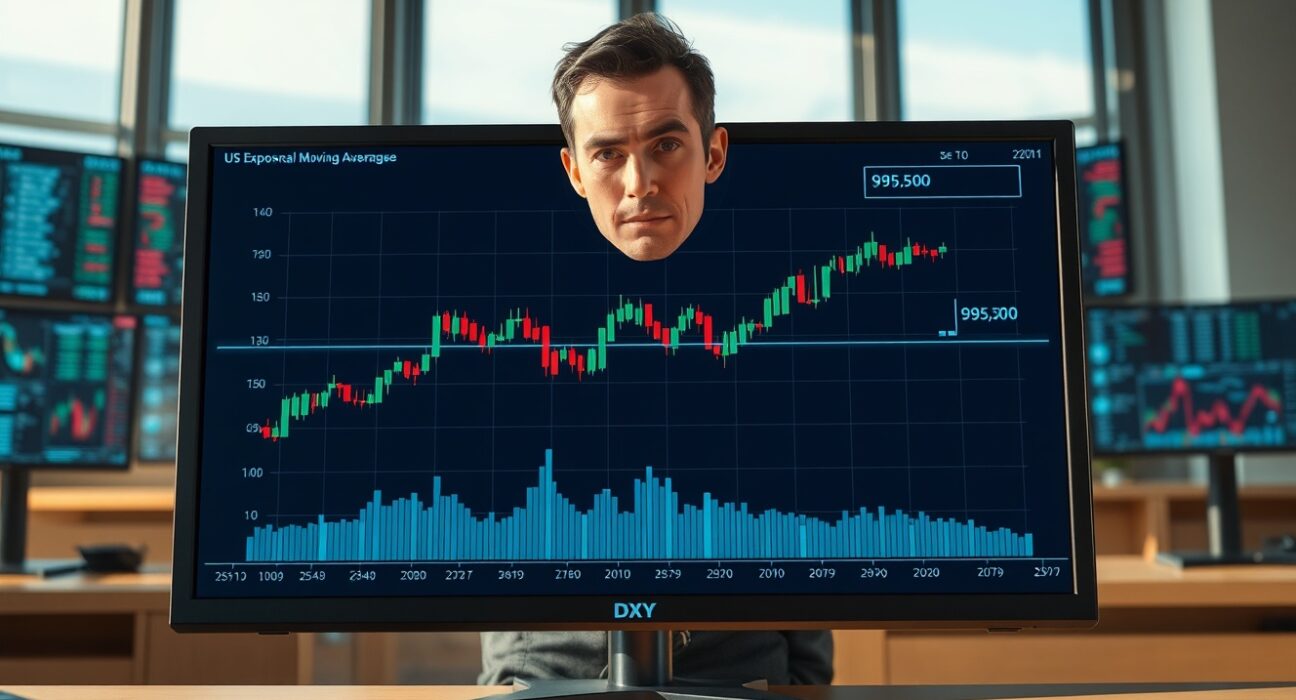
The US Dollar Index (DXY) faces a crucial technical test as it approaches the 99.50 support level near its nine-day Exponential Moving Average (EMA), signaling potential volatility shifts in global currency markets. This movement, observed in early 2025 trading sessions, reflects complex interactions between Federal Reserve policy expectations, relative global economic strength, and technical chart patterns. Market participants closely monitor this level because sustained breaks often precede significant directional moves. Consequently, traders analyze multiple timeframes to gauge momentum. Furthermore, institutional investors adjust hedges based on these technical signals. The current price action follows a period of consolidation after the index retreated from recent highs. Therefore, this support test carries substantial implications for forex pairs, commodities, and international trade flows.
US Dollar Index Technical Analysis and 99.50 Support
Technical analysts identify the 99.50 level as a critical support zone for the US Dollar Index. This price point represents a convergence of the nine-day EMA and previous resistance-turned-support from earlier trading ranges. The nine-day EMA serves as a short-term momentum gauge. When price tests this average, it often indicates whether bullish or bearish forces dominate. A decisive break below 99.50 could trigger further selling toward the 98.80 area. Conversely, a strong bounce might target resistance near 100.20. Several key indicators provide additional context for this setup.
Primary Technical Indicators:
- Relative Strength Index (RSI): Currently hovering near 45, suggesting neutral momentum without extreme overbought or oversold conditions.
- Moving Average Convergence Divergence (MACD): The histogram shows weakening bullish momentum as it approaches the zero line.
- Volume Profile: Shows significant trading activity previously occurred around the 99.50 level, increasing its importance.
- Bollinger Bands: Price tests the middle band (20-day SMA), with bands beginning to contract, indicating potential volatility expansion.
Market structure analysis reveals the index formed a lower high recently. This pattern often precedes trend changes if support levels fail. Meanwhile, the 50-day and 200-day moving averages remain above current prices, suggesting the longer-term trend might still be bullish. However, short-term momentum clearly favors sellers. Consequently, traders watch for either a consolidation pattern or a directional breakout. Each scenario requires different risk management approaches.
Fundamental Drivers Behind Dollar Index Movement
Beyond chart patterns, fundamental factors exert strong influence on the US Dollar Index. The index measures the dollar’s value against a basket of six major currencies: the euro, Japanese yen, British pound, Canadian dollar, Swedish krona, and Swiss franc. Therefore, relative economic performance and central bank policies drive its fluctuations. Recently, shifting expectations regarding the Federal Reserve’s interest rate path have created headwinds. Specifically, softer inflation data prompted markets to price in earlier rate cuts. This development reduced the dollar’s yield advantage.
Simultaneously, other central banks maintain more hawkish stances. The European Central Bank, for instance, remains cautious about cutting rates too soon. Similarly, the Bank of England faces persistent inflation pressures. These policy divergences affect currency pair weights within the DXY basket. Additionally, global risk sentiment influences dollar demand. During periods of market stress, investors often seek the dollar’s safe-haven status. Recent geopolitical tensions provided some support, but not enough to overcome rate expectations. Economic data releases will likely determine the next major move.
Expert Analysis and Market Implications
Financial institutions provide valuable context for this technical setup. J.P. Morgan analysts note that “the dollar’s correlation with rate differentials has strengthened recently.” They emphasize monitoring upcoming employment and inflation reports. Meanwhile, Goldman Sachs research highlights that “positioning data shows speculators reduced long dollar positions significantly last week.” This reduction suggests sentiment shifted before the price reached current levels. Bloomberg Intelligence adds that “historical volatility patterns suggest increased currency market swings during Fed policy transitions.”
The implications extend beyond forex trading. A weaker dollar typically supports commodities priced in dollars, like gold and oil. It also affects multinational corporate earnings. Companies with substantial overseas revenue often benefit from translation effects when the dollar depreciates. Conversely, emerging markets with dollar-denominated debt face different pressures. Their borrowing costs become more manageable with a softer dollar. Therefore, asset managers across categories monitor these developments. The table below summarizes key economic data points influencing the DXY:
| Data Point | Release Date | Expected Impact |
|---|---|---|
| US Non-Farm Payrolls | First Friday monthly | High – Strong jobs support Fed hawkishness |
| Consumer Price Index (CPI) | Monthly | High – Direct inflation gauge for rate policy |
| Federal Reserve Meetings | Eight times yearly | Highest – Direct policy announcements |
| Eurozone GDP Growth | Quarterly | Medium – Affects EUR/USD (57.6% of DXY) |
| Bank of Japan Policy | Variable | Medium – Affects USD/JPY (13.6% of DXY) |
Market participants synthesize this information with technical analysis. They create probability-weighted scenarios for different outcomes. Currently, the consensus suggests range-bound trading until clearer fundamental signals emerge. However, unexpected data surprises could trigger rapid movements. Risk management therefore remains paramount.
Historical Context and Comparative Analysis
The US Dollar Index has tested similar technical levels multiple times in recent years. During the 2023 banking stress, the index found support near 100.50 before rallying. In early 2024, it broke below 100.00 but recovered within weeks. Each instance involved different fundamental backdrops. Today’s environment combines moderate growth with disinflation trends. This combination creates uncertainty about the timing of policy shifts. Historical volatility studies show that the DXY experiences average daily moves of 0.4% during such transitional periods.
Comparing the current setup to 2019 provides useful insights. That period also featured a Fed pivot from hiking to cutting rates. The index initially weakened but then stabilized as global growth concerns emerged. The dollar’s safe-haven role resurfaced. Today, similar dynamics might develop if non-US economies show greater weakness. Already, manufacturing data from Europe and China suggests sluggish activity. Therefore, the dollar might receive support from relative economic resilience. Technical analysts watch for whether price action confirms this hypothesis.
Conclusion
The US Dollar Index faces a critical juncture as it tests the 99.50 support level near its nine-day EMA. This technical development reflects broader market reassessments of Federal Reserve policy and global economic trajectories. A decisive break below this support could signal further near-term weakness, potentially targeting the 98.80 region. Conversely, a successful hold might initiate a rebound toward 100.20 resistance. Traders should monitor upcoming economic data, particularly employment and inflation reports, for fundamental catalysts. The interplay between technical patterns and fundamental drivers will likely determine the index’s direction in coming weeks. Regardless of outcome, this support test highlights the importance of disciplined risk management in currency markets.
FAQs
Q1: What is the US Dollar Index (DXY)?
The US Dollar Index is a measure of the value of the United States dollar relative to a basket of six major world currencies: the euro, Japanese yen, British pound, Canadian dollar, Swedish krona, and Swiss franc. It provides a broad indication of the dollar’s international strength.
Q2: Why is the 99.50 level significant for the DXY?
The 99.50 level represents a convergence of technical factors including the nine-day Exponential Moving Average and historical price action where the index previously found support or resistance. It acts as a psychological and technical barrier that traders watch for potential trend direction signals.
Q3: How does Federal Reserve policy affect the Dollar Index?
The Federal Reserve’s interest rate decisions and policy guidance directly influence the dollar’s yield advantage. Expectations of higher rates or a more hawkish stance typically strengthen the dollar, while expectations of rate cuts or dovish policy tend to weaken it, affecting the DXY’s value.
Q4: What happens if the DXY breaks below 99.50 support?
A sustained break below 99.50 with increased volume could signal further near-term weakness, with technical analysts identifying the next potential support around 98.80. Such a move might reflect strengthened expectations for Federal Reserve rate cuts or improved economic outlooks in other major economies.
Q5: How do traders use the nine-day EMA in their analysis?
Traders use the nine-day Exponential Moving Average as a short-term momentum indicator. When price trades above the EMA, it suggests bullish momentum; when below, it indicates bearish momentum. The EMA also often acts as dynamic support or resistance, with tests of this average providing potential entry or exit signals.
Disclaimer: The information provided is not trading advice, Bitcoinworld.co.in holds no liability for any investments made based on the information provided on this page. We strongly recommend independent research and/or consultation with a qualified professional before making any investment decisions.