
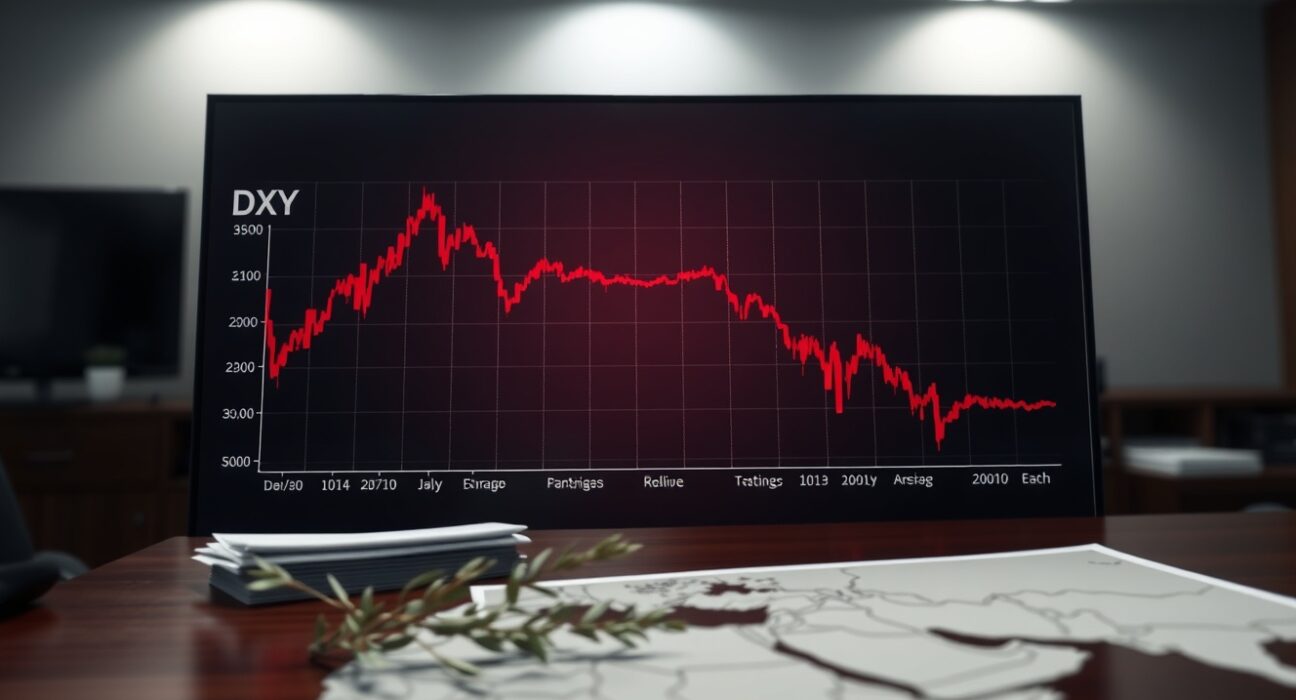
The US Dollar Index (DXY) plunged below the critical 100.00 psychological level this week, marking a significant shift in global currency dynamics as diplomatic progress in the Middle East reduces the dollar’s traditional safe-haven appeal. Market analysts immediately noted the correlation between advancing peace negotiations and the erosion of what traders call the “war premium”—the additional value investors assign to the dollar during geopolitical instability. Consequently, this development signals potential recalibrations across foreign exchange markets and Federal Reserve policy considerations.
US Dollar Index Tests Historic Support Level
The US Dollar Index, which measures the dollar’s strength against a basket of six major currencies, breached the 100.00 threshold during Tuesday’s trading session. This level represents a key technical and psychological barrier not tested since early 2023. Market data shows the DXY declined 1.8% over the past five trading days. Furthermore, trading volume spiked 40% above the 30-day average during the break below 100.00.
Technical analysts highlight several important support zones now in play. The 99.50 level represents the next significant Fibonacci retracement level from the 2022 rally. Additionally, moving average convergence divergence (MACD) indicators show bearish momentum increasing across multiple time frames. Major currency pairs reflected this dollar weakness immediately.
- EUR/USD rallied to 1.1050, its highest level in three months
- GBP/USD broke above 1.2850 resistance
- USD/JPY fell below 148.00, easing intervention concerns
This broad-based dollar selling reflects changing investor positioning rather than isolated currency movements. Hedge fund data reveals net long dollar positions decreased by $12 billion over the reporting period.
Middle East Diplomacy Undercuts Dollar’s War Premium
Diplomatic breakthroughs in Middle East negotiations directly triggered the dollar’s decline. Specifically, confirmed talks between major regional powers and international mediators created optimism for sustained de-escalation. The potential resolution of long-standing conflicts reduces global risk aversion. Historically, geopolitical tensions in oil-producing regions boost demand for dollar-denominated assets.
This “war premium” has supported the dollar through multiple crises since 2020. Analysts estimate this premium added 3-5% to the DXY during peak tension periods. With concrete peace framework discussions advancing, markets are pricing out this risk support. Energy markets corroborate this shift—Brent crude futures fell 7% on the news, breaking below $80 per barrel.
| Event | DXY Level Before | DXY Peak | Premium Estimate |
|---|---|---|---|
| 2022 Ukraine Invasion | 96.50 | 105.20 | 4.8% |
| 2023 Israel-Hamas Conflict | 102.30 | 107.00 | 3.2% |
| 2024 Red Sea Tensions | 101.80 | 104.50 | 2.1% |
The current diplomatic progress represents the most substantive since 2020. Consequently, currency markets are adjusting to a potential new paradigm of reduced Middle East risk.
Federal Reserve Policy Implications
A weaker dollar introduces complex considerations for Federal Reserve policymakers. Firstly, dollar depreciation makes imports more expensive, potentially slowing disinflation progress. However, it also boosts export competitiveness. Fed officials monitor the dollar’s trade-weighted index closely in their dual mandate assessments.
Recent Federal Open Market Committee (FOMC) minutes reveal particular attention to financial conditions. A sustained dollar decline below 100.00 could ease financial conditions independently of rate decisions. Therefore, the Fed might adjust its policy trajectory if this move persists. Market-implied probabilities for rate cuts in 2025 increased 15% following the DXY break.
Global central bank reactions will also influence outcomes. The European Central Bank faces different inflation dynamics with euro strength. Meanwhile, the Bank of Japan welcomes yen appreciation that reduces import cost pressures. This interconnected policy landscape makes the DXY’s 100.00 level a global macroeconomic focal point.
Global Currency Market Recalibration
Emerging market currencies showed mixed reactions to the dollar’s decline. Traditionally, dollar weakness supports emerging market assets by reducing dollar-denominated debt burdens. However, specific regional factors created divergence. Asian currencies generally strengthened, led by the Korean won and Thai baht. Conversely, Latin American currencies faced pressure from declining commodity prices.
Capital flow data indicates institutional investors reallocating from dollar assets to European and Asian alternatives. Bond markets reflected this shift with narrowing yield spreads between US Treasuries and German bunds. Additionally, gold prices retreated from record highs as reduced geopolitical risk diminished its safe-haven appeal.
The dollar’s role as the global reserve currency remains unchallenged structurally. Nevertheless, episodic weakness below key levels prompts portfolio rebalancing. International trade patterns may adjust if this dollar softness persists beyond short-term technical moves.
Historical Context and Market Psychology
The 100.00 level has served as major support and resistance for the DXY throughout its five-decade history. Breaking this barrier often precedes extended trends in either direction. For instance, the sustained break above 100.00 in 2014 began a two-year dollar bull market. Conversely, the breakdown below 100.00 in 2020 preceded a 10% decline over subsequent months.
Market psychology around round numbers amplifies their technical significance. Traders place substantial orders around these levels, creating self-fulfilling dynamics. The current break occurred with exceptional volume, suggesting conviction behind the move. Options market data shows increased demand for dollar put options at strikes below 99.00.
Seasonal patterns also merit consideration. The dollar typically faces pressure during the fourth quarter as corporate repatriation flows diminish. This year, geopolitical developments accelerated and amplified this seasonal tendency. Historical analysis suggests breaks of this magnitude during November often extend through year-end.
Economic Impacts and Forward Projections
A sustained lower dollar level affects multiple economic sectors differently. US multinational corporations benefit from overseas revenue conversion. Conversely, import-dependent businesses face margin pressure. Inflation dynamics become more complex with opposing forces from import prices and economic growth.
Forward-looking indicators suggest the dollar may test lower support levels. Speculative positioning remains net long despite recent reductions. This leaves room for further unwinding if peace prospects solidify. Technical analysts identify 98.50 as the next major support, representing the 61.8% Fibonacci retracement of the 2021-2022 rally.
Fundamental drivers will ultimately determine the dollar’s trajectory. Relative growth differentials between the US and other major economies show convergence. Additionally, interest rate differentials are narrowing as global central banks approach policy inflection points. These macroeconomic factors combined with reduced geopolitical risk premium create a challenging environment for dollar strength.
Conclusion
The US Dollar Index breaking below 100.00 represents a significant market development with global implications. Middle East peace hopes directly reduced the dollar’s war premium, triggering technical breaks and portfolio reallocations. Federal Reserve policy considerations now incorporate this currency weakness alongside domestic inflation and employment data. Market participants should monitor diplomatic developments alongside economic indicators, as sustained peace progress could extend the dollar’s decline toward next support levels. The DXY’s trajectory below 100.00 will influence global trade, inflation, and capital flows through 2025.
FAQs
Q1: What is the US Dollar Index (DXY)?
The US Dollar Index is a measure of the value of the United States dollar relative to a basket of six major world currencies: Euro (EUR), Japanese yen (JPY), British pound (GBP), Canadian dollar (CAD), Swedish krona (SEK), and Swiss franc (CHF). It provides a general indication of the dollar’s international value.
Q2: Why does Middle East peace affect the US dollar?
The US dollar traditionally functions as a safe-haven currency during geopolitical instability. When tensions rise in oil-producing regions like the Middle East, investors buy dollars for safety, creating a “war premium.” Peace prospects reduce this premium, decreasing dollar demand.
Q3: How significant is the 100.00 level for the DXY?
The 100.00 level represents a major psychological and technical barrier that has served as key support and resistance throughout the index’s history. Breaches of this level often signal sustained trend changes and trigger substantial algorithmic trading activity.
Q4: What are the implications of a weaker dollar for US consumers?
A weaker dollar makes imported goods more expensive, potentially increasing inflation. However, it makes US exports more competitive abroad, supporting manufacturing jobs. Travel abroad becomes more expensive for Americans, while foreign tourism to the US increases.
Q5: Could the dollar recover above 100.00 quickly?
While possible, sustained recovery would require either renewed geopolitical tensions, stronger-than-expected US economic data, or more hawkish Federal Reserve policy signals. Technical resistance now exists at the 100.00-100.50 zone where previous support becomes resistance.
Disclaimer: The information provided is not trading advice, Bitcoinworld.co.in holds no liability for any investments made based on the information provided on this page. We strongly recommend independent research and/or consultation with a qualified professional before making any investment decisions.