

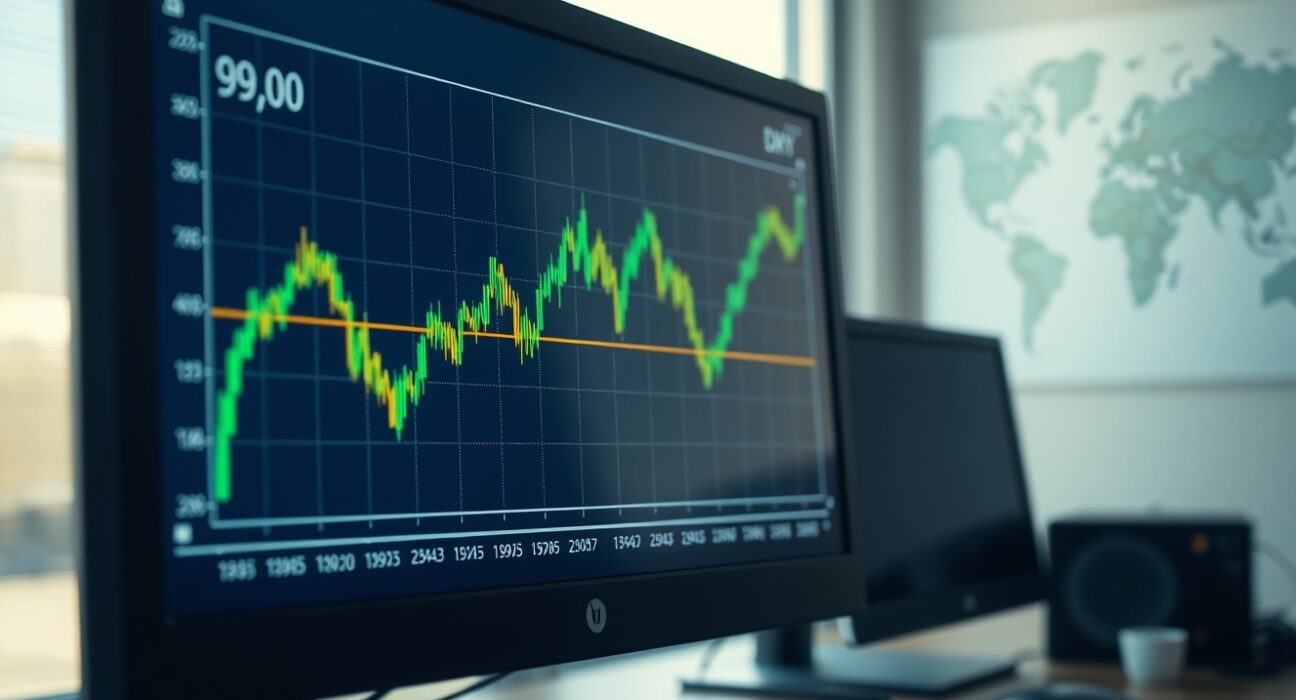
NEW YORK, March 21, 2025 – The US Dollar Index (DXY) continues to consolidate its recent losses, trading precariously near the 99.50 support level. This persistent weakness follows a week of heightened volatility, primarily driven by renewed uncertainty surrounding diplomatic talks between the United States and Iran. Market participants are now closely monitoring the 99.50 zone, a critical technical and psychological threshold that could dictate the greenback’s near-term trajectory.
US Dollar Index Holds Losses as Geopolitical Fog Thickens
The DXY, which measures the dollar against a basket of six major currencies, has failed to stage a meaningful recovery from its recent slide. Consequently, the index remains vulnerable to further downside pressure. The primary catalyst for this fragility is the apparent stall in indirect negotiations aimed at reviving the 2015 nuclear accord, formally known as the Joint Comprehensive Plan of Action (JCPOA).
Recent statements from officials in both capitals have injected a dose of reality into markets. For instance, a senior U.S. State Department official noted that “significant gaps” remain, while Iranian media reported that key sanctions relief demands are still unmet. This deadlock directly impacts currency valuations by influencing global risk sentiment and energy market stability.
Anatomy of the 99.50 Support Level
Technical analysts highlight the 99.50 level as a confluence zone of historical significance. Firstly, it represents the 61.8% Fibonacci retracement level from the dollar’s rally in late 2024. Secondly, it aligns with a prior resistance area from November 2024, which has now flipped to potential support.
A decisive break below 99.50 could trigger accelerated selling. Conversely, the market structure suggests that a firm hold above this level might pave the way for a corrective bounce. The following table outlines key technical levels for the DXY:
| Level | Type | Significance |
|---|---|---|
| 100.80 | Resistance | 50-day Moving Average & previous swing high |
| 99.50 | Support | Key Fibonacci & prior structure |
| 98.90 | Support | 2025 Year-to-Date low |
Expert Analysis on Market Mechanics
Dr. Anya Sharma, Chief Strategist at Global Macro Advisors, provided context on the market’s reaction. “Currency markets are acting as a real-time barometer for geopolitical risk premia,” she explained. “The dollar’s traditional ‘safe-haven’ bid is being partially offset by the specific nature of this risk. An escalation with Iran threatens higher oil prices, which can be stagflationary for the US economy, thereby limiting the Fed’s policy options and weakening the dollar’s yield appeal.”
This analysis is supported by recent correlations. Notably, the DXY has shown an inverse relationship with Brent crude prices over the past fortnight. As oil prices edged higher on supply concerns, the dollar faced selling pressure.
The Geopolitical Chessboard: A Timeline of Recent Events
Understanding the dollar’s position requires examining the recent sequence of diplomatic developments. The current phase of talks began in early 2025 after a prolonged hiatus.
- January 15, 2025: U.S. and Iranian envoys resume indirect talks in Oman.
- February 10, 2025: Tentative agreement on a framework for nuclear inspections is reported, boosting market optimism.
- March 5, 2025: Talks hit a snag over the scope of sanctions relief, particularly regarding Iran’s ballistic missile program.
- March 18, 2025: The U.S. imposes new sanctions on Iranian drone manufacturers, seen as a hardline negotiating tactic.
- Present: A stalemate persists, with no date set for the next round of discussions.
This stop-start process has created an environment of chronic uncertainty. Market participants dislike ambiguity, and the lack of a clear path forward is a persistent headwind for the dollar.
Broader Market Impacts and Cross-Asset Correlations
The DXY’s weakness near 99.50 has reverberated across other financial markets. The euro (EUR/USD) has capitalized on dollar softness, testing resistance above 1.0950. Similarly, gold prices have found a bid, trading above $2,150 per ounce as some investors seek alternative havens.
However, the reaction in equity markets has been mixed. While a weaker dollar typically benefits multinational U.S. corporations, the geopolitical undertones have capped broader risk appetite. The CBOE Volatility Index (VIX) has remained elevated, reflecting ongoing investor caution.
Furthermore, Treasury yields have been range-bound. This suggests that while the geopolitical story is dominant for forex, bond markets are more focused on domestic inflation data and Federal Reserve signaling.
Central Bank Policy in the Background
It is crucial to frame the DXY movement within the broader monetary policy landscape. The Federal Reserve’s current data-dependent pause contrasts with more dovish stances from other major central banks, like the European Central Bank. This policy divergence typically supports the dollar. Therefore, the fact that the DXY is struggling to gain traction underscores the significant weight of the Iran-related geopolitical overhang.
“The market is telling us that geopolitics is temporarily trumping interest rate differentials,” noted Michael Chen, a veteran forex trader. “Until we get clarity from the State Department or Tehran, the dollar will likely remain on the defensive, with 99.50 acting as the line in the sand.”
Conclusion
The US Dollar Index finds itself at a critical juncture, tethered to the 99.50 level amidst a fog of geopolitical uncertainty. The stalled talks between the US and Iran have injected a potent risk premium into currency markets, overshadowing traditional fundamental drivers. While technical support is being tested, the ultimate direction for the DXY will likely be determined by the next substantive development in diplomatic channels. Market participants should prepare for continued volatility as the situation evolves, with a break below 99.50 potentially signaling a deeper correction for the greenback.
FAQs
Q1: What is the US Dollar Index (DXY)?
The US Dollar Index is a measure of the value of the United States dollar relative to a basket of six major world currencies: the Euro, Japanese Yen, British Pound, Canadian Dollar, Swedish Krona, and Swiss Franc. It provides a broad gauge of the dollar’s international strength.
Q2: Why do US-Iran talks affect the US Dollar?
Geopolitical tensions, especially in oil-producing regions, influence global risk sentiment, energy prices, and expectations for economic stability. Uncertainty can lead investors to adjust their portfolios, impacting demand for the US dollar as a safe-haven asset and through its correlation with oil prices.
Q3: What happens if the DXY breaks below 99.50?
A sustained break below the 99.50 support level could trigger further technical selling, potentially pushing the index toward its yearly lows near 98.90. This would indicate a significant shift in market sentiment and a broader weakening trend for the dollar.
Q4: Are other factors influencing the dollar besides geopolitics?
Yes. Domestic factors like Federal Reserve interest rate policy, inflation data, employment reports, and overall economic growth remain primary long-term drivers. Geopolitical events often act as short-to-medium-term catalysts that amplify or temporarily override these fundamentals.
Q5: How can traders track developments in this situation?
Traders monitor statements from the U.S. State Department and Iranian foreign ministry, reports from international negotiators, oil price movements (especially Brent crude), and technical levels on the DXY chart. Reliable financial news sources provide synthesis of these developments.
Disclaimer: The information provided is not trading advice, Bitcoinworld.co.in holds no liability for any investments made based on the information provided on this page. We strongly recommend independent research and/or consultation with a qualified professional before making any investment decisions.
